

Yes, you can run air conditioning with solar. Here's the catch
Solar panels can absolutely power your air conditioner, and on a sunny afternoon a correctly sized system will run your compressor for free, straight off the roof. The catch is timing: solar generation peaks at midday, but plenty of households want their AC running well into the evening, and that gap only closes with a battery or a smart connection back to the grid.
As a rough rule of thumb, a 3 to 4 kW PV array will comfortably run a single-zone mini-split through a sunny afternoon. Before you go further, do three things:
- Check the rated kW or BTU of your AC unit (it’s on the nameplate or spec sheet)
- Estimate your average daily sun hours for your region
- Get a professional survey before buying any hardware
Key Takeaways
Solar can power air conditioning during daylight hours reliably, but evening or overnight cooling depends on battery storage or grid backup to bridge the gap.
| Point | Details |
|---|---|
| Daytime cooling works without a battery | Solar output and AC demand peak together on hot afternoons in most US regions. |
| Battery only if you need evening cooling | Skip storage if your household runs AC mainly during daylight hours. |
| Size for start-up surge, not just running load | Inverters need headroom above the AC’s rated wattage to handle compressor start-up. |
| Efficiency rating drives real savings | A high SEER/EER unit needs a smaller array to deliver the same cooling. |
| Get a coordinated survey before buying hardware | Akita checks electrical capacity, roof shading and inverter match in one visit. |
Table of Contents
- Why air conditioning with solar is a genuinely good technical match
- The hardware and system choices you’ll actually be picking between
- Sizing worked examples: panels and battery maths you can use today
- What it costs and when it pays for itself
- Installation checklist before you commit to anything
- Do you actually need a battery?
- The real trade-offs, and two myths worth killing
- What Akita checks on a survey, and how to hire the right installer
- Where the conventional advice on solar AC gets it wrong
- Get a professional survey before you spend a penny on hardware
- Frequently asked questions
- Sources
Why air conditioning with solar is a genuinely good technical match
Cooling demand and solar output follow almost the same curve. Your air conditioner works hardest between roughly 11am and 5pm, when the sun is strongest and outdoor temperatures peak, which is exactly when your panels are producing the most electricity. That overlap is well documented: EIA data on US electricity demand shows cooling load consistently tracking daytime and summer peaks across most regions.
Three things determine how well that overlap translates into real savings.
- Wiring setup. Most homes don’t wire the AC directly to solar. Power flows through your existing household supply, with solar offsetting whatever the compressor draws, unless you install a dedicated circuit.
- Efficiency rating. SEER and EER ratings dictate how many kilowatt-hours your unit actually consumes per hour of cooling, which is the number your solar sizing has to satisfy. Energy treats efficiency rating and correct sizing as the two biggest levers on running cost.
- Inverter logic. A hybrid inverter automatically routes solar power to whatever needs it first: your AC, a battery, or back to the grid if there’s surplus.
The hardware and system choices you’ll actually be picking between
Panel count depends on wattage (most residential panels run 350 to 450 watts each), roof orientation, and shading. South-facing roofs in most of the US produce meaningfully more usable energy than east or west-facing ones.
Inverters come in three flavours, and the choice matters more for AC pairing than most guides admit:
- String inverters are the cheapest option but treat the whole array as one unit, so shading on one panel drags down the rest
- Microinverters optimise each panel individually, useful on complex or partially shaded roofs
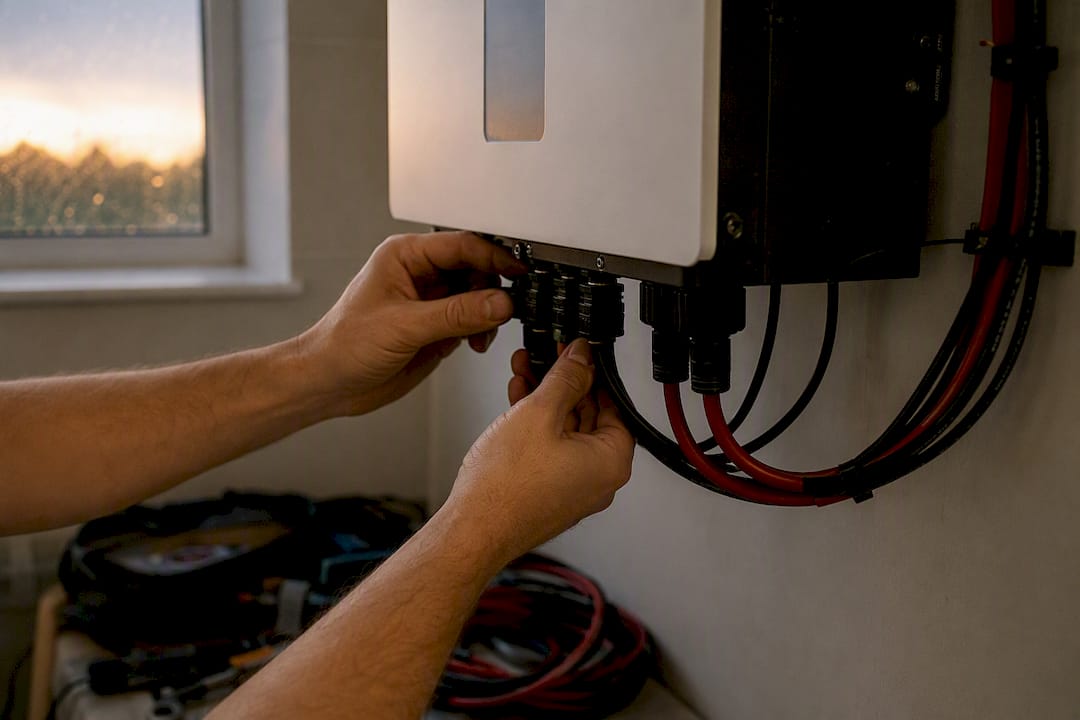
- Hybrid inverters manage solar, battery and grid power together, which is what makes battery-backed evening cooling possible at all
Batteries range from small 5 kWh lithium units for topping up an evening’s cooling to 10 to 15 kWh systems built for whole-house backup. On the AC side, you’ll encounter portable units (least efficient, easiest to add later), single-splits, multi-split systems for several rooms or a small office, and heat pump or VRF systems that add heating capacity for the shoulder seasons. Smart thermostats and app-based monitoring squeeze more value from all of it by nudging your cooling schedule to match generation.
Sizing worked examples: panels and battery maths you can use today
The sizing logic is straightforward once you have the numbers: multiply your AC’s kW rating by the hours you run it daily to get kWh needed, then divide by your region’s kWh output per kWp of solar (roughly 4 to 5.5 in most of the sun-belt US, lower in the Pacific Northwest or New England). That gives you the kWp required, which you convert to panel count using your chosen panel’s wattage. The EE Renewables panel-count method uses this exact approach, and the maths holds regardless of which country’s sun hours you plug in.
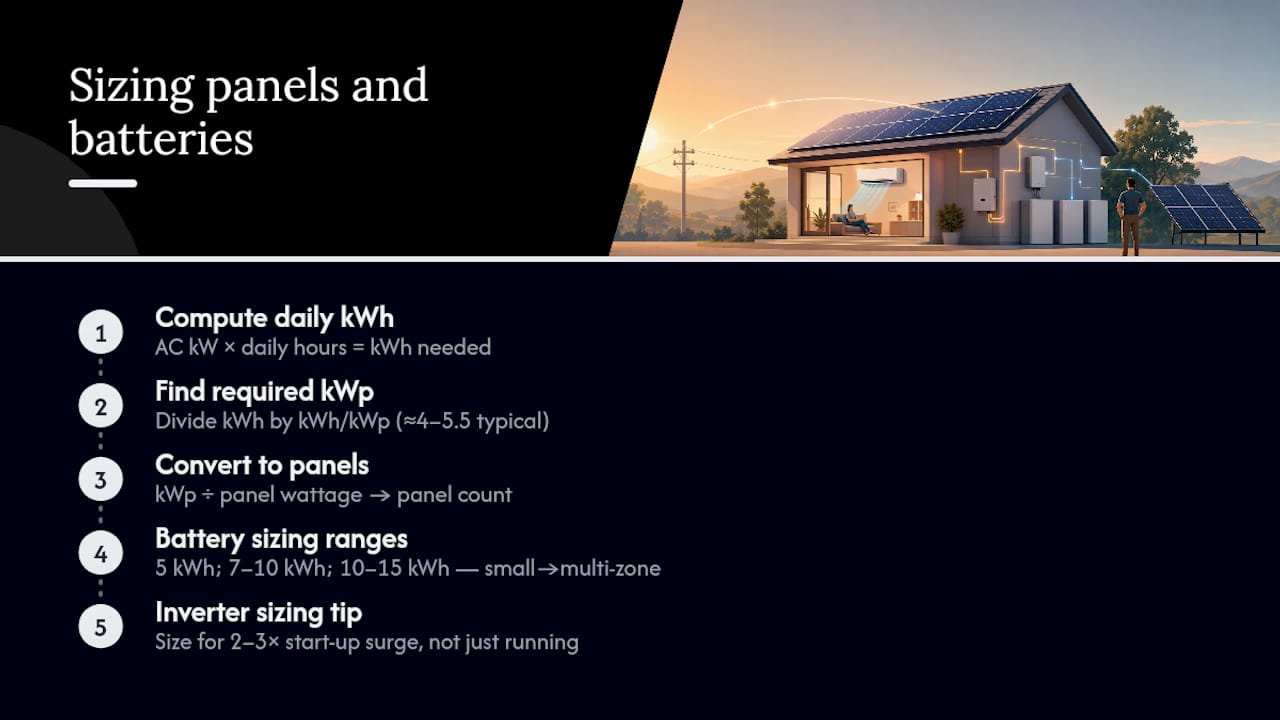
For batteries: a 5 kWh unit covers a couple of evening hours on a small split system, 7 to 10 kWh suits a single-zone household wanting dinner-through-bedtime cooling, and 10 to 15 kWh starts to make sense for multi-zone homes or small offices with longer occupied hours.
Pro Tip: Always size the inverter’s peak output above your AC’s start-up surge, not just its running load. Compressors can draw two to three times their rated wattage for a second or two on start-up, and an undersized inverter will trip rather than cope.
What it costs and when it pays for itself
Installed solar PV in the US typically runs $2.50 to $3.50 per watt before incentives, so a 4 kW array lands somewhere between $10,000 and $14,000. Battery storage adds roughly $800 to $1,200 per kWh, meaning a 10 kWh battery can add another $8,000 to $12,000 to the project.
AC installation costs vary by system type:
- A single-zone mini-split typically runs $3,000 to $6,000 installed
- A multi-zone system for a small business or larger home often lands between $8,000 and $16,000
Households pairing solar with AC often see a large share of daytime cooling costs offset entirely, since self-consumption of solar power during operating hours avoids paying retail electricity rates. Payback periods usually land somewhere between six and twelve years depending on local electricity prices, sun hours and whether you’re on a time-of-use tariff. Net metering policies vary significantly by state and utility, and they directly affect whether exporting surplus solar power is worth as much as the electricity you’d otherwise buy back at night.
Installation checklist before you commit to anything
A proper site visit should work through the same list every time, whether it’s a homeowner or a small business:
- Electrical capacity. Confirm your main panel and breaker have headroom for both the new AC circuit and the solar inverter’s grid connection.
- Roof and shading survey. Check orientation, pitch, and shading from trees or neighbouring structures across the whole day, not just at noon.
- Inverter and AC match. Verify the inverter’s continuous and peak output covers the AC’s running and start-up loads, including any battery charging happening at the same time.
- Permits and interconnection. Confirm your utility’s interconnection agreement, any required safety disconnects, and how warranty terms treat combined installations.
- Coordinated scheduling. Booking your solar and AC installers for the same visit, or at least a coordinated sequence, avoids rework on wiring or mounting.
Do you actually need a battery?
Batteries earn their cost in specific situations, and skipping them is the right call in others.
- Battery makes sense if you cool your home mostly after work, run AC overnight, or live somewhere with frequent grid outages
- Battery is optional if you or someone in your household is home during the day and the AC runs mostly between 10am and 6pm anyway
- Cheaper alternatives to storage include smart thermostat scheduling, pre-cooling the house before the sun peaks, and simply nudging the thermostat two degrees warmer during non-solar hours
- Rough guidance: a 5 kWh battery suits a single evening-cooling zone; 10kWh-plus starts to make sense for multi-zone homes or businesses with long occupied hours
The real trade-offs, and two myths worth killing
The genuine upsides: lower daytime electricity bills, a real cut in household emissions, and a demand curve that happens to match solar output almost perfectly on hot days.
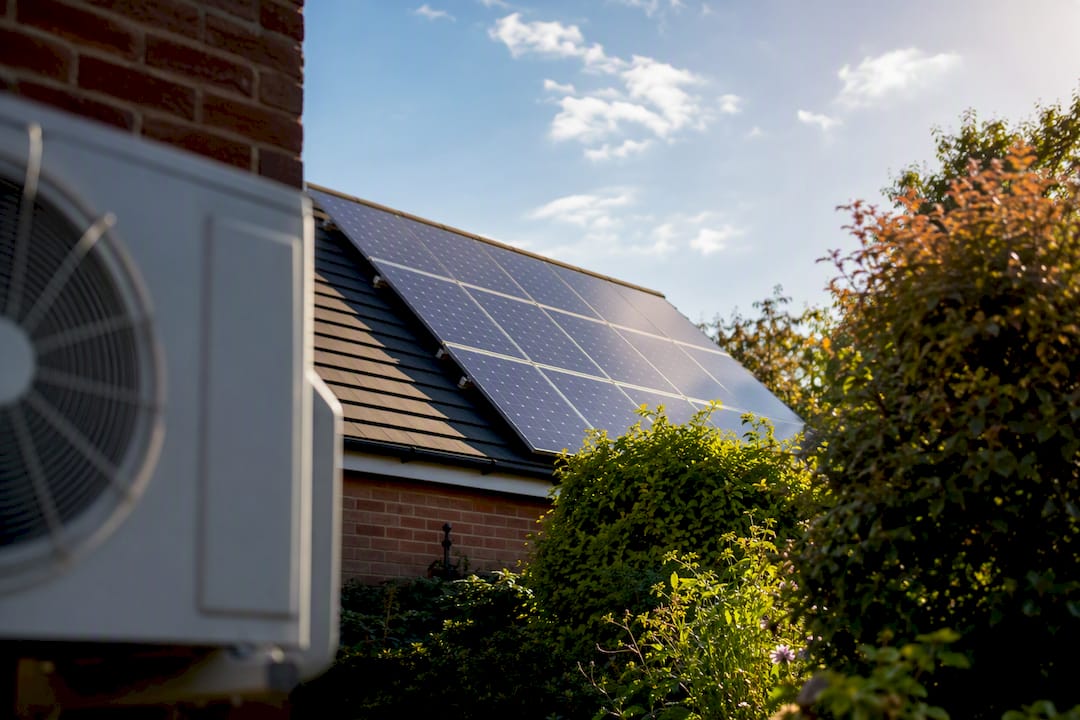
The genuine limits: meaningful upfront cost, no evening cooling without a battery or grid draw, and output that drops fast under heavy shading or on overcast days.
Two myths deserve killing outright. “Solar makes AC free” ignores upfront cost, financing, and the fact that most systems still draw from the grid at some point. And plenty of portable “solar-ready” units marketed online are just standard portables with a solar input bolted on. A properly designed, professionally wired split system usually delivers better long-term efficiency and reliability than a portable unit marketed as solar-compatible.
What Akita checks on a survey, and how to hire the right installer
A proper survey from Akita covers electrical capacity, roof condition and shading, existing wiring, and whether your controls can support solar-aware scheduling. It’s the same checklist covered above, done in person with test equipment rather than guesswork.
Before hiring anyone, ask:
- What SEER/EER rating does the recommended unit carry, and why that one?
- What’s covered under warranty, and for how long?
- Is finance available, and what are the real repayment terms?
- Will one team handle both AC and solar coordination, or will I be managing two separate contractors?
DIY suits monitoring and thermostat scheduling. Wiring, refrigerant handling and inverter matching are jobs for a licensed professional.
Where the conventional advice on solar AC gets it wrong
Most guides on air conditioning with solar spend too long on panel brands and not nearly enough on the one number that actually determines whether the project works: your AC’s start-up surge relative to inverter peak capacity. Get that wrong and the rest of the maths is decorative.
The other place conventional advice misleads readers is battery sizing. Plenty of installers default to selling the biggest battery a household can finance, when the honest first question should be: when do you actually need cooling? A household that’s out at work until 6pm doesn’t need the same storage as one running a home office with the AC on from 9am to 9pm. Match the battery to your actual schedule, not to a sales target.
If there’s one priority worth acting on first, it’s getting your AC’s SEER rating and kW draw confirmed before you talk to anyone about panel counts. Every other calculation in this article flows from that single figure, and guessing it wrong cascades into an oversized, overpriced system or an undersized one that trips on the first hot afternoon.
Get a professional survey before you spend a penny on hardware
Akita is the practical route to solar-ready cooling for homeowners and small businesses across Suffolk, Norfolk and Essex who want a system sized correctly the first time, not retrofitted after an underpowered inverter trips on day one.

Rather than guessing at panel counts from a generic online calculator, Akita surveys your electrical capacity, roof orientation and existing wiring in person, then recommends an AC and inverter pairing that actually matches your household’s cooling pattern. Transparent pricing and flexible finance options mean you know the real cost before committing, and warranty cover protects the installation for years afterwards. If you’re weighing up a single-zone split system for a home office or a multi-zone setup for a small business, request a domestic air conditioning installation survey and get a firm quote based on your actual roof, panel and load numbers rather than rough averages.
Frequently asked questions
Can I run my existing air conditioner on solar without replacing it? Yes, in most cases. Your existing AC draws from household supply regardless of source, so adding solar panels offsets its running cost without requiring a new unit, provided your electrical setup and inverter can handle the load.
Does solar-powered air conditioning work in cloudy or humid regions? Solar cooling works everywhere, but output drops with cloud cover, so cloudier regions need a larger array or battery buffer to deliver the same cooling hours as sun-belt states.
How many solar panels do I need for a 12,000 BTU AC unit? Roughly four to seven 400-watt panels, depending on your local sun hours and how many hours daily you run the unit, using the sizing method covered earlier in this guide.
Is a battery required for solar air conditioning? Only if you need cooling outside daylight hours. Daytime-only use works fine on solar alone, with the grid or a battery covering evenings and overcast days.
What’s the difference between solar-ready AC and a standard split system with solar power? “Solar-ready” often just means a DC input bolted onto a portable unit, while a properly wired split system paired with a hybrid inverter delivers better efficiency and reliability over its lifespan.
Sources
- EIA: U.S. electricity demand and seasonal patterns
- How many solar panels are needed to run an air conditioner? | EE Renewables