

Homeowners: Use kW Not BTU to Calculate Air Conditioner Running Cost
Running an air conditioner typically costs a small amount per hour, depending on the unit’s electrical draw and your electricity rate. To work it out yourself: multiply the unit’s electrical input in kW by your price per kWh. The three things that move that number most are your tariff, how long the compressor actually runs (its duty cycle), and how well insulated the room is.
TL;DR:
- The duty cycle and heat gain from nearby heat sources significantly influence an air conditioner’s actual energy draw and cost.
- Fixed-speed units cycle on and off, often causing higher energy consumption, while inverter systems modulate their speed for better efficiency.
- Regular maintenance, sealing leaks, shading windows, and setting a sensible thermostat temperature can reduce operational costs without equipment upgrades.
- Using real measurements of power draw and duty cycle provides a more accurate estimate of running costs than relying solely on nameplate data or general averages.
- Homeowners should verify actual system performance with a power monitor or professional assessment before investing in replacements or upgrades.
Table of Contents
- How to calculate your air conditioner running cost
- What affects how much your AC actually draws
- How efficiency and unit type change running costs
- Practical ways to cut running costs
- Worked examples: cost per hour, per day, per month
- How professionals estimate running cost on site
- Get a measured quote instead of an estimate
- What the numbers actually tell you
- Sources
How to calculate your air conditioner running cost
Start with the right number. Every AC has a cooling capacity (often shown in BTU or kW of cooling output) and an electrical input (the kW it actually pulls from the wall). These are not the same figure, and using the cooling capacity by mistake will wildly overstate your bill. The electrical input sits on the nameplate or datasheet, sometimes labelled “rated power input” or “running current” (amps) which you can convert to kW by multiplying by voltage.
The compressor doesn’t run flat out constantly. It cycles on and off to hold your set temperature, so what matters is the duty cycle, the percentage of time it’s actually drawing power. Controlled Climate’s method explanation backs this approach: use measured or realistic input figures rather than the nameplate cooling capacity alone.
The maths is simple:
Average input (kW) = Max electrical input × duty cycle Cost per hour = Average input × your unit rate ($/kWh)
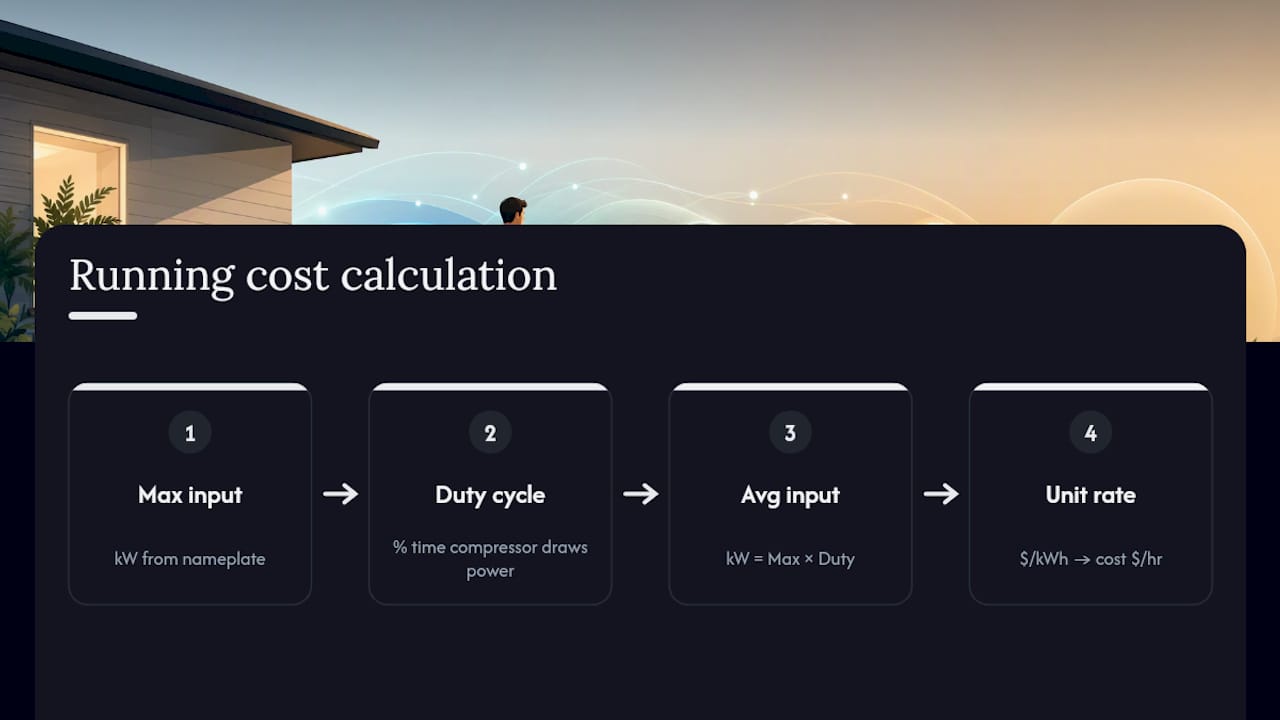
Fill in your own figures and you’ve got a realistic hourly cost instead of a guess.
What affects how much your AC actually draws
Two identical units in two different houses can cost noticeably different amounts to run, because the load isn’t really about the machine. It’s about what the machine is fighting against.
- Duty cycle and heat gain: a south-facing room full of glazing, a heat-emitting oven nearby, or a houseful of people all push the compressor to run longer.
- Insulation and air leakage: poorly sealed windows, gaps under doors, and thin loft insulation let cooled air escape and warm air in, forcing longer run times.
- Thermostat setpoint: every degree below around 24 to 25°C adds meaningfully to run hours; continuous low-temperature operation costs far more than intermittent use with a sensible setpoint.
- Tariff structure: a flat unit rate is simple to calculate, but a time-of-use tariff can make afternoon cooling far pricier than the same hour overnight.
- Standing charges and maintenance: these don’t change your per-hour figure, but a clogged filter or dirty coil forces the compressor to work harder for the same cooling, quietly inflating your duty cycle.
How efficiency and unit type change running costs
Efficiency ratings exist precisely to answer “how much cooling do I get per unit of electricity?” SEER (Seasonal Energy Efficiency Ratio) and EER (Energy Efficiency Ratio) measure cooling output against energy input; SCOP does the same for heating on heat pump systems. Higher numbers mean less electricity for the same comfort. ENERGY STAR’s list of top-performing units is a genuinely useful way to compare models before buying, since certified units are measurably cheaper to run for the same output.
Inverter versus fixed-speed matters just as much as the efficiency rating. A fixed-speed compressor is either fully on or fully off, so it overshoots and cycles hard. An inverter unit modulates its speed continuously, settling at a lower steady draw once the room reaches temperature. Homeowner guides consistently note that inverter-driven systems cost noticeably less to run than older fixed-speed equivalents doing the same job.
Typical average draws, based on independent wattage guides, look roughly like this:
- Portable units: 0.5 to 1.5 kW
- Window units: 0.5 to 1.2 kW
- Single-split systems: 0.3 to 1.0 kW
- Central/ducted systems: 1.5 to 5 kW or more, depending on house size
If you’re running any of these for long stretches each day, checking the energy efficiency of an upgrade against your current running costs is worth doing before assuming replacement isn’t worthwhile.
Practical ways to cut running costs
Behavioural changes cost nothing and often deliver the biggest first win. Homeowner cost guides consistently rank maintenance and simple habit changes above equipment swaps for return on effort.
- Set a sensible target temperature. Around 24 to 25°C balances comfort against duty cycle; each degree lower adds noticeably to run time.
- Service the unit annually. Clean filters and coils let the system move air properly instead of straining to hit the same setpoint.
- Block heat before it gets in. Shading, blinds, and heavier curtains on sun-facing windows reduce the heat the compressor has to fight.
- Seal obvious leaks. Draught-proofing doors and windows, and topping up loft insulation, keeps cooled air where you paid for it.
- Check your tariff. A time-of-use plan or a supplier switch can shift or shrink your rate without touching the equipment at all.
- Consider a smart thermostat if you don’t have one, since scheduling and setbacks remove the guesswork of remembering to adjust the system.
Pro Tip: Before you spend money on anything, fix the free stuff first, shading, sealing, and filters, then re-check your running cost. If it’s still high after that, the unit itself, not your habits, is the likely culprit.
For a longer checklist of small changes that add up, see ways to reduce HVAC costs, and for building-envelope fixes specifically, new interior doors can meaningfully improve efficiency in older homes where draughts under doors are a bigger loss than people expect.
Worked examples: cost per hour, per day, per month
Using a benchmark rate of $0.16/kWh, here’s what different average electrical inputs cost to run. Swap in your own bill’s unit rate for an accurate figure.
At $0.16/kWh that’s $0.096 an hour, roughly $0.77 for an 8-hour stretch, and around $23 across a 30-day month of similar use. Perch Energy’s calculator follows this same input times rate method if you want to double-check the arithmetic with your own numbers.
How professionals estimate running cost on site
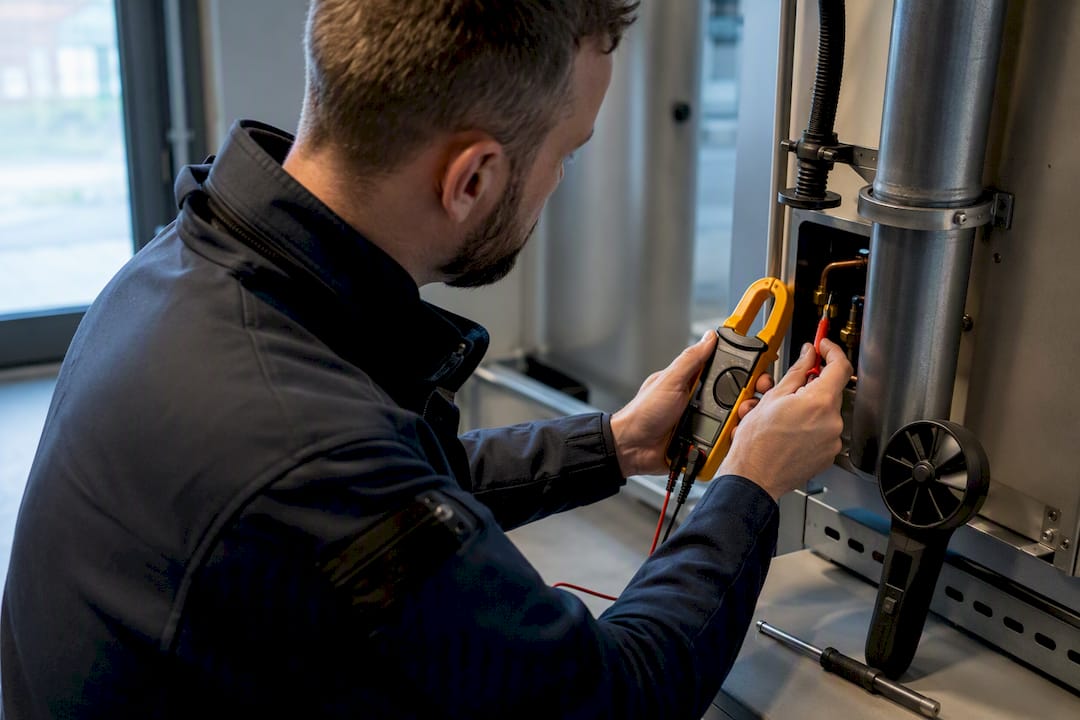
An installer doesn’t guess at duty cycle, they measure it. A clamp meter or sub-meter on the circuit shows live power draw, technicians check the temperature split between return and supply air, and they verify airflow and refrigerant charge, since a low charge forces longer run times for the same cooling.
Correct sizing at commissioning matters more than most homeowners realise. An oversized unit short-cycles and wastes energy on start-up surges; an undersized one runs almost continuously and still can’t hit the setpoint.
Before a site visit, it helps to have:
- A recent electricity bill showing your actual unit rate
- Rough room dimensions and window/glazing details
- Any known issues (short-cycling, weak airflow, unusual noises)
Get a measured quote instead of an estimate
Every formula in this article gives you an estimate, and estimates are only as good as the duty cycle assumption behind them. If your bills don’t match your calculations, or your current system is old enough that its real-world efficiency has drifted from its rated figures, a site visit settles it with measured numbers instead of guesswork. Akita’s engineers across Suffolk, Norfolk, and Essex can check sizing, airflow, and refrigerant charge, and quote a fixed-price installation if replacement genuinely pays back faster than repair.
What the numbers actually tell you
The conventional advice on this topic leans too hard on nameplate cooling capacity and rough national averages, and both routinely mislead homeowners into overestimating their bills or misdiagnosing an efficient system as a wasteful one. Electrical input and a realistic duty cycle get you close to reality; cooling capacity in BTU never will.
What’s underrated is maintenance. A dirty filter or low refrigerant charge can push a system’s real duty cycle up by a wide margin without anyone noticing, because the thermostat still eventually hits its target, just slower and at greater cost. Homeowners chase tariff switches and smart thermostats before checking whether their existing unit is even running as designed.
If there’s one priority worth acting on first, it’s measurement over assumption. A $20 plug power monitor, or fifteen minutes with an installer’s clamp meter, tells you more about your actual running cost than any national benchmark ever will.
— Akita
Sources
Cross-check any estimate against EIA’s household electricity data, ENERGY STAR’s efficiency listings, and EIA’s regional price tables for your current local rate rather than relying on national averages.
- EnergySage — How many watts does an air conditioner use?