

Recover 20% Efficiency and Fix Uneven Cooling for Homeowners
Start with the vents, the filter and the returns. Open every register, swap a clogged filter, and clear anything blocking a return grille. If one or two rooms stay stubbornly warm after that, the cause is usually a duct problem, a badly placed thermostat, or a system fault, and that’s a job for a professional. The good news: fixing uneven cooling nearly always cuts wasted energy too.
TL;DR:
- Most cases of uneven cooling are caused by duct leaks, poor insulation, or incorrect thermostat placement, not system failure or a need for replacement.
- Sealing and insulating ducts can improve efficiency by about 20 percent and resolve the largest source of temperature imbalance without system replacement.
- Moving or blocking furniture, closing vents, or improper thermostat locations can worsen airflow and should be checked before calling a professional.
- A professional diagnosis involves measuring static pressure, duct leakage, and airflow, which helps determine whether sealing, zoning, or equipment size adjustments are necessary.
- DIY fixes are limited, and ongoing issues often require technical tests to identify leaks or faults that cannot be corrected with simple cleaning or repositioning.
Table of Contents
- Quick checks for a home with uneven cooling
- How do you diagnose the real cause of hot and cold rooms?
- What are the permanent fixes for uneven air conditioning?
- When should you call a professional for uneven cooling?
- How Akita diagnoses and fixes uneven cooling
- Does furniture placement affect how evenly a room cools?
- Our take: fix the cause, not just the symptom
- Get a proper diagnostic instead of guessing
- Sources
- FAQ
Quick checks for a home with uneven cooling
Before you assume something’s broken, rule out the obvious. Most uneven cooling complaints trace back to something you can check in twenty minutes.
Walk every room in the house and physically confirm that supply registers and return grilles are open. Sofas, rugs, and curtains blocking a return are a surprisingly common culprit, since a starved return changes airflow across the whole system.
Pull the air filter and hold it up to a light. If you can’t see through it, replace it. A clogged filter restricts airflow to every room, not just the one nearest the unit, and it’s the cheapest fix on this list.
Buy two or three inexpensive room thermometers and leave them running for a few hours in the rooms that feel off. Write down the readings. A number beats a guess when you’re trying to work out whether the problem is one room or the whole system.
- Check every vent and return is open and unobstructed
- Replace or clean the filter if it’s more than a few months old
- Log room temperatures with cheap thermometers to confirm the gap
- Use fans, blackout blinds, or run the AC during cooler parts of the day as a stopgap
Pro Tip: Don’t close vents in unused rooms to force more air elsewhere. It raises static pressure in the ductwork and can make the imbalance worse rather than better.
How do you diagnose the real cause of hot and cold rooms?
Quick checks rule out the easy stuff. If the imbalance persists, you need a proper diagnostic sequence rather than more guessing.
- Map the temperatures. Take readings in every room at the same time of day, ideally mid-afternoon when solar gain peaks, and build a simple table: room name, reading, difference from the thermostat’s room.
- Inspect visible ductwork. Check the attic, basement, or crawl space for disconnected joints, crushed flexible duct, or sections running through unconditioned space, since ducts routinely lose 20 to 30% of moving air to leaks and poor connections.
- Check the thermostat’s location and setup. A thermostat in a hallway, near a kitchen, or in direct sun reads the wrong temperature for the rest of the house, and a single thermostat can only ever manage one zone properly.
- Separate envelope issues from HVAC issues. A west-facing room that bakes in the afternoon or an attic with thin insulation behaves differently to a duct fault, even though both produce the same symptom.
A technician takes this further with instruments: static pressure readings across the system, a duct leakage test, airflow measurement at each register, and a refrigerant charge check. Sealing and insulating ducts that fail a leakage test can lift system efficiency by roughly 20%, which is the single biggest lever most homes have.
What are the permanent fixes for uneven air conditioning?
Quick checks and diagnostics tell you what’s wrong. These are the fixes that actually stay fixed.
- Duct sealing and insulation. This addresses the most common root cause. Sealing joints and insulating runs through attics or crawl spaces recovers air that’s currently escaping before it reaches the room, and industry guidance links duct condition directly to uneven room temperatures.
- Balancing and zoning. Motorised dampers, manual balancing dampers, or a second thermostat let you direct more airflow to problem rooms without overcooling the rest of the house. The same logic used to balance flow differentials in radiator systems applies to forced-air ductwork.
- Ductless mini-splits. For a converted garage, a loft conversion, or a room that’s always been the outlier, a dedicated mini-split sidesteps the duct problem entirely rather than trying to force more air through an already-stretched system.
- Equipment sizing and condition. An oversized unit cools the thermostat’s room fast, switches off, and never runs long enough to push air to the far end of the house. That’s short-cycling, and it’s a sizing problem, not a duct problem.
- Envelope improvements. Attic insulation, window coverings on the sunniest side of the house, and air sealing around doors and windows reduce the solar and thermal load that no amount of duct work will fully offset.
Most homes need a combination of two or three of these, not a single silver bullet.
When should you call a professional for uneven cooling?
DIY checks and a bit of duct-taping only go so far. Call in a professional when you’ve done the basics and the problem is still there, when energy bills have climbed without explanation, or when airflow feels weak at several vents at once rather than just one.
A proper diagnostic should include a duct leakage test, static pressure measurements, a load calculation for the property, and a refrigerant check, since sizing and refrigerant issues often compound duct or insulation problems rather than replacing them as the sole cause.
Typical contractor work breaks down roughly like this:
- Diagnostic visit: usually a few hours, and should end with measured numbers, not a verbal guess
- Duct sealing: often completed in a day for a typical home
- Zoning installation: one to three days depending on how many zones and dampers are needed
- Equipment replacement: a day or two, plus lead time for the right-sized unit to arrive
Pro Tip: Ask any contractor what they measured, not just what they think. “It’ll fix everything” with no static pressure reading or leakage number is a red flag worth walking away from.
How Akita diagnoses and fixes uneven cooling
Akita’s diagnostic approach starts with the same measured checks a good technician always runs: duct inspection, airflow measurement, thermostat placement review, and a check on whether the system itself is correctly sized for the property. That’s laid out in more detail in Akita’s HVAC diagnostics guide, which walks through what a full inspection actually covers before any work is quoted.
Akita’s engineers work across:
- Diagnostics and fault-finding for existing systems
- Ductwork inspection, repair and sealing
- Ductless mini-split and air source heat pump installation
- Ongoing servicing through the Comfort Club membership
Every quote is fixed and explained before work starts, so you know what’s being fixed and why, not just a total at the bottom of an invoice.
Does furniture placement affect how evenly a room cools?
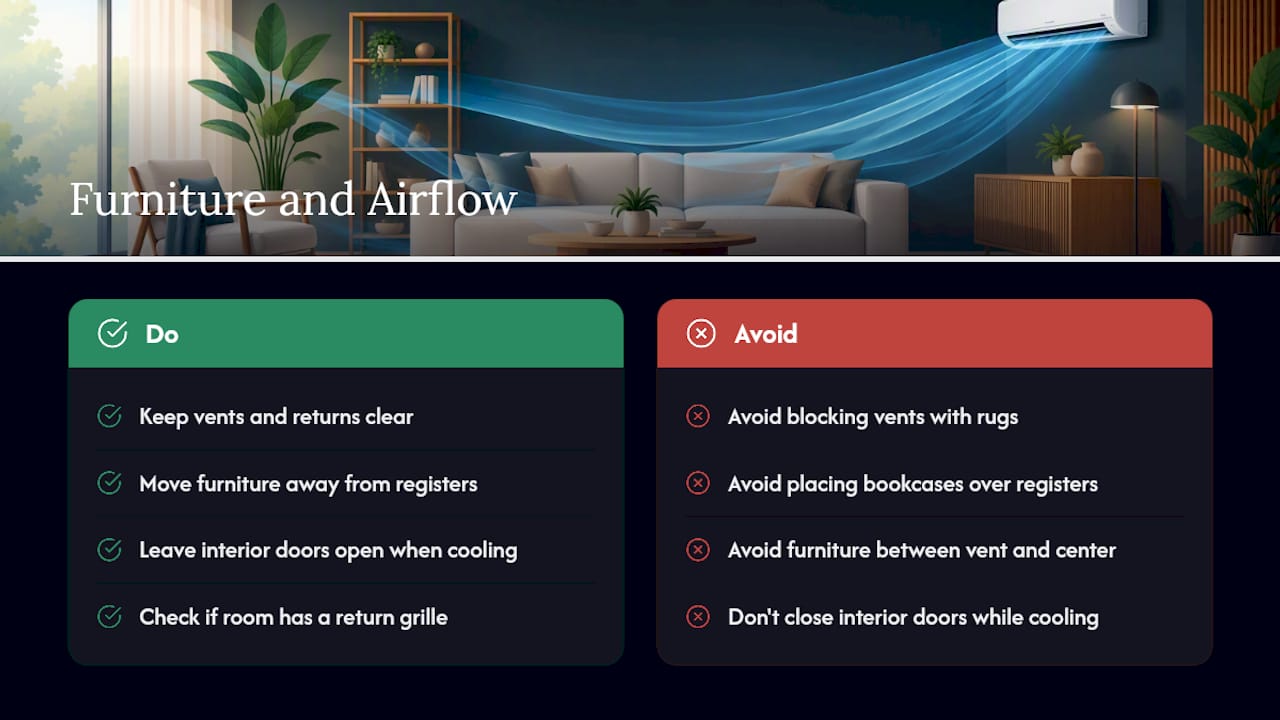
Furniture blocking a supply register or return grille is one of the most overlooked causes on this whole list, partly because it seems too simple to matter. A sofa pushed against a wall vent, a rug covering a floor return, or a bookcase built over a supply register all restrict airflow at exactly the point it needs to move freely.
Room layout matters beyond individual vents too. A large piece of furniture positioned between the supply register and the middle of the room can deflect cooled air toward a corner instead of letting it circulate, leaving the far side of the room noticeably warmer even though the vent itself is technically open. Open-plan layouts create a different problem: air conditioned for a large combined space often struggles to reach a room at the far end, particularly if a door is usually kept shut.
Closed interior doors deserve a specific mention here, because they don’t just block air moving into a room, they can also starve the return path for the whole system, altering pressure and worsening the very imbalance you’re trying to fix. If a bedroom stays warm every night, check whether the door is closed and whether that room has its own return grille at all. Many older homes simply weren’t built with one, which is a design gap no amount of furniture rearranging will fully solve.
Our take: fix the cause, not just the symptom
Uneven cooling is rarely one thing. It’s usually a duct that’s leaking a bit, a thermostat that’s misreading the house, and a room layout that’s quietly blocking airflow, all at once. Treating it as a single fault is why so many DIY fixes only half work.
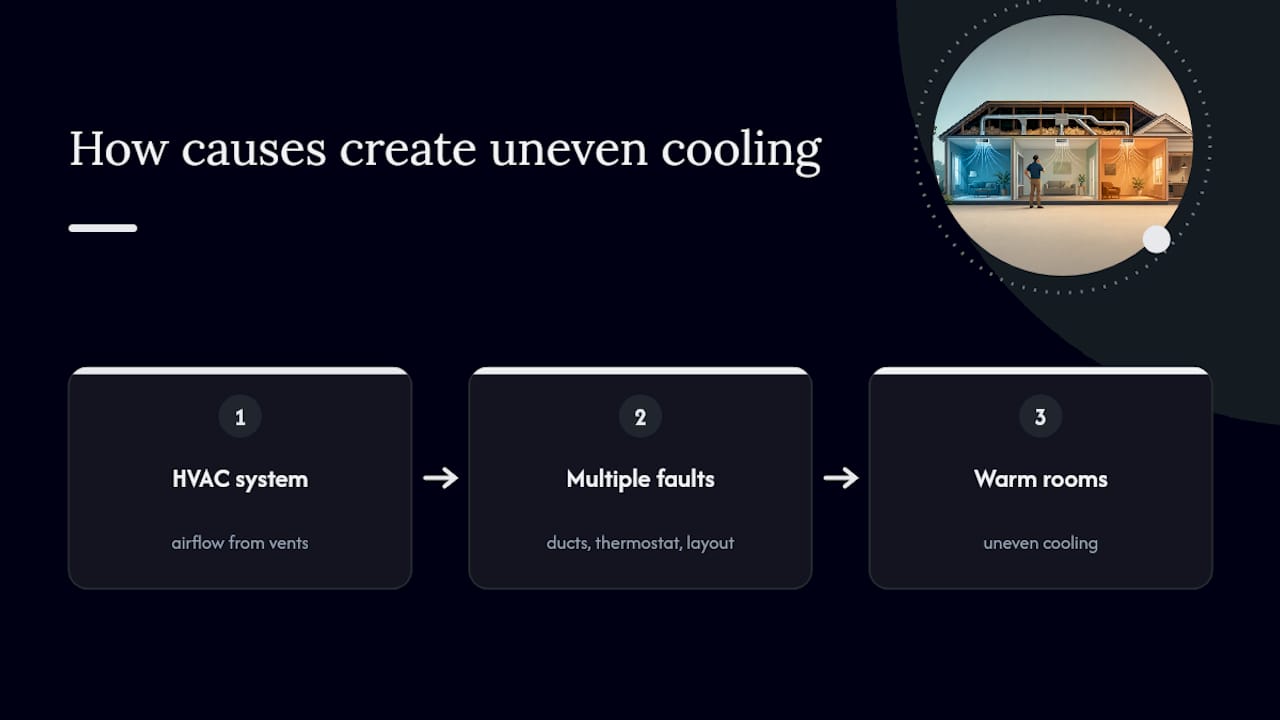
The order matters: try the quick checks first, gather temperature evidence over a few hours, then book a diagnostic if the gap persists. That sequence saves money, because it stops you paying for a system replacement when the actual fault is a £50 duct seal or a moved bookcase.
We’d rather run the numbers and tell you honestly that your system is fine than sell you equipment you don’t need.
— Akita
Get a proper diagnostic instead of guessing
If you’ve worked through the checks above and one room is still fighting the rest of the house, it’s time for measurements rather than more troubleshooting. Akita is the alternative to guesswork for uneven cooling across Suffolk, Norfolk, and Essex: fixed, transparent quotes before any work starts, F-Gas certified engineers running the same static pressure and leakage tests covered in this guide, and flexible finance including 0% options if a fuller fix turns out to be needed.

A domestic air conditioning installation starts from a described fixed price as a one-off cost, VAT-free for qualifying domestic installs, and covers the diagnostic groundwork that shows exactly where a system is losing performance. If your existing setup just needs sealing, balancing, or a service rather than a full replacement, the Air Conditioning Maintenance page and Comfort Club membership cover ongoing care so the problem doesn’t quietly come back next summer. Book a diagnostic and get a fixed quote before you spend a penny on guesswork.
Sources
- Why is one room hotter or colder than the rest of my house? | Mitsubishi Electric
- How to balance radiators | Homebuilding
- Why Is My House Unevenly Cooled? — Best Guide 2026
FAQ
Why is one room in my house always hotter than the rest?
It’s usually a combination of duct leakage, thermostat placement, and solar exposure rather than a single cause. Duct systems typically lose 20 to 30% of moving air to leaks, which hits rooms furthest from the air handler hardest.
Can closing vents in unused rooms fix uneven cooling?
No, this usually makes things worse. Closing vents raises static pressure in the ductwork and can reduce airflow efficiency across the whole system rather than pushing more air to the rooms that need it.
How much does duct sealing improve cooling performance?
Sealing and insulating leaky ducts can improve system efficiency by roughly 20%, on top of fixing the room-to-room temperature gap. It’s often the single most cost-effective fix available before considering zoning or new equipment.
How much does an Akita diagnostic or installation cost?
A domestic air conditioning installation from Akita starts from 1200 GBP one-off as detailed on the domestic installation page. Diagnostic, repair, and maintenance pricing is quoted individually after an assessment, since it depends on what the inspection finds.
Is a mini-split better than fixing my ducts?
Not necessarily. A ductless mini-split makes sense for an extension, converted garage, or room that never connected properly to the main ductwork, but if your existing ducts are simply leaking or unbalanced, sealing and zoning usually solves the problem for less.