

$150–$600: Smart Thermostat Installation Costs Homeowners Actually Pay
Most homeowners pay between $150 and $600 for professional smart thermostat installation, with a typical job landing around $250 to $350. That figure usually covers labour only, not the thermostat itself, and the single biggest swing factor is whether your system already has a C‑wire. No C‑wire or a heat pump setup, and the price climbs fast.
TL;DR:
- Costs can rise significantly if your home lacks a C-wire or if you have a heat pump, with wiring and system complexity increasing installation fees.
- Additional components like zone controls or running new wiring can add hundreds of dollars to the project, especially in older or hard-to-access homes.
- Proper installation involves compatibility checks, safe wiring, app setup, and system testing, with licensed technicians ensuring system reliability.
- DIY installation is feasible only for simple, battery-powered thermostats in compatible systems; complex or high-risk setups should involve professionals.
- Verifying licensing, getting fixed quotes, and preparing your wiring details beforehand save money and prevent unexpected charges during installation.
Table of Contents
- Smart thermostat installation cost breakdown: device, labour and extras
- What makes smart thermostat installation cost more?
- What does a professional installer actually do?
- Can you install a smart thermostat yourself?
- How to lower your smart thermostat installation cost
- What to ask before booking a smart thermostat installation
- How Akita approaches smart thermostat and HVAC installation
- Our take: the quote matters less than the questions behind it
- Book a smart thermostat installation with a fixed price up front
- Sources
Smart thermostat installation cost breakdown: device, labour and extras
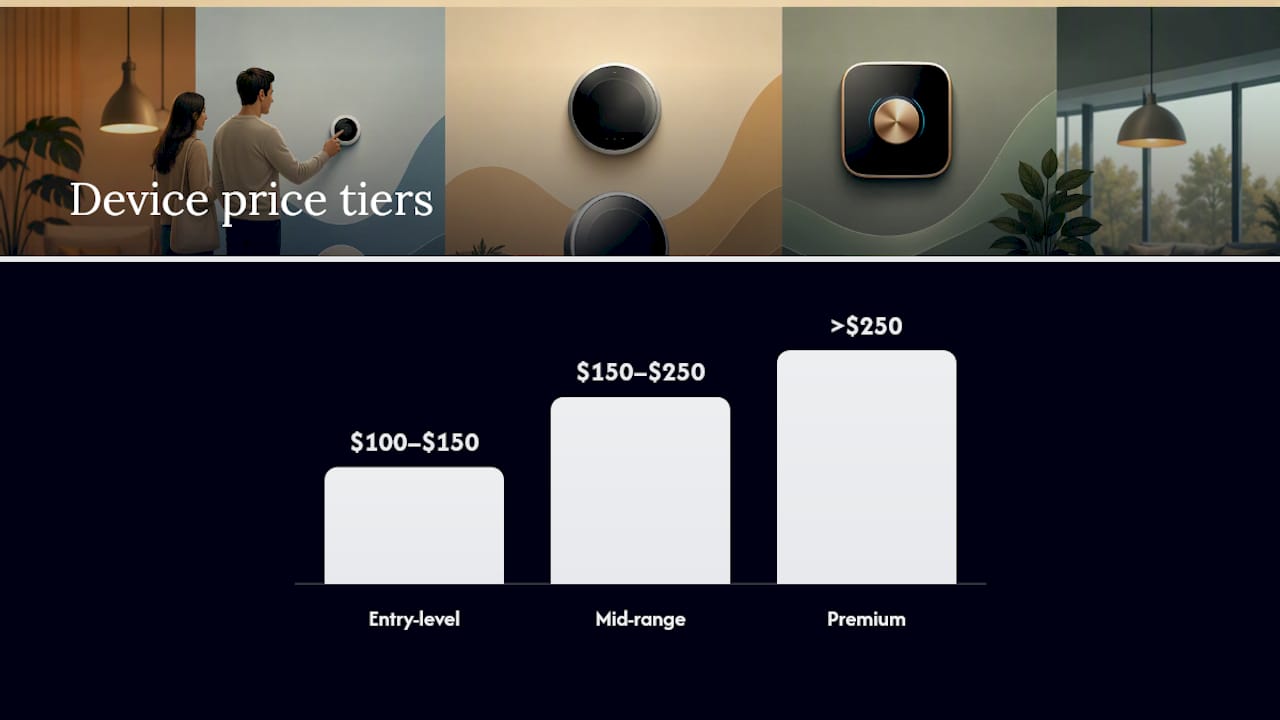
The device itself is a separate line from the work of putting it on your wall. Entry-level smart thermostats sit around $100 to $150, mid-range models with sensors and geofencing run $150 to $250, and premium units with zoning support or advanced learning features go past $250.
Labour is where quotes diverge most. A straightforward swap, where an existing smart-compatible wire setup is already in place, often runs as a fixed, low-complexity installation fee under $200 at big retailers. Independent HVAC technicians typically charge either a flat call-out fee or an hourly rate, and total installed costs commonly land between $150 and $600, with wiring-heavy or multi-zone jobs pushing toward the top end.
Add-ons change the maths quickly:
- C‑wire installation: adds $75 to $150 if power needs running from the furnace or air handler
- New receiver or adapter: $30 to $80 for systems needing a bridge device
- Thermostatic radiator valves (TRVs) or zone controls: $50 to $120 per unit
- Extra thermostat wiring runs: $100 to $200 depending on wall access
These bands match what most homeowners report, though a technician who has to fish new wire through finished walls or ceiling voids will quote toward the higher figures every time.
What makes smart thermostat installation cost more?
A quote above the typical range almost always traces back to one of a handful of technical realities. Understanding them before the technician arrives means fewer surprises on the invoice.
- No C‑wire present: older homes wired for simple mercury or bimetal thermostats often lack the dedicated low-voltage power wire smart thermostats need, and running one is the single most common cost add-on.
- Heat pump or multi-stage furnace systems: these need more wiring terminals and careful staging configuration, which takes longer than a standard single-stage gas furnace.
- Y‑plan or OpenTherm compatibility: boiler-based heating systems with modulating controls need extra diagnostic time to wire and commission correctly.
- Multiple zones or thermostats: each additional zone adds its own wiring run, mounting, and commissioning step, so per-unit costs rarely fall in a straight line as you add more.
- Access difficulties: thermostats mounted in awkward locations, or wiring buried behind finished drywall, add labour hours.
- Regional labour rates: installer wages vary meaningfully by occupation and region, which is why the same job can cost noticeably more in one metro area than another.
- Permits and inspections: rare for a thermostat swap alone, but if the job triggers broader electrical work, a local permit may apply.
Multi-zone homes benefit from reading up on how zoning systems actually work before the quote call, since a homeowner’s guide to HVAC zoning explains why each zone effectively behaves like its own mini installation job.
What does a professional installer actually do?
Paying for installation buys more than someone screwing a plate to your wall. A properly run job includes:
- Compatibility check — confirming your HVAC system’s voltage, wiring configuration, and terminal labels match the new thermostat before any wire gets cut.
- Safe wiring and mounting — labelling and connecting wires correctly, since misidentified wiring is one of the most common causes of failed installs and callback visits.
- App setup and scheduling — configuring the thermostat’s app, Wi‑Fi connection, and initial heating/cooling schedule.
- Commissioning and testing — running the system through heating and cooling cycles to confirm it responds correctly, with a fallback setting in case Wi‑Fi drops.
Pro Tip: Ask your installer to show you the fallback or manual override setting before they leave. If your Wi‑Fi goes down in January, you want to know how to keep the heat running without waiting on a support call.
Can you install a smart thermostat yourself?
Some jobs genuinely suit a confident DIY homeowner. Others don’t, and getting it wrong costs more than the installer fee would have.
- DIY-friendly: swapping a battery-powered or wireless thermostat where a compatible receiver is already installed, and the existing wiring matches the new unit’s terminals.
- Call a professional if: there’s no C‑wire, you have a heat pump or dual-fuel system, the wiring is decades old, or you’re not confident identifying R, W, Y, G and C terminals.
- Risks of getting it wrong: voided manufacturer warranty, a fried control board from a shorted wire, or a heating system that won’t fire on a cold night.
- Rough cost comparison: DIY parts plus your own time might save $100 to $250 versus a professional fee, but that gap shrinks fast if you damage a board or need a follow-up service call to fix a wiring mistake.
How to lower your smart thermostat installation cost
A few practical moves cut the total spend without cutting corners on safety.
- Check for rebates first: many utilities and states offer incentives for ENERGY STAR-certified models, and smart thermostats are one of the more reliable energy-saving upgrades when installed and scheduled correctly, which strengthens the case for claiming any available rebate before booking.
- Prep the site yourself: clear access to the thermostat location, take photos of your existing wiring, and note your HVAC system type before the technician arrives, cutting diagnostic time.
- Ask for a fixed fee, not an hourly estimate, when the scope is known, since hourly rates carry the most price risk.
- Bundle installs if you’re doing more than one zone, since a single visit often costs less per unit than separate call-outs.
- Verify licence and warranty rather than chasing the cheapest quote, since an uninsured or unlicensed installer’s mistakes come out of your pocket, not theirs.
What to ask before booking a smart thermostat installation
Getting three comparable quotes means giving every installer the same information and asking the same questions.
- Share upfront: your current thermostat model, clear photos of existing wiring, your HVAC system type (furnace, heat pump, boiler), and the number of zones.
- Ask directly: “Is C‑wire work included in this price, or is it extra if needed?”
- Ask about the fee structure: “Is this a fixed price or an hourly rate, and what’s the call-out fee if you leave without finishing?”
- Confirm testing and warranty: “Do you commission and test the system before you leave, and what’s covered under warranty?”
- Check credentials: ask for a licence number and verify it against your state’s licensing board before booking, the same way you’d check a state contractor licence lookup.
Vague line items and reluctance to confirm licensing are the two clearest red flags in any quote.
How Akita approaches smart thermostat and HVAC installation
Akita treats a thermostat install the same way it treats every HVAC job: a compatibility check first, transparent pricing second, and a working system before the technician leaves. That sequencing matters more than most homeowners realise, because skipping the compatibility check is exactly where DIY jobs and rushed quotes go wrong.
A fixed quote for a known-scope swap, and an hourly allowance only when wiring work might be needed, keeps pricing honest on both sides. It’s the same logic behind Akita’s approach to cost-saving HVAC upgrades: triage before you quote, not after.
Every installation includes commissioning, testing, and a follow-up path if something needs adjusting once the system’s running.
Our take: the quote matters less than the questions behind it
The conventional advice on this topic focuses almost entirely on price ranges, and that’s backwards. A $600 quote with C‑wire work, commissioning, and a licensed technician is a better deal than a $180 quote that turns out to exclude the wiring your system actually needs.
What the research behind this guide actually supports is a simple priority order: figure out your wiring situation before you call anyone, get every quote broken down into device, labour, and add-ons, and treat licence verification as non-negotiable rather than optional. Homeowners who skip straight to comparing bottom-line numbers end up comparing incompatible jobs, then feel misled when the “cheaper” installer adds $150 mid-visit for work that should have been scoped from the start.
Price still matters. It just isn’t the first question worth asking.
— Akita
Book a smart thermostat installation with a fixed price up front
Akita installs and commissions smart thermostats and full climate control systems for homeowners across Suffolk, Norfolk, and Essex, and the same fixed-price philosophy applies to both: you get a scoped quote before work starts, not a hopeful estimate that grows once the wall’s open.

That matters most for anyone who’s been burned by a vague callout fee or a technician who “discovers” extra work halfway through. Akita’s technicians check wiring and system compatibility upfront, so the price you’re quoted is the price you pay, backed by warranty cover and follow-up support if anything needs adjusting after the visit. If you’re weighing a thermostat upgrade against a wider heating or cooling refresh, Akita’s domestic air conditioning installation page shows current fixed pricing for the region. Ready to get a straight answer on your own setup? Request a quote and get a scoped price before any work begins.