TL;DR:
- Smart AC integration allows remote control, scheduling, and energy monitoring through smart home platforms. It offers savings, convenience, and environmental benefits, especially when using two-way communication controllers with ModBus or RS485. Compatibility, standards, and proper installation are essential for effective and secure smart system setup.
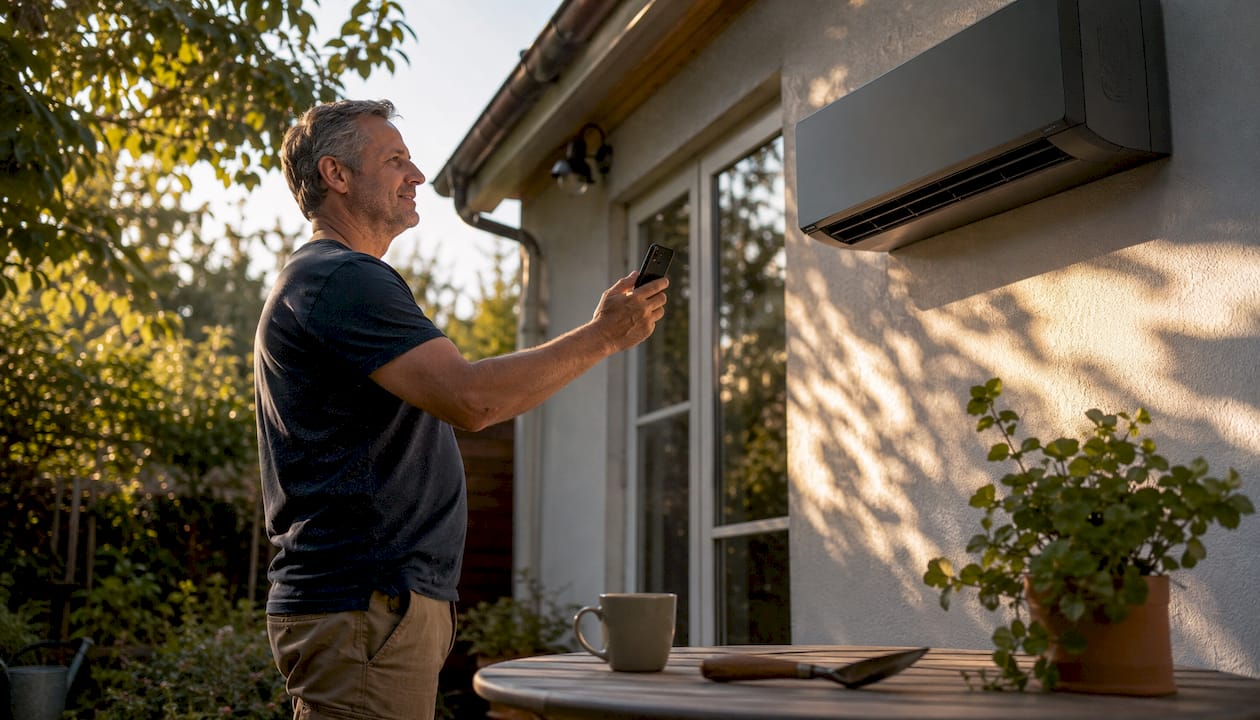
Smart AC integration connects your air conditioning system to your smart home technology so you can control, schedule, and monitor it remotely. Rather than walking to a wall unit or hunting for a remote, you manage temperature from your phone, set it to cool down before you arrive home, or let it adjust automatically based on occupancy. In the UK, this typically works through Wi-Fi, infrared signals, or dedicated smart controllers, and ties into platforms like Google Home, Amazon Alexa, or Apple HomeKit.
Here is what smart AC integration covers at a glance:
- Remote control via smartphone apps, anywhere with an internet connection
- Voice control through Google Home, Amazon Alexa, or Apple HomeKit
- Automated scheduling to cool or heat rooms only when needed
- Energy monitoring to track consumption and reduce waste
- Maintenance alerts that flag issues before they become costly repairs
- Compatibility with UK standards, including BS EN 50631-2:2023 for smart appliance connectivity
What are the real benefits of smart AC integration?
The most immediate benefit is lower energy bills. Smart AC systems avoid the common habit of leaving cooling running in empty rooms, and adaptive scheduling means the unit only works hard when it genuinely needs to. AI-driven retrofit controllers can reduce running costs noticeably on average without affecting room temperature comfort, confirmed through integrated measurement and verification data logging.
Beyond bills, there is the convenience factor. You can turn the system on during your commute home, set different temperatures for different rooms using smart zoning, and receive alerts if something goes wrong with the unit. Smart thermostats with zoning capabilities, such as the Resideo evohome, let you create per-room schedules and avoid conditioning spaces nobody is using.
The environmental case is straightforward too. Less energy wasted means a smaller carbon footprint, and the BS EN 50631-2:2023 standard for household appliance network connectivity specifies that heat pump air conditioners can reduce energy consumption noticeably when responding to grid price signals automatically.
- Lower bills through scheduling and adaptive control
- Convenience via remote and voice operation
- Maintenance visibility with real-time alerts and diagnostics
- Reduced carbon footprint through smarter energy use
- Longer equipment life when compressor cycling is managed intelligently
How can you integrate your AC with smart home technology?
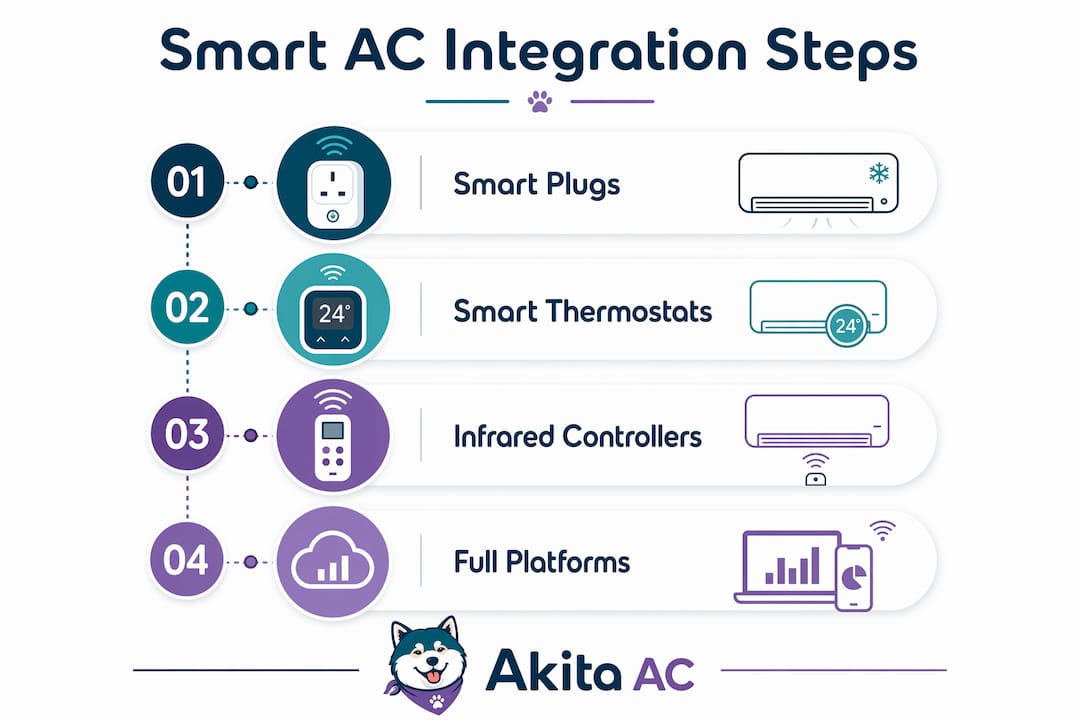
There are four main routes, ranging from a quick plug-in fix to a fully wired automation system. The right choice depends on your existing AC unit, your smart home platform, and how much control you actually want.
Smart plugs
The simplest option. A smart plug sits between your AC unit and the wall socket, giving you remote on/off control through an app. It works with most platforms and costs very little. The catch is that it cannot adjust temperature, change modes, or read the unit’s status. Fine for a portable unit; not enough for a split system.
Smart thermostats
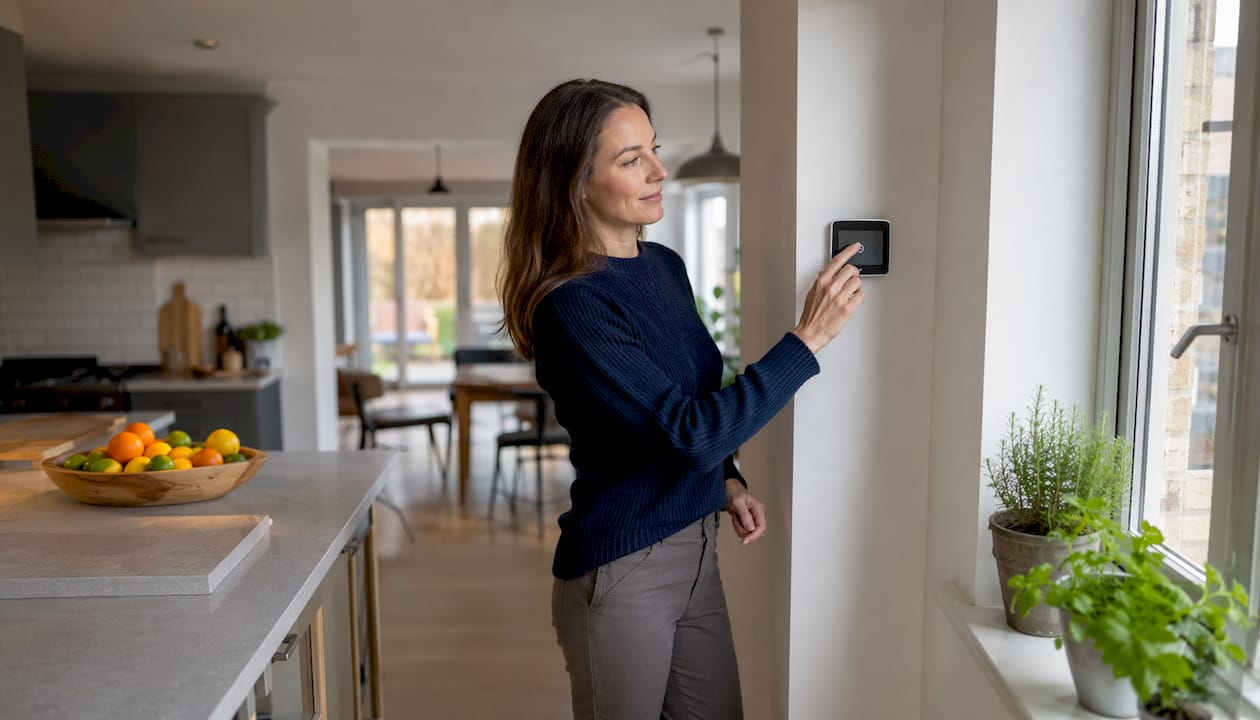
A step up in capability. Devices like the Resideo evohome support up to 12 heating and cooling zones, letting you set individual schedules per room. They connect via Wi-Fi and integrate with voice assistants. For UK homeowners with multi-room setups, AC zoning through a smart thermostat is one of the most practical upgrades available.
Infrared (IR) retrofit controllers
These clip onto your existing unit and mimic the original remote control using infrared signals. Tuya Smart devices fall into this category, and they work with Google Home, Amazon Alexa, and Apple HomeKit. The limitation is one-way communication: the controller sends commands but cannot read back the unit’s actual state. You cannot confirm whether the AC actually changed mode, and energy optimisation is limited as a result.
Direct communication controllers and full platforms
The most capable approach. Controllers using ModBus or RS485 interfaces offer two-way communication, meaning the system can read real-time status, manage compressor cycling intelligently, and report faults. That feedback loop is what separates genuine smart control from basic remote switching.
Pro Tip: If your AC unit has a ModBus or RS485 port, prioritise a controller that uses it over an IR blaster. Two-way communication gives you real energy data and smarter compressor management, not just remote on/off.
What should you check before integrating your AC system?
Compatibility is the first question. Not every AC unit speaks the same language as your smart home platform, and discovering that after purchase is frustrating. Check whether your unit supports Wi-Fi natively, has a ModBus or RS485 port, or requires an IR retrofit controller.
- Protocol support: confirm whether your unit uses Wi-Fi, ModBus, RS485, or IR
- Ecosystem fit: choose devices certified for your platform (Google Home, Apple HomeKit, Amazon Alexa)
- Installation complexity: direct communication controllers often require a qualified engineer; IR blasters are DIY-friendly
- Cost: smart plugs cost very little; full system automation involves hardware, installation, and potentially ongoing subscription fees
- Warranty impact: some manufacturers void warranties if third-party controllers are wired directly to the unit
- Data privacy: connected devices transmit data over the internet, so check the manufacturer’s privacy policy and whether data is stored locally or in the cloud
Security deserves specific attention. Encrypted communication using TLS 1.2 and two-factor authentication are the baseline standards for secure smart home devices. Emerging protocols like EEBUS use the WebSocket protocol over TLS 1.2 mutual authentication between all connected nodes, which sets a solid security floor for air conditioning integration.
Pro Tip: Before buying any smart AC controller, check whether it receives regular firmware updates. A device that stops receiving security patches becomes a vulnerability on your home network within a year or two.
Which smart AC approach works best for UK homes?
The UK market is moving towards open interoperability standards, and that shift matters when you are choosing equipment. The Matter protocol enables automatic device discovery and native voice control across smart home brands, meaning a Matter-certified AC controller should work with any Matter-compatible thermostat or hub without custom configuration. EEBUS goes further for energy management, allowing air conditioning devices from different manufacturers to coordinate power consumption automatically, which is particularly useful if you have solar panels or a battery storage system.
For most UK homeowners right now, the practical advice is to prioritise ecosystem harmony. If your home already runs on Apple HomeKit, choose AC devices with HomeKit certification. Mixing platforms creates fragmented control experiences where some devices appear in one app and others in another.
- Matter-certified devices offer the broadest future compatibility across platforms
- EEBUS-enabled systems suit homes with solar PV or battery storage, coordinating energy use automatically
- Direct communication controllers (ModBus/RS485) outperform IR blasters for energy savings and diagnostics
- BS EN 50631-2:2023 compliance confirms a device meets UK and European smart appliance connectivity requirements
- Professional installation protects your warranty and ensures the system is configured correctly from day one
Akita installs and maintains smart-ready AC systems across Suffolk and north Essex, and the team can advise on which integration approach fits your existing setup. Getting the hardware right at installation is considerably easier than retrofitting smart controls to a system that was not designed with them in mind. For broader guidance on smart air conditioning performance, the principles of ecosystem compatibility and two-way communication apply regardless of brand.
How do you set up smart AC integration step by step?
Setting up smart AC integration follows a consistent process regardless of which method you choose.
- Audit your existing AC unit. Identify the make, model, and available ports (Wi-Fi module slot, ModBus, RS485, or IR-only). Check the manufacturer’s app and compatibility list.
- Choose your integration method. Smart plug for basic control, IR controller for retrofit, or a native Wi-Fi/direct communication controller for full functionality.
- Select a compatible smart home platform. Confirm the controller or device is certified for Google Home, Amazon Alexa, or Apple HomeKit, whichever you use.
- Install the hardware. IR controllers and smart plugs are typically DIY. Direct communication controllers wired to the AC unit should be fitted by a qualified engineer to avoid warranty issues.
- Connect to your home network. Follow the manufacturer’s app setup to connect the device to your Wi-Fi. Use a 2.4GHz network if the device does not support 5GHz.
- Integrate with your smart home platform. Add the device in Google Home, the Home app, or the Alexa app. Assign it to a room and configure any automation routines.
- Set schedules and test. Create cooling or heating schedules, test voice commands, and verify the unit responds correctly. Check the app confirms the unit’s actual status if using a two-way communication controller.
Common problems with smart AC integration and how to fix them
Device not appearing in the smart home app. The most common cause is a 5GHz Wi-Fi connection. Most smart AC controllers only support 2.4GHz. Switch your phone temporarily to the 2.4GHz band during setup.
IR controller not responding reliably. Check the line of sight between the controller and the AC unit’s IR receiver. Obstructions or strong ambient light can interfere. Repositioning the controller a few centimetres often resolves it.
Schedules not running as expected. Confirm the device’s time zone is set correctly in the app. A mismatch between the device clock and your local time causes schedules to fire at the wrong time.
App shows incorrect temperature or status. This is a known limitation of IR-only controllers, which cannot read back the unit’s state. Upgrading to a direct communication controller with ModBus or RS485 resolves this entirely.
Integration dropping out after a router restart. Assign a static IP address to the smart AC controller in your router settings. Dynamic IP allocation can cause the device to appear on a different address after a restart, breaking the connection.
Key takeaways
Smart AC integration gives UK homeowners remote control, automated scheduling, and real energy savings, but the method you choose determines how much of that potential you actually unlock.
| Point | Details |
|---|---|
| Two-way communication matters | ModBus/RS485 controllers outperform IR blasters by reading real-time unit status and managing compressor cycling. |
| Ecosystem compatibility first | Choose devices certified for your existing platform (Google Home, Apple HomeKit, or Amazon Alexa) to avoid fragmented control. |
| UK standards apply | BS EN 50631-2:2023 sets connectivity and energy flexibility requirements for smart heat pump air conditioners in the UK. |
| Professional installation protects your investment | Wiring direct communication controllers without a qualified engineer can void the manufacturer’s warranty. |
Our team installs Mitsubishi Electric and Daikin systems in homes across Suffolk and north Essex. Every install starts with a free heat-load survey and is carried out by F-gas certified engineers under our REFCOM registration (REF1023379). Entry installs start from £1,300, and VAT on domestic installs is 0% until 31 March 2027, then 5%. Every install by our team comes with a 12-month installation warranty, plus up to 5 years’ manufacturer warranty when the system has its annual service. Book a free survey.
Common issues and expert tips for optimising air conditioning controls in the UK
Common faults include stuck TRVs, poor thermostat placement, sizing errors causing short-cycling or underperformance, installation faults, and inactivity leading to malfunction. Understanding these pitfalls helps you avoid costly mistakes and system inefficiency.
Stuck valves occur when TRVs or control valves remain unused for extended periods. The mechanism seizes, preventing proper operation. This commonly happens with seasonal systems left dormant for months. Regular operation, even briefly during off-seasons, prevents this issue. If valves do stick, gentle manual operation sometimes frees them, though severely seized units require replacement.
Thermostat placement dramatically affects performance. Positioning thermostats near radiators, in drafty hallways, or beside windows causes false readings. A thermostat near a radiator detects artificially high temperatures, switching heating off whilst other rooms remain cold. Conversely, drafty locations trigger excessive heating to compensate for localised cold spots.
Incorrect system sizing creates persistent problems. Oversized systems cycle on and off too frequently, reducing efficiency and component lifespan. Undersized systems run continuously without achieving target temperatures. Both scenarios waste energy and money. Professional heat loss calculations determine precise heating requirements based on property dimensions, insulation levels, and usage patterns.
Installation faults include incorrect wiring, airlocks in hydronic systems, and poorly configured zone valves. These issues prevent controls from communicating properly with heating equipment. Symptoms include heating that won’t switch off, zones that don’t respond to commands, or systems that operate opposite to programmed schedules.
UK experts recommend TRVs on all radiators, zone controls for large buildings, and professional heat loss calculations before upgrades. This approach ensures appropriately sized systems with granular control capabilities.
Best practices for installation and maintenance:
- Commission a professional heat loss survey before system upgrades
- Install TRVs on every radiator except in rooms with main thermostats
- Position thermostats on internal walls at approximately 1.5 metres height
- Bleed radiators annually to remove air pockets affecting heat distribution
- Test all controls monthly during heating season to prevent seizure
- Replace thermostat batteries before they fully discharge
- Clean dust from thermostat vents that can affect temperature sensing
- Document control settings and schedules for easy restoration after power cuts
Pro Tip: Always commission professional heat loss calculations before upgrading air conditioning systems to ensure proper sizing that prevents short-cycling and underperformance issues.
Selecting appropriate equipment from the start avoids many problems. Guidance on choosing efficient air conditioning systems helps you match controls and equipment to your specific requirements.
Advanced and smart air conditioning controls: AI, predictive models, and energy savings
These systems analyse multiple data sources simultaneously to optimise heating and cooling decisions before conditions change, rather than simply reacting to current temperatures.
Model Predictive Control examines weather forecasts, building thermal properties, occupancy patterns, and energy prices to determine the most efficient heating schedule. If tomorrow’s forecast predicts mild afternoon temperatures, MPC might delay morning heating or reduce intensity, knowing natural warmth will supplement the system later. This forward-looking approach prevents energy waste from overshooting temperature targets.
AI-powered air conditioning controls learn from your behaviour patterns. They detect when you typically arrive home, adjust for seasonal variations, and recognise exceptions like holidays. Some systems integrate with occupancy sensors, automatically reducing heating in unoccupied rooms. Others connect to weather services and energy tariff data, shifting consumption to cheaper off-peak periods when possible.
Geofencing technology uses your smartphone location to trigger heating adjustments. When you leave a defined area around your home, the system reduces heating. As you approach, it begins warming your property to reach comfortable temperatures upon arrival. This eliminates the need to heat empty homes or return to cold spaces.
“Smart air conditioning controls leveraging AI and predictive algorithms can reduce residential energy consumption noticeably compared to traditional thermostat-based systems, whilst maintaining superior comfort levels.”
Advantages of smart air conditioning systems include:
- Remote control via smartphone apps from anywhere with internet access
- Automatic adjustments based on weather forecasts and occupancy
- Detailed energy consumption reports identifying waste
- Integration with other smart home devices and voice assistants
- Learning algorithms that optimise settings without manual programming
- Multi-zone management from a single interface
Smart and AI controls offer superior efficiency but require upfront investment, reliable Wi-Fi, and raise data privacy concerns. Reliable broadband connectivity is essential, as these devices depend on cloud services for advanced features. Some users worry about companies collecting data on their heating patterns and home occupancy.
Compatibility represents another consideration. Not all smart controls work with every heating system type. Heat pumps, combination boilers, and underfloor heating may require specific control models. Verify compatibility before purchasing to avoid costly returns or additional equipment needs.
Despite these challenges, the Air conditioning smart control energy benefits often justify the investment within three to five years through reduced energy bills. For comprehensive guidance on implementing smart automation, review this smart air conditioning automation guide covering integration strategies.
3. In what ways does smart air conditioning lower costs and maintenance overhead?
The cost savings from smart air conditioning come from two sources: lower energy bills and reduced maintenance spend. Most buyers focus on energy, but predictive maintenance savings often exceed pure energy savings in commercial settings.
Smart systems continuously monitor component performance. When a compressor starts drawing more current than normal, or a filter restricts airflow beyond a set threshold, the system flags the fault before it becomes a breakdown.
Equipment lifespan also extends when systems run within their designed parameters. A unit that never overheats because its filters are always clean and its refrigerant charge is always correct will outlast one that runs degraded for months before anyone notices. Remote monitoring dashboards give facilities managers and homeowners a live view of system health without needing an engineer on site.
- Fault detection: Alerts identify failing components before breakdown occurs.
- Remote diagnostics: Engineers can assess system status before arriving on site, reducing visit time and cost.
- Filter monitoring: Automated reminders prevent the efficiency losses that come from blocked filters.
| Cost area | Conventional air conditioning | Smart air conditioning |
|---|---|---|
| Energy bills | Fixed schedule, no occupancy response | – |
| Reactive, unplanned costs | Predictive alerts reduce breakdowns | |
| Filter maintenance | Manual checks, often missed | Automated monitoring and reminders |
| Equipment lifespan | Degraded by undetected faults | Extended through continuous monitoring |
For a practical overview of Air conditioning maintenance best practice, a structured checklist helps you stay ahead of the most common failure points.
Recommended
- What is AC zoning? A UK homeowner’s guide – Akita AC
- Benefits of smart air conditioning: 9 advantages worth knowing – Akita AC
- Air conditioning buying guide 2026: smart UK choices – Akita AC
- What are air conditioning controls: UK homeowners and businesses guide – Akita AC
Speak to Akita Air Conditioning
Find out more about our air conditioning installation, or see how we work with homes and businesses in Suffolk and the surrounding area.
Ready to talk about your property? Book a free survey and one of our engineers will assess your space and recommend the right system for it.