

Role of air conditioning in commercial buildings
TL;DR:
- Most commercial air conditioning systems do more than just control temperature; they regulate ventilation, humidity, and air filtration to ensure indoor air quality and occupant productivity. Efficient HVAC systems can significantly reduce energy waste—up to 30%—by using smart controls, regular maintenance, and occupancy-based adjustments, thereby lowering costs and environmental impact. Proper management of AC influences health, decision-making, and organizational performance through continuous monitoring and advanced technologies.
Most building managers think of air conditioning as a temperature switch. Too hot, crank it up. Too cold, dial it back. That framing costs businesses money every single day. The role of air conditioning in commercial buildings is far broader than cooling. It manages ventilation, regulates humidity, filters contaminants, and directly shapes whether the people inside that building can think clearly and work effectively. Around 30% of energy used in commercial buildings is wasted, much of it tied to poorly managed HVAC. Getting this right is not a technical luxury. It is a business decision.
Table of Contents
- Key takeaways
- The role of air conditioning in commercial buildings
- Energy efficiency in offices: where the waste hides
- Impact of AC on productivity, health, and wellbeing
- Modern AC technologies for better building performance
- What I have learnt from managing commercial AC systems
- How Akita can support your commercial building
- FAQ
Key takeaways
| Point | Details |
|---|---|
| AC does more than cool | Commercial air conditioning controls ventilation, humidity, air quality, and temperature together. |
| HVAC dominates energy bills | HVAC uses 40–50% of building energy, making it the single largest efficiency lever available to managers. |
| CO2 levels affect cognition | Cognitive performance declines above 1,000 ppm CO2, linking ventilation quality directly to productivity. |
| Smart controls reduce waste | Demand-controlled ventilation and IoT sensors match fresh air supply to actual occupancy in real time. |
| Maintenance prevents failure | Regular servicing and sensor calibration protect both indoor air quality and energy performance simultaneously. |
The role of air conditioning in commercial buildings
Temperature control is just the starting point. A well-designed commercial AC system is simultaneously managing four distinct functions: regulating temperature, controlling ventilation, managing humidity, and filtering airborne contaminants. When any one of these fails, the others are compromised too.
Ventilation and CO2 management are where most building managers have blind spots. Occupants exhale CO2 continuously, and in a sealed commercial space, concentrations climb quickly. ASHRAE Standard 62.1 sets minimum ventilation requirements based on CO2 levels and occupancy because research consistently links elevated CO2 to impaired cognitive performance. A meeting room with eight people and no fresh-air cycling is not a comfortable environment. It is a slow leak on your team’s decision-making capacity.
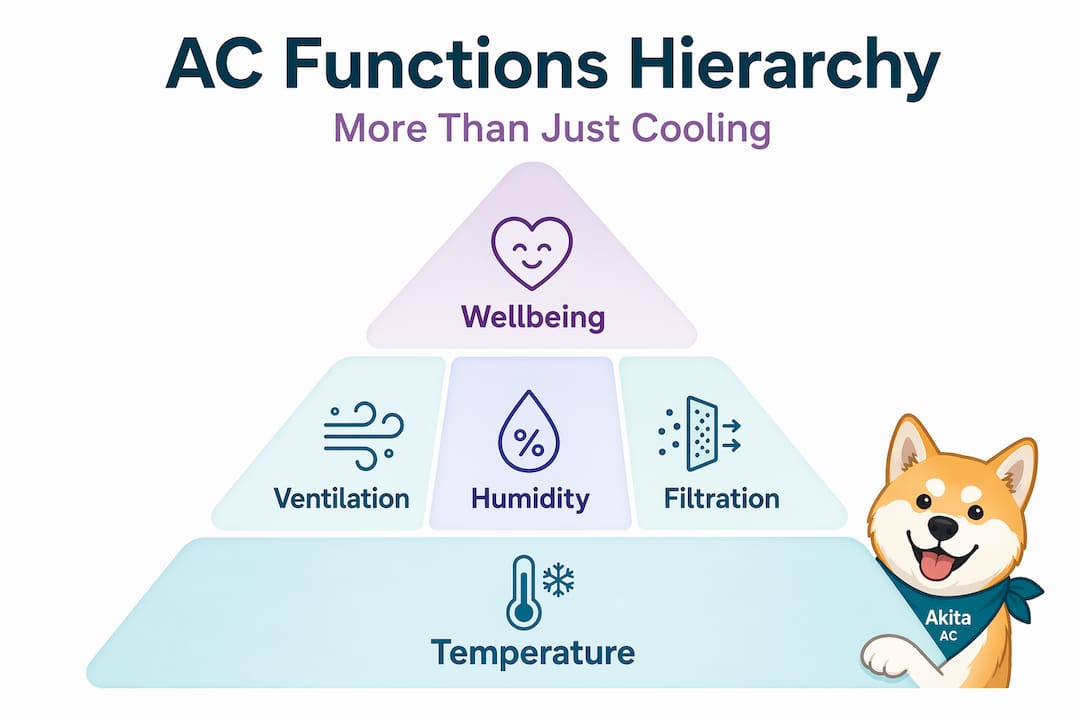
Humidity control deserves equal attention. The sweet spot for occupant comfort sits between 40% and 60% relative humidity. Below 40%, occupants experience dry eyes, irritated airways, and increased susceptibility to airborne viruses. Above 60%, mould risk increases and physical discomfort rises sharply. Commercial AC systems actively manage this balance year-round, particularly in the UK where outdoor humidity swings are significant across seasons.
The filtration role of commercial air conditioning is increasingly visible since 2020. Modern systems capture:
- Dust and particulates that affect respiratory health
- Pollen and biological allergens
- VOCs (volatile organic compounds) from furniture, cleaning products, and equipment
- Bacteria and viral particles with appropriate filter grades
- Fine particulates from outdoor pollution entering through fresh-air ducts
None of this happens by accident. It requires the right system specification, proper maintenance, and filters suited to the building’s actual contaminant profile. This is why a detailed understanding of commercial AC systems matters before any installation or upgrade decision is made.
Energy efficiency in offices: where the waste hides
HVAC accounts for 40–50% of a commercial building’s total energy use, which makes it the obvious target when organisations want to cut costs and reduce emissions. The challenge is that inefficiency rarely announces itself. It hides in patterns that feel normal until someone looks carefully at the data.
The most common sources of HVAC energy waste in commercial buildings are:
- Running at full capacity during low-occupancy periods. A system designed for 200 people burning full energy on a quiet Friday with 20 staff present is not serving anyone well.
- Blocked or dirty filters. When filters clog, systems work harder to push the same volume of air through, consuming more energy for less output.
- Poor thermostat placement. A sensor near a window or heat-generating equipment gives a false reading, causing unnecessary cycling.
- Lack of zone control. Heating an empty boardroom at the same rate as a packed open-plan floor is pure waste.
- Deferred maintenance. Refrigerant leaks, worn components, and misaligned belts all reduce efficiency without triggering obvious alarms.
Demand-controlled ventilation (DCV) directly addresses the occupancy problem. DCV uses CO2 sensor data to adjust fresh-air damper positions dynamically, supplying more outside air when the building is busy and reducing it when occupancy drops. For a medium-sized office building, this single technology can produce meaningful reductions in ventilation energy without any compromise to air quality.
| Strategy | Energy impact | Complexity |
|---|---|---|
| Demand-controlled ventilation | High | Moderate |
| Zone scheduling and setback | High | Low |
| Predictive maintenance programme | Medium | Moderate |
| Filter maintenance and replacement | Medium | Low |
| Building automation system integration | High | High |
Pro Tip: Benchmarking HVAC energy use should account for occupancy patterns, plug loads, and seasonal weather variation. Looking at whole-building consumption figures alone will mask whether your HVAC improvements are actually working.
The practical tools available to building managers have improved significantly. Platforms like ENERGY STAR Portfolio Manager allow you to track energy, water use, and emissions against comparable buildings, giving you a real benchmark rather than an internal comparison that might be optimistic.
Impact of AC on productivity, health, and wellbeing
The business case for proper climate control is not just about comfort. It is about output. When the indoor environment is poorly managed, the effects on occupant performance are measurable and significant.
“Cognitive performance declines above 1,000 ppm CO2.” ASHRAE ventilation guidance links this directly to the design and operation of commercial AC systems. In practical terms, this means a stuffy meeting room is not just unpleasant. It is reducing the quality of the decisions being made inside it.
The importance of climate control extends across multiple dimensions of occupant health:
- Temperature extremes reduce concentration and increase error rates. Research on thermal comfort consistently shows performance degradation outside the 20–25°C comfort band.
- High humidity creates physical fatigue, increases complaints, and raises sick-building syndrome risks.
- Poor filtration exposes occupants to allergens and particulates that drive absenteeism, especially among staff with respiratory sensitivities.
- Low humidity in winter months dries airways, making occupants more susceptible to airborne infections and increasing short-term sick leave.
The benefits of HVAC systems extend beyond individual wellbeing to organisational outcomes. Buildings that maintain good indoor air quality consistently report lower absenteeism, fewer health-related complaints, and stronger tenant retention. For commercial property managers, this translates directly into lease renewals and reduced void periods. For business owners, it translates into workforce reliability.
Continuous IAQ monitoring, using real-time CO2, temperature, and humidity sensors, gives building managers the data to act on problems before occupants are affected. The HVAC role in improving indoor air quality becomes far more controllable once you have that visibility. Without sensors, you are essentially managing blind.

Modern AC technologies for better building performance
The gap between how most commercial buildings manage their HVAC and what current technology makes possible is substantial. Emerging HVAC technologies include IoT-based sensors, AI-driven controls, and predictive maintenance systems that move building management from reactive to genuinely proactive.
Smart controls are the entry point. Rather than running on fixed schedules, modern systems respond to actual conditions: occupancy, outdoor temperature, internal heat loads from equipment, and real-time energy pricing signals. This dynamic response is what separates a well-performing building from one that simply has air conditioning installed.
| Technology | Core benefit | Typical application |
|---|---|---|
| IoT CO2 and humidity sensors | Real-time IAQ visibility | Open-plan offices, meeting rooms |
| AI-driven scheduling | Predictive energy optimisation | Large commercial buildings |
| Fault detection diagnostics | Early issue identification | Any commercial HVAC system |
| Building automation system (BAS) integration | Unified control of HVAC, lighting, and access | Multi-tenanted commercial properties |
| DCV with sensor calibration | Ventilation matched to occupancy | Variable-occupancy offices |
Predictive maintenance deserves particular attention. Traditional maintenance schedules are time-based, which means systems are often serviced when they do not need it, and left running when they do. Fault detection systems analyse operational data continuously, flagging anomalies like unusual energy draw or temperature deviation before they become failures. This approach protects both the equipment investment and the building’s operational continuity.
ASHRAE’s performance-based ventilation compliance approach (known as IAQP) allows building managers to verify acceptable air quality through demonstrated filtration and source control rather than fixed outdoor air quantities. This gives greater operational flexibility, particularly in buildings with advanced filtration, provided compliance is actively verified over time rather than assumed after initial commissioning.
Pro Tip: DCV systems require careful commissioning and regular sensor calibration to perform as intended. A poorly calibrated CO2 sensor can cause the system to either under-ventilate or waste energy on unnecessary fresh-air cycling. Budget for ongoing verification, not just initial setup.
The HVAC industry trends shaping 2026 point clearly toward integration: systems that communicate across platforms, feed data into central dashboards, and support decarbonisation goals alongside operational performance. Building managers who invest in this infrastructure now are positioning their properties well ahead of tightening energy regulations.
What I have learnt from managing commercial AC systems
In my experience working with commercial buildings across Suffolk, Norfolk, and Essex, the most persistent problem is not equipment age or specification. It is the assumption that once a system is installed and working, the job is done.
The buildings that perform best are the ones where someone is actively watching the data. CO2 levels by zone, filter pressure differentials, energy consumption against occupancy figures. That ongoing attention is what separates a system that functions from one that genuinely performs. I have seen well-specified systems fail to deliver because nobody noticed the sensors had drifted, or because the maintenance schedule had slipped by six months.
The other lesson I would pass on is this: how air conditioning impacts business is not abstract. When an office becomes uncomfortable in a July heatwave, productivity does not dip slightly. It collapses. Clients notice. Staff notice. And the cost of that single week of poor performance often dwarfs a year of maintenance spend.
My honest view is that the commercial HVAC maintenance workflow should be treated with the same seriousness as financial reporting. It is not a cost centre. It is a performance lever that affects every person in the building, every day.
— Akita
How Akita can support your commercial building
If you manage a commercial property and you are rethinking how your air conditioning system is working, Akita is the right place to start.
Akita designs and installs commercial air conditioning systems tailored to the specific demands of offices, retail environments, and multi-use commercial spaces across Suffolk, Norfolk, and Essex. Every project begins with a proper site assessment, not a generic specification. Akita focuses on energy-efficient systems with smart controls, giving building managers the operational visibility they need to run their HVAC effectively from day one. Ongoing maintenance and servicing contracts mean your system stays calibrated, compliant, and performing at its best through every season. Get in touch with Akita to arrange a no-obligation commercial assessment.
FAQ
What does air conditioning do beyond cooling in commercial buildings?
Commercial AC systems manage ventilation, humidity, and air filtration alongside temperature. Together these functions control indoor air quality, occupant comfort, and energy consumption across the entire building.
How much energy do HVAC systems use in commercial buildings?
HVAC typically accounts for 40–50% of total energy consumption in commercial buildings, making it the single largest contributor to energy costs and the most impactful area for efficiency improvements.
How does air conditioning affect productivity in offices?
Poor ventilation causes CO2 levels to rise above 1,000 ppm, which measurably reduces cognitive performance. Maintaining correct temperature and air quality through a well-managed AC system directly supports concentration, decision-making, and reduced absenteeism.
What is demand-controlled ventilation and why does it matter?
DCV adjusts fresh-air supply dynamically based on real-time CO2 sensor readings, supplying more ventilation when the building is busy and less when it is not. This cuts energy use without compromising indoor air quality.
How often should commercial air conditioning systems be serviced?
Most commercial systems should be serviced at least twice per year, with filter checks and sensor calibration carried out more frequently in high-occupancy or high-particulate environments. Deferred maintenance is the leading cause of both efficiency losses and premature system failure.