

Homeowners: AC Installation Usually Takes 4–8 Hours, Avoid Delays
Most residential air conditioner replacements take 4 to 8 hours of labour, completed within a single day. New central systems that need ductwork changes usually run 1 to 2 days. That timeframe covers hands-on work only — it excludes permitting, equipment delivery, and any electrical upgrades, which are the real reasons a job that “should” take an afternoon stretches into next week.
TL;DR:
- Most residential AC replacements, especially single-zone units, can be completed in 4 to 8 hours of actual work within a single day, but ductwork or electrical upgrades may extend this to 1 or 2 days.
- The total installation process includes site surveys, equipment delivery, and sometimes permits, which can add days or weeks, though these are not part of the hands-on labor estimate.
- Longer installation times often result from delayed equipment shipments, ductwork repairs, electrical upgrades, building material challenges, or permit issues, with estimates typically exceeding initial timelines by 20% or more.
- Pre-installation preparation, like clearing access and confirming delivery windows in writing, can prevent delays and help keep the project on schedule.
- A fixed-price quote based on an on-site survey and a detailed commissioning report provides the most accurate timeline and cost estimate, especially for complex or multi-zone systems.
Table of Contents
- How long does AC installation take by system type?
- What happens during each phase of the installation?
- What makes AC installation take longer than expected?
- How can you keep your AC installation on schedule?
- How Akita estimates installation time on real jobs
- What a reasonable AC installation timeline actually looks like
- Request a survey and fixed price quote from Akita
- Sources
- FAQ
How long does AC installation take by system type?
The honest answer depends entirely on what you’re having fitted, and the gap between the fastest and slowest jobs is bigger than most quotes let on.
A window unit swap is the quickest job on this list. Most installers finish in 1 to 2 hours, since there’s no refrigerant line to run and no wall to drill. Portable units need even less, often under an hour, because there’s genuinely nothing to install beyond positioning the unit and venting the hose.
Mini-split systems (ductless heat pumps and single-zone AC) sit in the middle. A single-zone install typically takes 4 to 8 hours, matching a standard central swap. Add extra indoor units and the clock keeps running: multi-zone installs commonly add roughly 2 to 4 extra hours per additional indoor unit when pipe runs are long or loft access is awkward. A three-zone system with tricky routeing can easily become a two-day job rather than a one-day one.
Central systems split into two very different categories:
- A direct swap of an existing central unit for an equivalent new one, using the same ductwork and electrical setup, often finishes the same day.
- A new ducted installation, or one requiring duct replacement, usually takes 1 to 2 days, sometimes longer if the ductwork needs substantial rework.
The contrast is worth remembering: a like-for-like replacement is a same-day job in nearly every case, while anything involving new ducting or a first-time install belongs in the multi-day bracket from the outset.
What happens during each phase of the installation?
Every AC installation moves through three distinct phases, and knowing what happens in each one explains why the “hours of labour” figure and the “total project time” figure are rarely the same number.
- Preparation. This starts with a site survey, typically 30 to 60 minutes on-site, where the installer checks wall construction, electrical capacity, and where pipework will run. It reduces surprises later. After that comes the quote, scheduling, and equipment ordering, which can add days or weeks to the calendar depending on stock availability, even though none of it counts as labour time.
- Installation day. The engineer removes any old unit, mounts the new one, runs pipework and cabling, and connects the electrical supply. A rough breakdown for a standard swap: removal (30 to 60 minutes), mounting (1 to 2 hours), pipework and electrical connection (1 to 3 hours), then testing.
- Commissioning and handover. This is the invisible hour that decides how long the system lasts. Vacuum drying, pressure and leak testing, and refrigerant charging together add 30 to 90 minutes to the job, followed by airflow balancing and a walkthrough.
Pro Tip: Ask your installer to show you the vacuum gauge reading before they charge the system. A proper vacuum should hold below 500 microns. Skipping this step is invisible to you on the day but shortens the system’s working life through trapped moisture.
What makes AC installation take longer than expected?
Quoted timelines are estimates, not guarantees, and several recurring issues explain most of the gap between the two.
- Equipment lead times. If your chosen unit isn’t in stock, delivery can add days or weeks before installation day even gets scheduled.
- Electrical upgrades. Older properties often need a dedicated circuit or consumer unit work before the AC can be connected, which usually means bringing in an electrician separately.
- Ductwork condition. Mouldy, collapsed, or undersized ducts need repair or replacement before a new central system can be fitted properly, adding hours or days.
- Access and wall materials. Reinforced concrete or stone walls take far longer to drill through than plasterboard or brick, and awkward loft or floor routeing multiplies the time needed for pipe runs.
- Permits and inspections. Depending on your jurisdiction and system size, permit approval and inspection scheduling can stall a project independently of the actual fitting work.
One thing worth knowing before you sign anything: installations commonly exceed their initial time estimate by 20% or more once hidden factors like these surface. Most experienced contractors already build a buffer into their quotes for exactly this reason, so a realistic timeline usually has some slack built in rather than none.
How can you keep your AC installation on schedule?
A few hours of preparation on your end can prevent a full day of delay on installation day.
Before the crew arrives:
- Clear access to both the indoor and outdoor unit locations, including any parking space the van will need.
- Secure pets away from work areas for the full duration.
- Move furniture or belongings away from the installation route in advance.
When reviewing a written quote, ask directly:
- What’s the delivery window for the equipment, and is it confirmed or estimated?
- Who is responsible for arranging permits, and is that cost included?
- What happens if an electrical upgrade turns out to be necessary mid-job?
- Will commissioning tests be shown to me, and is a written report included?
Our guide to questions to ask HVAC installers covers this in more depth if you want the full list before your first quote call.
Pro Tip: Get the delivery window confirmed in writing before you take a day off work for the install. “Should arrive that week” is not the same commitment as a dated delivery slot.
How Akita estimates installation time on real jobs
The on-site survey is where an accurate timeline actually gets built, not the phone quote. During that visit, our engineers check wall construction for drilling difficulty, confirm electrical capacity, measure pipe run distances, and flag anything that might need a second trade. Skipping this step is how “one day” quotes turn into three-day jobs.
Commissioning gets the same attention on every job: vacuum drying, leak testing, refrigerant charging, and airflow balancing, documented rather than rushed.
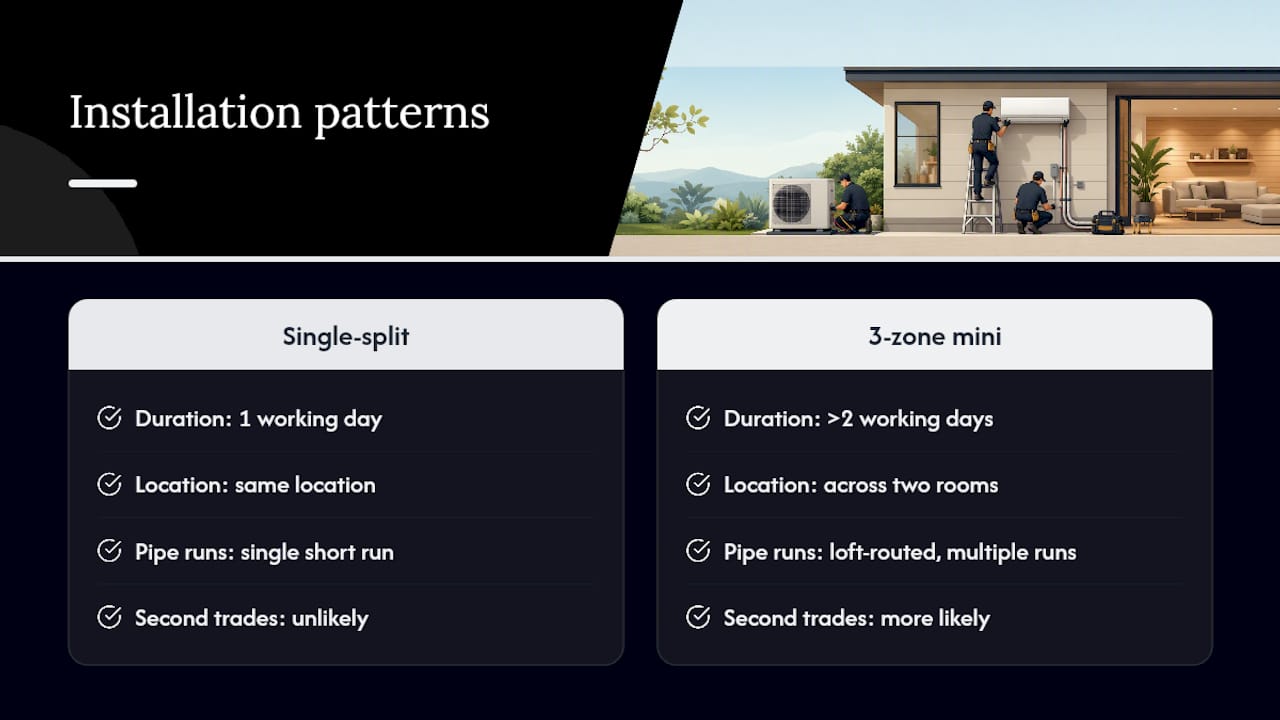
Two real patterns from our schedule: a straight replacement of an existing single-split system, same brand, same location, typically wraps in a single working day. A three-zone mini-split with loft-routed pipework across two rooms has run over two days more than once, purely because of the additional pipe runs per zone.
What a reasonable AC installation timeline actually looks like
Contractor estimates are only as good as what’s written down. If a quote gives you a single number with no range and no mention of contingency, ask why. A fair timeline includes a stated window (not a single figure), a clear note on who covers delay costs if an electrician turns out to be needed, and a commissioning checklist you get to see, not just hear about. Confirm delivery dates before you book time off work. None of this is difficult to ask for, and any installer worth hiring will already have the answers ready.
— Akita
Request a survey and fixed price quote from Akita
Some service providers replace the guesswork of a phone-quote estimate with an actual on-site survey, a fixed-price quote, and a commissioning report you can keep for warranty purposes.

That combination matters most on the jobs this article has covered: multi-zone installs, ductwork replacements, and older properties where an electrical upgrade might be hiding behind the wall. A survey catches those issues before installation day rather than during it, which is exactly where quoted timelines tend to fall apart. If you’re weighing up a straightforward swap against a fuller central system, Akita’s domestic air conditioning installation page covers both, and the fixed-price installation package gives you a clear cost and schedule before any work starts. Request your survey through either page to get a written timeline for your specific property, not a generic average.
Sources
- How Long Does AC Installation Take? What to Expect - Arthur Heating & Air
- How Long Does Air Conditioning Installation Take? (A Realistic Timeline) - WarmZilla®
- How long does it take to install an AC unit? Expert timelines & hidden factors
- The Air Conditioning Installation Process: What to Expect from Site Survey to Final Commissioning | Aboveboard Group
FAQ
What is the $5,000 rule for AC?
It’s a rule of thumb some contractors use to decide between repairing and replacing: multiply the age of your unit by the repair cost, and if the result exceeds a certain threshold, replacement is usually the better financial call rather than another repair.
What is the 3 minute rule for AC?
It refers to waiting at least 3 minutes after switching an AC unit off before turning it back on, giving internal pressure time to equalise so the compressor isn’t strained on restart. It applies to normal operation, not installation timing.
Can an AC unit be replaced in a day?
Yes, a direct swap of an existing unit for an equivalent new one, using the same ductwork and electrical setup, typically finishes the same day, usually within 4 to 8 hours of labour.
What should I expect when a new AC unit is installed?
Expect a site survey beforehand, then an installation day covering removal, mounting, pipework, and electrical connection, followed by commissioning: vacuum testing, leak checks, and refrigerant charging before final handover and a walkthrough of the system.
How long does a heat pump installation take?
A single-zone heat pump typically takes a similar 4 to 8 hours to a standard AC mini-split, while multi-zone systems or those needing electrical upgrades commonly run 1 to 2 days, following the same phases as central AC installation.