

Homeowners: Heat Pump Running Constantly? Triage Signs, Check Controls
Running for long stretches is normal for a well-sized heat pump, especially in cold weather when it holds a steady low output rather than cycling on and off like a boiler. It becomes a fault when the house never reaches the temperature you set it to, or when you notice ice building up on the outdoor unit or a smell suggesting a refrigerant leak. A handful of simple checks on the thermostat and airflow can usually rule out the easy causes before you pick up the phone.
TL;DR:
- Continuous long run times are normal in cold weather if the house reaches the set temperature and outdoor ice buildup or strange smells are absent.
- Faults such as incorrect thermostat settings, dirty filters, refrigerant leaks, or undersizing the system often cause prolonged operation and should be diagnosed promptly.
- Homeowner checks, including thermostat review, filter cleaning, and outdoor unit clearing, can identify common issues within ten minutes, but persistent problems require professional assessment.
- A heat pump never reaching the setpoint despite long runtimes indicates a deeper fault like refrigerant loss, sensor failure, or improper sizing, needing expert intervention.
- Improving efficiency involves modest setbacks, weather compensation, and regular maintenance, preventing unnecessary energy waste and prolonging system lifespan.
Table of Contents
- Signs to check if your heat pump never shuts off
- Common causes of continuous heat pump operation
- Quick homeowner checks you can do safely
- When continuous running is normal and when it isn’t
- When to call a professional and what they’ll check
- Energy costs and cutting unnecessary run time
- Commissioning and maintenance priorities
- Get a proper diagnosis instead of guessing
- Sources
- FAQ
Signs to check if your heat pump never shuts off
Before assuming the worst, work through what the system is actually doing. The pattern of symptoms tells you far more than the fact that it’s running.
- Indoor temperature: Does the house reach your setpoint and hold steady, or does it overshoot, undershoot, or never quite get there?
- Outdoor unit: Look for ice on the coil or casing, an unusually loud or grinding compressor noise, or a fan that has stopped turning while the compressor still runs.
- Airflow and vents: Weak air coming from registers, closed vents in occupied rooms, or a blocked return grille all force the system to work harder for longer.
- Thermostat behaviour: Check the mode (heat, auto, emergency heat), the schedule, and whether a smart thermostat is fighting the heat pump’s own controls. Any error code on the display is worth writing down before you call anyone.
If the house is warm and steady, you’re probably looking at normal long, low-output running. If it’s cold despite hours of runtime, that’s the signal worth chasing.
Common causes of continuous heat pump operation
Once you know which symptoms you’re dealing with, the likely cause usually narrows fast.
- Thermostat or control misconfiguration. Wrong mode, an overly ambitious setpoint, or a smart thermostat clashing with the heat pump’s own weather-compensated controller can all keep the compressor running well past the point it should have stopped.
- A dirty or blocked air filter. Restricted airflow makes the system work harder to move the same amount of heat, extending run times without improving comfort.
- Low refrigerant charge or a leak. A heat pump short on refrigerant struggles to transfer heat efficiently, so it runs longer for less output. This is one of the more common technical causes behind prolonged run times.
- Excessive defrosting. Some defrosting is normal in cold, damp weather. Frequent defrost cycles in mild conditions usually point to a sensor fault or refrigerant issue rather than the weather.
- Undersizing or poor commissioning. A heat pump specified too small for the property’s heat loss, or commissioned with the wrong flow temperatures, will chase the setpoint indefinitely. Most performance complaints trace back to design and installation issues rather than a faulty unit.
- Faulty sensors or a stuck reversing valve. Less common, but a failed temperature sensor or a reversing valve that won’t fully switch can leave the system stuck in an inefficient operating state.
Quick homeowner checks you can do safely
Work through these in order. Most take less than ten minutes each, and together they’ll rule out the causes that don’t need a technician.
- Check the thermostat mode, setpoint, and any programmed schedule. Switch it off and back on to clear a stuck instruction.
- Replace or clean the air filter, and check that vent registers around the house are open and unobstructed.
- Walk out to the outdoor unit. Clear leaves, snow, or debris from around it, and look for ice on the coil.
- Note any unusual sounds, then watch whether the system settles into a normal cycle over the next 30 to 60 minutes after your reset.
- Stop and call a professional if you smell refrigerant, see ice that won’t clear, or the display shows an error code. A heat pump not heating properly after these checks is a job for an engineer, not another reset.
Pro Tip: Write down what time you did the filter check and outdoor unit clear. If you end up calling an engineer, telling them “still running two hours after I cleared the outdoor unit” saves them a diagnostic step and you money on the call-out.
When continuous running is normal and when it isn’t
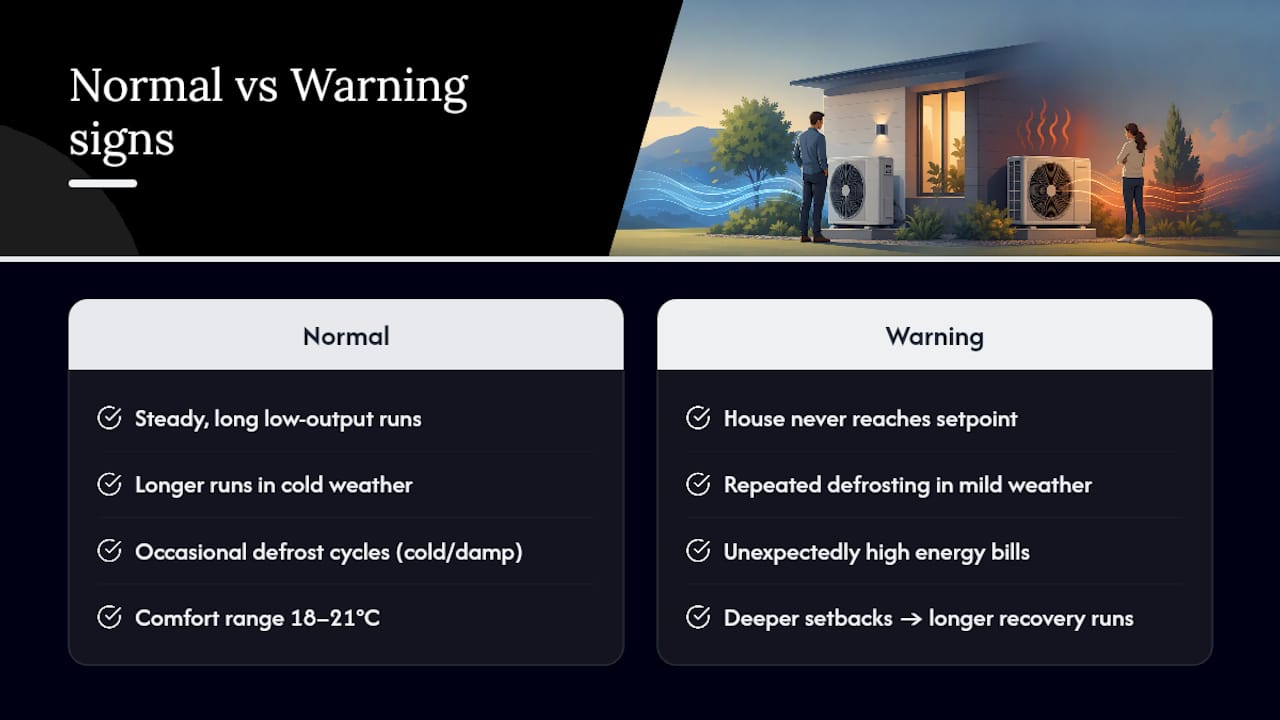
Heat pumps aren’t built to fire up, blast heat, and switch off the way a gas boiler does. They’re designed to run steadily at a lower output for longer periods, which is usually the more efficient way to hold a house at a comfortable temperature.
In cold weather, expect longer run times as standard. You’ll also see occasional defrost cycles, where the system briefly pauses heating to clear ice from the outdoor coil. This is expected behaviour in cold, damp conditions, not a malfunction.
The red flags are different: a house that never reaches setpoint no matter how long the system runs, defrosting happening repeatedly in mild weather, or a bill that’s climbed well beyond what the outside temperature would explain. On setpoints, most homes sit comfortably between 18°C and 21°C, and a modest 1 to 2°C setback overnight is sensible. Deeper setbacks often backfire, forcing the system into a longer, harder recovery run the next morning.
When to call a professional and what they’ll check
Book an engineer if you smell refrigerant, see ice that keeps returning after you clear it, get a persistent error code, the house won’t reach setpoint despite hours of running, or your bill jumps sharply with no obvious explanation.
A qualified engineer visiting for this kind of fault will typically look at:
- Refrigerant pressure and leak detection across the circuit.
- Control integration and thermostat wiring, checking for conflicts between a smart thermostat and the heat pump’s own controller.
- Flow temperatures and whether weather compensation is set up correctly.
- Sensor function, compressor operation, and fan diagnostics on the outdoor unit.
- Siting and airflow around the outdoor unit, and whether the system was sized correctly for the property in the first place.
It’s worth mentioning to them if the property has had recent retrofit work, since undersized hot water coils can quietly force a heat pump to prioritise tank heating over space heating, mimicking an “always-on” fault. Bring runtime notes, your thermostat schedule, and a couple of photos of the outdoor unit. It speeds up the visit considerably.
Energy costs and cutting unnecessary run time
Inefficient cycling costs more than steady running. A heat pump fighting a blocked filter, a refrigerant leak, or a badly tuned weather compensation curve burns more electricity for less heat delivered, and that shows up on the bill within a billing cycle or two.
A few adjustments help without risking the system:
- Use modest setbacks of 1 to 2°C rather than switching the system off entirely.
- If you’re on a time-of-use electricity tariff, shift non-essential loads (not core heating) to cheaper periods where your system allows it.
- Leave weather compensation switched on and let the installer set sensible flow temperatures rather than running everything at maximum.
- Avoid emergency or boost heat modes unless genuinely needed. Owners who flip into boost mode out of frustration typically end up paying more than if they’d left the system to run steadily.
- Keep the outdoor unit clear and radiators or emitters unobstructed for the airflow the system needs.
Efficiency context: heat pumps transfer heat rather than generating it from scratch, which is why they can remain effective even at low outdoor temperatures, unlike a system relying purely on resistive heating.
Commissioning and maintenance priorities
A heat pump that runs constantly and never keeps the house warm almost always traces back to how it was sized and set up, not the unit itself. A proper heat-loss survey and correct commissioning prevent most chronic cases before they start. Routine maintenance, catching a dirty filter, a slow refrigerant leak, or a control conflict early, stops small issues becoming expensive ones.
— Akita
Get a proper diagnosis instead of guessing
If you’ve worked through the checks above and the heat pump is still running flat out without warming the house, it’s time for a proper look rather than another reset. Akita’s air source heat pump diagnostic visit checks refrigerant pressure, control settings, sizing, and outdoor unit siting in one call, so you get an actual answer rather than another guess.
Where the fault turns out to be low refrigerant, a control conflict, or a filter that’s been neglected for months, that’s usually fixable on the same visit. For homes that keep running into the same issues every winter, the Comfort Club membership covers ongoing servicing that catches these faults before they turn into a cold house and a high bill. If your system is struggling to hold temperature at all and you suspect it was never sized correctly, Akita’s air conditioning maintenance service can review the original commissioning as part of the visit. Book a diagnostic call and get the runtime notes ready, the engineer will want them.
Sources
- Air Source Heat Pump Problems: 7 Common Issues & Fixes (UK 2026) | PumpSwap UK
- Should I leave my air source heat pump on all the time? — Libtek
- Why is my heat pump constantly running? | Viessmann
- Heat pumps: how they work, costs and savings - Energy Saving Trust
FAQ
How many hours a day should a heat pump run?
There’s no fixed number. It depends on outdoor temperature, house insulation, and system sizing, and a well-matched heat pump can run for most of a cold day at low output without that being a problem. What matters more than the hours is whether the house reaches and holds your setpoint comfortably.
Why does my heat pump never seem to stop running?
Usually it’s either normal steady operation in cold weather, or a fault like a dirty filter, low refrigerant, or a thermostat and control conflict. Check whether the house is actually reaching temperature. If it is, the system is likely doing exactly what it’s designed to do.
What is the 20 degree rule for heat pumps?
There’s no single official rule about a specific temperature setpoint. Some installers suggest keeping the setpoint at a comfortable temperature and avoiding large temperature swings, since heat pumps recover from a big overnight setback more slowly and less efficiently than a boiler would. A modest 1 to 2°C setback is a safer guideline than a strict number.
Is it normal for a heat pump to run 20 hours a day?
In very cold weather, yes, that can be normal for a correctly sized system running in its efficient long, low mode. If it’s running that long and the house still isn’t warm, or it’s mild outside and the system is still working nearly non-stop, that points to a fault worth having checked by a professional.