

The homeowner's guide to energy-efficient system upgrades
Six upgrades deliver most of the savings available to a typical home: air sealing and insulation, an efficient heating and cooling system (usually a heat pump), efficient water heating, tighter windows and doors, smart controls with LED lighting, and solar where the roof orientation and shading make it effective. The right first move isn’t buying equipment. It’s booking a home energy audit or a blower-door test, so you know exactly where the money is leaking out before you spend a cent replacing it.
ENERGY STAR and the U.S. Department of Energy both frame this as a coordinated package rather than a shopping list, and the sequencing matters: envelope work first, mechanical systems second, renewables last.
- Envelope: attic insulation, air sealing, duct sealing, window and door upgrades with ENERGY STAR-rated units
- Mechanical systems: heat pump or high-efficiency HVAC, heat-pump water heater (recognized energy-efficient options)
- Controls: smart thermostat, LED lighting
- Renewables: solar PV, battery storage where the economics support it
Key Takeaways
Sequencing beats spending: tightening the building envelope before installing new heating and cooling equipment produces better performance and a smaller, cheaper system overall.
| Point | Details |
|---|---|
| Audit first | Book a home energy audit or blower-door test before buying any equipment. |
| Envelope before mechanicals | Insulate and air-seal the building before replacing heating or cooling systems. |
| Heat pumps need sizing | Get a heat-loss calculation and correct commissioning before installing a heat pump. |
| Quick wins add up | LED lighting and smart thermostats pay back almost immediately with minimal disruption. |
| Akita for installation | Akita offers fixed-price quotes, financing, and maintenance memberships for heat pump and AC installs across Suffolk, Norfolk, and Essex. |
Table of Contents
- High-impact upgrades at a glance
- Building envelope: insulation, air sealing and windows
- Heating and cooling: heat pumps, efficient furnaces and ductwork
- Water heating: efficient options and small wins
- Renewables and storage: solar PV and batteries — when they pay
- Controls and lighting: smart thermostats, LEDs and behavioural controls
- How to prioritise upgrades and plan a retrofit
- Incentives, rebates and financing: how to reduce upfront cost
- Practical implementation checklist and budget guide
- Why a qualified installer matters
- What actually moves the needle
- Get your upgrade plan started with Akita
- Frequently asked questions
- Sources
High-impact upgrades at a glance
Not every upgrade earns its keep at the same rate, and disruption varies enormously. Here’s how the main options stack up when you weigh impact against hassle and cost.
- Attic insulation and air sealing — low disruption, high impact, usually the best return on investment in the whole house.
- Duct sealing — low to medium disruption; leaky ducts routinely waste conditioned air before it reaches a single room.
- Heat pump replacing an ageing furnace or AC — high impact, medium to high disruption, but transforms your running costs for the next 15 to 20 years.
- Window replacement — medium disruption, variable return; often better to draught-proof first and replace only genuinely failing units.
- Solar PV — high upfront capital, long-term value, best sized after other efficiency work is done.
Space and water heating together account for a large share of the energy a typical American home consumes, according to EIA data, which is exactly why envelope and heating upgrades sit at the top of this list rather than at the bottom. Quick wins matter too: switching your most-used fixtures to LEDs and fitting a smart thermostat can shave money off your bill within the first billing cycle, long before any bigger project breaks ground.
Building envelope: insulation, air sealing and windows
Get the envelope right before you touch anything mechanical. The Department of Energy is blunt about this: air sealing and insulation are the foundational measures that determine how hard your heating and cooling system has to work afterwards. Skip this step and even the best heat pump on the market will underperform.
Start with diagnostics, not demolition. A blower-door test pressurises your home and reveals exactly where air is escaping, while thermographic imaging shows the cold spots where insulation has failed or never existed. Both tests turn guesswork into a target list.
- Top up loft insulation to current recommended depths, or switch to blown-in cellulose or fibreglass for full coverage in awkward joists.
- Choose cavity-wall insulation where the wall type allows it; solid-wall homes usually need internal or external insulation boards instead.
- Draught-proof energy-efficient doors and windows before assuming you need full replacements.
- Replace only the windows that are genuinely failing, and look for ENERGY STAR-rated units, which outperform older single-pane glass by a wide margin.
- Seal and insulate ductwork running through unconditioned spaces such as attics and crawl spaces, since leaky ducts bleed conditioned air before it ever reaches a vent.
Pro Tip: Sequence matters. Insulate and air-seal before you invest in a new heat pump. A tighter building envelope lets you install a smaller, cheaper unit that runs more efficiently, rather than oversizing an expensive system to fight drafts it shouldn’t have to.
Heating and cooling: heat pumps, efficient furnaces and ductwork
A heat pump moves heat rather than generating it, which is why it can deliver several units of heating or cooling energy for every unit of electricity it consumes. DOE guidance is clear that both air-source and ground-source heat pumps outperform fossil-fuel boilers and old-style electric resistance heating in most climates, especially once the building envelope has already been tightened.
Sizing is where projects go wrong. An oversized unit short-cycles, wastes energy, and wears out faster; an undersized one can’t keep up on the coldest or hottest days. Ask any installer for a proper heat-loss calculation, not a rule-of-thumb estimate based on square footage alone, and check the equipment’s rated efficiency (COP for heating, SEER for cooling) against your climate zone before signing anything.
- Get a heat-loss calculation and a full home survey before choosing equipment size or type.
- Ask about correct commissioning, since a poorly commissioned heat pump can underperform its rated efficiency for years.
- Pair the new system with duct sealing and zoning controls, which recapture efficiency that a single old thermostat and leaky ductwork were quietly losing.
For homeowners weighing a like-for-like AC swap against a full heat pump conversion, this comparison of eco-friendly HVAC upgrades walks through real-world configurations worth considering.
Water heating: efficient options and small wins
Heat-pump water heaters pull ambient heat from the surrounding air rather than generating it directly, which is why the Department of Energy flags them as one of the most effective upgrades for hot-water energy use. They need a bit of clearance in a garage or utility space to draw air efficiently, so check that before you buy.
If a full replacement isn’t in this year’s budget, smaller fixes still help:
- Insulate the tank and lag exposed hot-water pipes.
- Lower the thermostat setting to around 120°F, which cuts standby losses without sacrificing comfort.
- Fit low-flow fixtures on showers and taps.
- Size any replacement unit against your household’s actual usage pattern, not just tank capacity.
Renewables and storage: solar PV and batteries — when they pay
Solar only pays off properly on a roof with decent southward or westward orientation and minimal shading, so a structural and shading check should come before any quote. Batteries make the most sense either for shifting self-generated power into evening use or for backup resilience during outages, rather than as a blanket recommendation for every household.
Here’s the part installers don’t always volunteer: doing your envelope and heating upgrades first shrinks the size of solar array you actually need. A smaller system costs less upfront and pays back faster, so tackling insulation before panels isn’t just sequencing advice, it’s a direct cost saving on the renewables budget itself.
- Check roof orientation, pitch and shading before requesting a solar quote.
- Treat batteries as a resilience or self-consumption tool, not a default add-on.
- Reduce overall demand through efficiency work first, then size solar and storage to match the smaller load.
Controls and lighting: smart thermostats, LEDs and behavioural controls
Smart thermostats and LED lighting are the cheapest upgrades on this entire list, and they start paying back almost immediately. A thermostat that learns your schedule, or one you programme yourself with sensible setback temperatures, routinely trims heating and cooling runtime without you noticing any drop in comfort.
- Replace your most-used fixtures with LEDs first; that’s where the payback is fastest.
- Set realistic thermostat schedules rather than manually adjusting the dial throughout the day.
- Use occupancy sensors in rooms that sit empty for long stretches.
Pro Tip: Pair scheduling with occupancy sensors in spare rooms and hallways. It’s a small change that quietly stops you paying to heat or cool space nobody’s using.
How to prioritise upgrades and plan a retrofit
Piecemeal spending is the most common mistake homeowners make: a new window here, a smart plug there, with no coherent plan tying it together. A proper retrofit follows a decision flow, not a wish list.
- Book a home energy audit or blower-door test to find where energy is actually being lost.
- Prioritise envelope measures first: insulation, air sealing, duct sealing.
- Get a heat-loss calculation before choosing heating and cooling equipment.
- Collect itemised quotes, and ask each installer for a projected savings figure per measure, not just a total price.
- Phase the work over the year rather than trying to fund everything at once.
Weigh comfort improvements alongside payback period. Some measures, like sealing draughty gaps around doors, pay back in months but rarely feel dramatic; others, like a heat pump conversion, cost more upfront but significantly improve comfort and running costs.
Pro Tip: Ask installers to bundle measures where they can. Combining duct sealing with a heat pump installation, or attic insulation with air sealing, often costs less than hiring separate crews for each job.
Incentives, rebates and financing: how to reduce upfront cost
Start at ENERGY STAR and your state energy office for the current federal tax credits and utility rebates available in your area. Programmes like NYSERDA’s efficiency initiatives show the kind of region-specific support many states now offer, from weatherisation grants to rebates tied to specific equipment.
- Check federal tax credits and state-level rebate programmes before finalising any quote.
- Ask your installer to document eligibility in writing, since rebate rules often hinge on specific equipment ratings.
- Compare financing routes: on-bill repayment, PACE financing where it’s available locally, and zero or low-interest loans through utilities or installers.
- Point-of-sale financing offers can reduce the cash needed upfront, but read the term length against the equipment’s expected lifespan.
Practical implementation checklist and budget guide
Most homeowners can move from audit to finished project inside 6 to 12 months if they phase the work sensibly rather than waiting to fund everything simultaneously.
- Book an energy audit or blower-door test.
- Tackle air sealing and insulation first.
- Get heat-loss calculations and quotes for heating and cooling equipment.
- Schedule mechanical installation, then commissioning checks.
- Add smart controls and LED lighting.
- Revisit solar sizing once demand has dropped.
Rough budget bands vary by region and home size, but attic insulation typically sits at the lower end of a retrofit budget, heat pump installation in the middle, and solar toward the top given panel and inverter costs. Treat any figure a contractor gives you as an estimate until you have a written, itemised quote. On installation day, ask for a visible commissioning check: airflow readings, refrigerant charge verification for heat pumps, and a walkthrough of the new thermostat settings before the crew leaves.
Why a qualified installer matters
Correct sizing and commissioning are what separate a heat pump that performs efficiently from one that underperforms. Duct sealing done alongside a system upgrade only pays off if it’s done properly, which is why accreditation and warranty backing matter as much as the equipment brand.
- Ask any installer for their accreditation, warranty terms, and a written heat-loss calculation before signing.
- Akita provides quotes and financing options across Suffolk, Norfolk, and Essex, alongside maintenance memberships to keep systems running efficiently.
- A domestic air conditioning survey is the practical next step if you’re weighing a heat pump or AC upgrade.
What actually moves the needle
Homeowners tend to reach for the most visible upgrade first, usually windows or solar panels, because they’re the ones you can see and show off. That’s the wrong order. The unglamorous stuff, attic insulation, duct sealing, air sealing around doors and rim joists, delivers more savings per dollar spent and makes every upgrade after it work better.
The conventional advice to “get quotes for a heat pump” skips a step that changes the outcome: get the heat-loss calculation first, so the quotes you receive are for equipment actually sized to your tightened house, not to the leaky one you’re about to fix. Skipping this is how homeowners end up with an oversized, expensive unit that short-cycles for fifteen years.
If there’s one thing worth doing differently from what most guides suggest, it’s resisting the urge to solve everything with a bigger, smarter piece of equipment. Fix the box first. Then choose what heats and cools it.
Get your upgrade plan started with Akita
Akita is the practical route to acting on this guide rather than just reading it. Where a national programme can point you toward what to upgrade, Akita is the Suffolk, Norfolk, and Essex installer that actually surveys your home, sizes the equipment correctly, and gets it commissioned to run at its rated efficiency, backed by transparent fixed pricing and flexible financing rather than a vague estimate.
Whether you’re weighing a heat pump conversion, need duct sealing alongside a new system, or want an ongoing maintenance membership to keep everything running efficiently after installation, Akita handles the survey-to-commissioning process directly. Start with a domestic air conditioning installation quote to see fixed pricing for your home, or check the fixed-price 2.5kW installation if you’re sizing up a smaller room first.
Frequently asked questions
What is the single best first step in a guide to energy-efficient system upgrades? Book a home energy audit or blower-door test. It identifies exactly where your home loses energy, so every upgrade after it targets a real problem instead of a guess.
Should I insulate before replacing my heating system? Yes. The Department of Energy treats air sealing and insulation as foundational, and a tighter envelope means you can install a smaller, less expensive heat pump that runs more efficiently.
Are heat pumps worth it in every climate? Heat pumps perform best in well-insulated homes and now cover a wide range of climates, but DOE guidance recommends a proper heat-loss calculation before choosing a specific system for your region.
How do I find rebates for energy-efficient upgrades? Start with ENERGY STAR and your state energy office; programmes like NYSERDA list region-specific rebates and financing options.
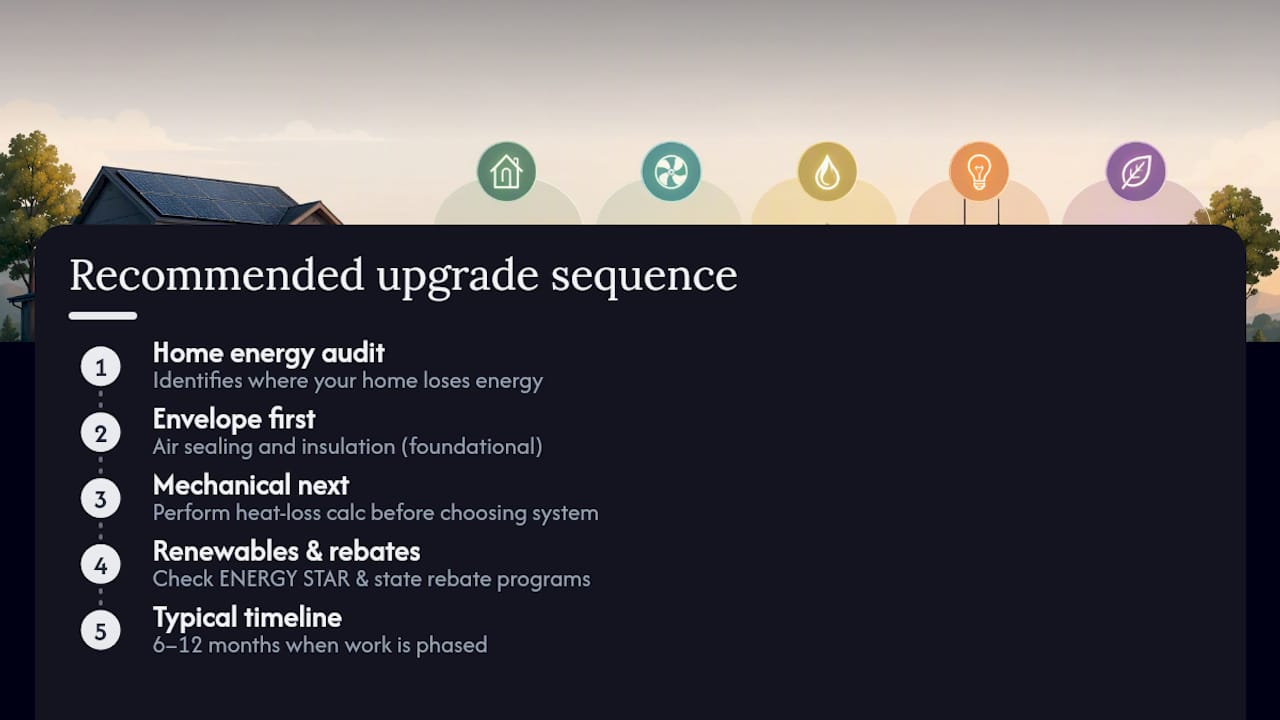
How long does a full home energy retrofit take? Most homeowners move from audit to completed upgrades within 6 to 12 months when the work is phased: envelope first, mechanical systems next, renewables last.