

Why choose inverter air conditioners: a 2026 guide
TL;DR:
- Inverter air conditioners use a variable-speed compressor to provide consistent temperatures while saving up to 50% energy. They last longer, operate more quietly, and maintain tighter temperature control compared to traditional units. The higher initial cost is offset by faster payback periods and environmental benefits for regular users.
An inverter air conditioner is a cooling and heating system that uses a variable-speed compressor to deliver consistent temperatures while consuming 30–50% less electricity than traditional fixed-speed units. That single fact makes inverter technology the most cost-effective choice for any homeowner or business running air conditioning for more than a few hours each day. Unlike conventional models that switch their compressor fully on or fully off, inverter units modulate speed continuously, which eliminates the energy spike every time the system starts. The result is quieter operation, steadier indoor temperatures held within ±0.5–1°C, and a unit that lasts significantly longer. For anyone evaluating why choose inverter air conditioners, the answer sits squarely in those three outcomes: lower bills, greater comfort, and a longer service life.
Why choose inverter air conditioners: how the technology works
The compressor is the heart of any air conditioning unit. In a conventional fixed-speed system, the compressor runs at full power until the room hits the target temperature, then cuts out completely. When the temperature drifts, it restarts at full power again. That cycle repeats dozens of times per hour.
An inverter compressor works differently. Think of it like a dimmer dial rather than a light switch. Instead of snapping between fully on and fully off, the compressor adjusts its speed continuously to match exactly how much cooling or heating the room needs. When the room is nearly at the right temperature, the compressor slows right down rather than switching off. That slow, steady operation is where the energy savings come from.
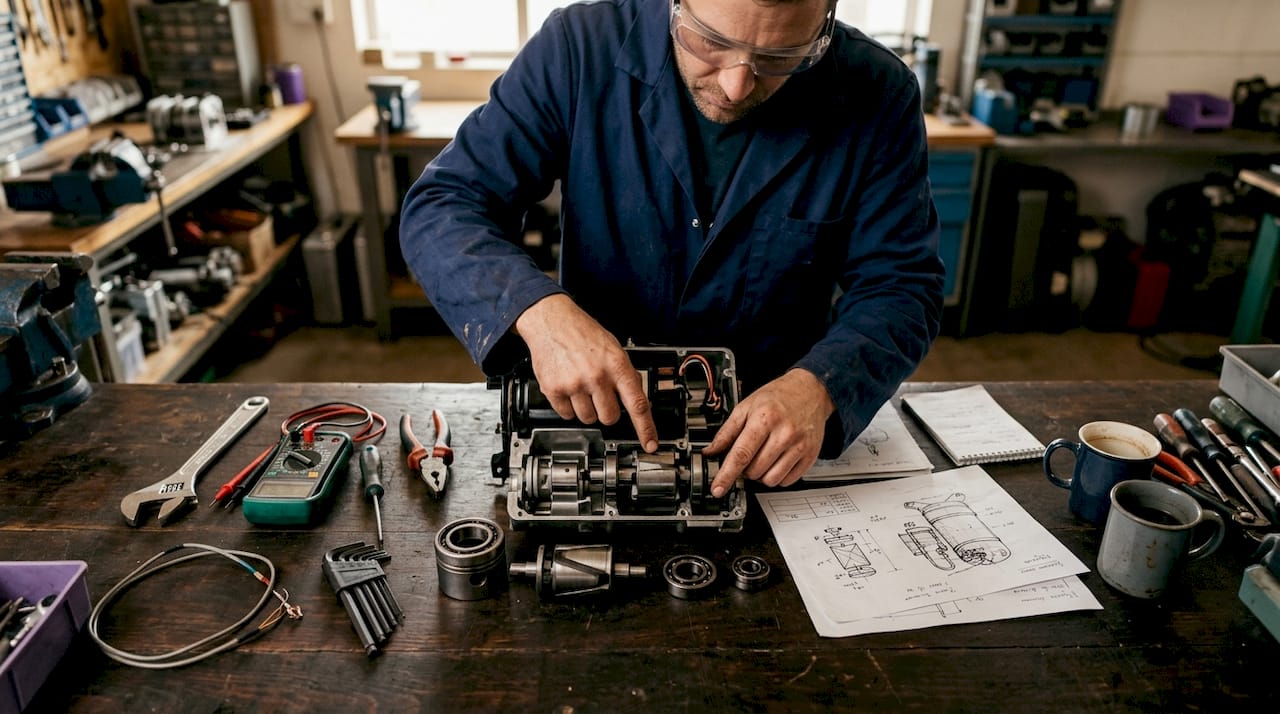
The start-up phase of any electric motor draws the most power. A fixed-speed compressor triggers that high-draw start dozens of times per day. An inverter compressor avoids most of those hard starts entirely. Less mechanical stress also means less wear on internal components, which directly contributes to a longer operational life.
One common misconception is worth addressing directly. The word “inverter” leads many people to assume these units provide battery backup during a power cut. They do not. Inverter refers solely to compressor speed modulation, not to any form of emergency power supply. The name comes from the electronic inverter circuit that converts power to control motor speed.
Pro Tip: If noise is a concern in a bedroom or home office, check the unit’s decibel rating before buying. Inverter models typically run at 26–32 dB, which is close to a whisper. That figure matters far more than headline cooling capacity for rooms where people sleep or concentrate.
Inverter vs traditional AC: a direct comparison
The differences between inverter and non-inverter units show up across every dimension of daily use. Energy consumption is the most significant. Inverter ACs use 30–50% less electricity than their fixed-speed counterparts. For a household or business running air conditioning through a British summer and into autumn, that reduction translates into a meaningful drop in energy bills each year.
Temperature control is the second major difference. Non-inverter units allow indoor temperatures to swing by ±2–3°C before the compressor kicks back in. Inverter units hold the room within ±0.5–1°C of the set point. In a bedroom, that difference is the gap between sleeping soundly and waking up too warm.
Noise is the third area where inverter technology pulls ahead. Fixed-speed compressors generate 35–42 dB during operation. Inverter units run at 26–32 dB. That gap of roughly 10 dB is not subtle. Human hearing perceives a 10 dB reduction as approximately half as loud.
Key differences at a glance
| Feature | Inverter AC | Non-inverter AC |
|---|---|---|
| Energy consumption | 30–50% lower | Baseline |
| Temperature stability | ±0.5–1°C | ±2–3°C |
| Noise level | 26–32 dB | 35–42 dB |
| Lifespan | 10–12 years | 6–8 years |
| Upfront cost | Higher (approx. 20–30% more) | Lower |
| Repair complexity | Higher (specialist parts) | Lower |
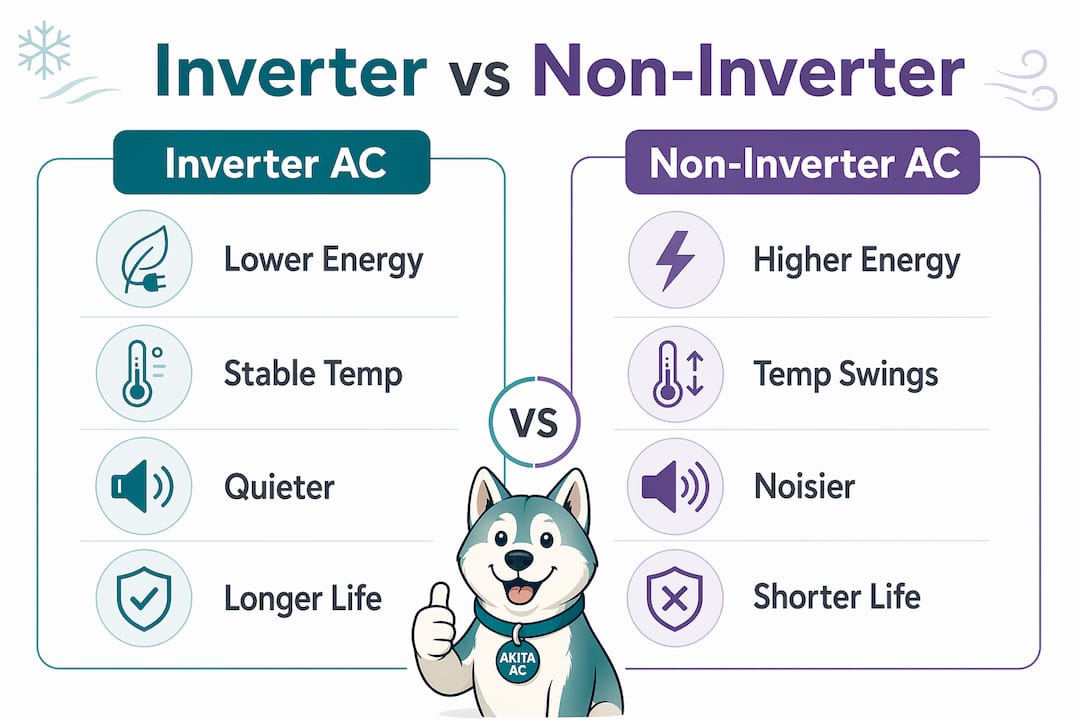
The lifespan difference is particularly relevant for long-term planning. Inverter units last 10–12 years compared to 6–8 years for non-inverter models. Over a 12-year period, a homeowner with a non-inverter unit may need to replace the system entirely, while an inverter owner is still running the original installation.
Repair costs for inverter units are higher when something does go wrong. The electronic circuit boards that control compressor speed require specialist technicians and are more expensive to source than the simpler components in fixed-speed systems. The trade-off is that inverter compressors fail less often. Fewer hard starts mean less mechanical stress, so the need for repairs arises less frequently over the unit’s life.
Environmental and economic benefits of inverter ACs in 2026
The environmental case for inverter air conditioning has strengthened considerably as refrigerant standards have evolved. Modern inverter units are increasingly paired with R32 refrigerant, which carries a significantly lower Global Warming Potential than older refrigerants such as R410A. That combination of reduced electricity consumption and lower-impact refrigerant makes inverter technology the most environmentally responsible choice available in the residential and commercial AC market today.
Reduced electricity consumption has a direct environmental effect. The UK’s electricity grid still carries a carbon intensity that varies by time of day and season. Any system that draws less power from the grid produces fewer associated carbon emissions. An inverter AC running at partial load for several hours produces far less grid demand than a fixed-speed unit cycling on and off at full power.
The economic picture is equally clear. Energy prices in the UK have risen sharply over recent years and show no sign of returning to pre-2021 levels. A system that cuts electricity consumption by up to half delivers proportionally greater savings as unit prices rise. The SEER rating (Seasonal Energy Efficiency Ratio) is the standard metric used to compare this performance. Higher SEER values indicate better efficiency, and inverter units consistently achieve higher SEER ratings than fixed-speed equivalents at the same cooling capacity.
For businesses, the environmental argument also carries reputational weight. Organisations with sustainability commitments find that energy-efficient HVAC systems contribute directly to measurable reductions in operational carbon footprint, which supports reporting under frameworks such as the UK’s Streamlined Energy and Carbon Reporting requirements.
How to decide if an inverter AC is right for you
The inverter AC advantages are real, but they are not equally relevant to every situation. Usage duration is the single most important factor in the decision.
Inverter units deliver their energy savings by running continuously at low speed rather than cycling. That benefit only accumulates when the unit is actually running. For users running AC for four or more hours daily, the payback period on the higher upfront cost typically falls within 12–24 months. For occasional use of two hours or less per day, a lower-cost fixed-speed unit may take far longer to pay back the price difference, if it ever does.
The practical questions to work through before buying:
- How many hours per day will the unit run? Four or more hours daily makes an inverter unit the clear choice on cost grounds alone.
- Where will the unit be installed? Bedrooms, home offices, and meeting rooms benefit most from the noise reduction and temperature stability that inverter technology provides.
- What is the budget for installation? Inverter units cost roughly 20–30% more upfront. That premium is recovered through energy savings, but the initial outlay must be manageable.
- Who will service the unit? Inverter systems need regular HVAC maintenance from engineers familiar with variable-speed electronics. Confirm that qualified service is available in your area before committing.
- What are the noise requirements? If the unit will run near sleeping areas or quiet workspaces, the 26–32 dB operating range of an inverter model is a genuine quality-of-life advantage.
Pro Tip: Ask your installer for the SEER rating of any unit you are considering. A higher SEER rating means lower running costs. For UK homes and offices, a SEER rating above 6.1 qualifies as high efficiency under current European-derived standards still applied in the UK market.
Avoid the assumption that any inverter AC will work on a home UPS during a power cut. The inverter label on an air conditioner refers to the compressor control circuit, not to battery storage. Running an AC unit from a domestic UPS is not feasible for most households.
Key takeaways
Inverter air conditioners deliver lower running costs, quieter operation, and a longer service life than fixed-speed units, making them the better choice for any property where air conditioning runs for four or more hours daily.
| Point | Details |
|---|---|
| Energy savings are substantial | Inverter ACs use 30–50% less electricity than non-inverter models, cutting annual bills significantly. |
| Temperature control is tighter | Inverter units hold indoor temperature within ±0.5–1°C, compared to ±2–3°C for fixed-speed systems. |
| Noise levels are lower | Inverter compressors run at 26–32 dB, roughly half as loud as the 35–42 dB of non-inverter units. |
| Payback period is 12–24 months | For users running AC four or more hours daily, the higher upfront cost is typically recovered within two years. |
| Lifespan is longer | Inverter units last 10–12 years versus 6–8 years for non-inverter models, reducing replacement frequency. |
Akita’s view: the upfront cost argument is largely settled
The debate about whether inverter air conditioners justify their higher purchase price used to be genuinely open. It is not any more. At current UK energy prices, the payback period for most residential and commercial installations falls well within two years for anyone running their system regularly. After that point, every year of operation is net saving compared to running a fixed-speed alternative.
What I find more interesting is the comfort argument, which tends to get less attention than the energy numbers. The difference between a room held at ±0.5°C and one swinging by ±3°C is not abstract. It is the difference between a bedroom that stays comfortable through the night and one that wakes you up. For offices and retail spaces, consistent temperature directly affects how long customers and staff stay comfortable. That has a value that does not appear on an energy bill but is very real.
The environmental dimension matters too, and not just for businesses with formal reporting obligations. Pairing an inverter unit with R32 refrigerant and a high SEER rating is one of the most straightforward steps a homeowner can take to reduce the carbon footprint of their property. The technology exists, the payback is fast, and the comfort improvement is immediate.
My advice to anyone still on the fence: look at your air conditioning options with a 10-year horizon, not a purchase-day horizon. The unit that costs slightly more today is almost certainly the one that costs less overall.
— Akita
Akita installs inverter air conditioning across Suffolk, Essex, and Norfolk
Choosing the right technology is only half the decision. The quality of the installation determines how well that technology performs over its lifetime.
Akita installs domestic inverter AC systems across Suffolk, Essex, and Norfolk, with fixed-price quotes so there are no surprises on the day. For businesses, Akita’s commercial air conditioning service covers everything from single-room office installations to multi-zone commercial builds. Every installation is carried out by qualified engineers who understand variable-speed systems and can advise on the right unit size and SEER rating for your specific space. If you are ready to move forward, Akita’s team is available to assess your property and provide a clear, transparent quote.
FAQ
What are inverter air conditioning units?
Inverter air conditioning units use a variable-speed compressor that adjusts its output continuously rather than switching fully on or off. This allows the system to maintain a steady temperature while consuming significantly less electricity than fixed-speed alternatives.
How much energy do inverter ACs save?
Inverter air conditioners consume 30–50% less electricity than non-inverter models. The savings are greatest when the unit runs for four or more hours per day, with most installations recovering the higher upfront cost within 12–24 months.
Are inverter ACs quieter than standard units?
Inverter units operate at 26–32 dB, compared to 35–42 dB for non-inverter models. That difference makes inverter systems noticeably quieter, which is particularly valuable in bedrooms, home offices, and meeting rooms.
Do inverter air conditioners work as a backup power source?
No. The term “inverter” refers to the electronic circuit that controls compressor speed, not to any battery or backup power function. An inverter AC requires a standard mains supply to operate and cannot run a property during a power cut.
How long do inverter air conditioners last?
Inverter units typically last 10–12 years, compared to 6–8 years for non-inverter models. The extended lifespan comes from reduced mechanical wear, as the compressor avoids the repeated hard starts that cause stress in fixed-speed systems.