

F-gas compliance explained: UK guide for businesses
F-gas compliance is the set of statutory duties that operators, businesses and certificated technicians in the UK must follow to contain, record, recover and phase down fluorinated greenhouse gases used in refrigeration, air conditioning and heat pump equipment. If you operate, install or service any system containing F-gases in Great Britain, these obligations apply to you now, and the most urgent first step is to audit your refrigerant charges and confirm that every person handling refrigerant holds the correct individual qualification.
The principal legal instruments are the retained Regulation (EU) No 517/2014 as it applies in Great Britain, the Fluorinated Greenhouse Gases Regulations 2015 (SI 2015/310) and subsequent amendments. Policy sits with the Department for Environment, Food and Rural Affairs (Defra); enforcement in England falls to the Environment Agency, with the Scottish Environment Protection Authority (SEPA) covering Scotland and Natural Resources Wales (NRW) covering Wales.
Before reading further, run through these five checks:
- Charge size: identify the refrigerant type and charge weight (in CO₂-equivalent tonnes) for every system you control.
- Certification: confirm each technician holds a valid individual Category I, II, III or IV qualification for the activities they perform.
- Leak checks: verify that scheduled leak checks are in place and documented for every system at or above the 3 kg threshold.
- Records: check that you hold at least five years of maintenance logs, leak-check results and gas-quantity records.
- Recovery: confirm that any refrigerant removed from a system is handled by certificated personnel and disposed of through a licensed route.
Key takeaways
F-gas compliance in Great Britain requires operators to contain, record, recover and phase down fluorinated greenhouse gases under the retained Regulation (EU) No 517/2014 and the Fluorinated Greenhouse Gases Regulations 2015, with enforcement by the Environment Agency, SEPA and NRW.
| Point | Details |
|---|---|
| Audit your refrigerant charges first | Identify every system’s refrigerant type and charge size to determine which leak-check frequency and record-keeping obligations apply. |
| Individual certificates are personal and mandatory | Every technician must hold their own Category I–IV qualification; a company certificate does not substitute for individual certification. |
| Keep five years of records per system | Logs must include leak-check dates, technician certificate numbers, gas quantities added or recovered, and waste transfer documentation. |
| Quota risk is real for importers and producers | Placing bulk HFCs on the GB market without Environment Agency quota risks customs holds and civil penalties. |
| Akita provides certificated installation and servicing | Akita’s qualified engineers cover Suffolk, Norfolk and Essex, delivering compliant installations with full documentation from day one. |
Table of Contents
- What is F-gas compliance: the legal framework in Great Britain
- Who must comply: operators, businesses and certificated personnel
- Operational obligations and charge-size thresholds
- Personnel and company certification: categories, bodies and how to get certified
- A step-by-step compliance checklist for operators and business owners
- Enforcement, penalties and the compliance failures that trigger them
- HFC phasedown, the quota system and what it means for purchasing and servicing
- Where to find official guidance, certification bodies and regulator contacts
- Akita’s perspective on compliance and operational continuity
- Compliant HVAC installation and servicing in Suffolk, Norfolk and Essex
- Sources
What is F-gas compliance: the legal framework in Great Britain
The substantive rules come from Regulation (EU) No 517/2014, retained in domestic law after EU Exit and applied in Great Britain through the Fluorinated Greenhouse Gases Regulations 2015 and a series of amending statutory instruments. Northern Ireland operates under a separate arrangement aligned with EU rules; this article covers Great Britain only.
Defra sets policy and publishes guidance. The Environment Agency administers the quota system and leads enforcement in England. SEPA and NRW hold equivalent powers in Scotland and Wales respectively. HMRC handles trade controls at the border, including import and export of bulk HFCs subject to quota.
The retained Regulation covers four broad areas: containment and leak checking, recovery and reclamation, certification of personnel and companies, and the HFC phasedown quota system. Each area carries its own obligations, thresholds and record-keeping requirements. The Gov is the single most reliable starting point for operators, producers and traders who need to locate the specific information sheets and application forms relevant to their situation.
Phasedown context: The retained Regulation sets a phasedown mechanism that progressively reduces the total quantity of HFCs that producers and importers may place on the GB market, expressed as CO₂-equivalent tonnes against a baseline. The Environment Agency administers quota allocation under this mechanism for Great Britain.
Several Commission Regulations adopted before EU Exit, covering certification standards and equipment-specific rules, remain the technical basis for UK qualification systems. This means the Category I–IV qualification structure and the company-certificate framework that existed under EU law continue to operate in Great Britain, administered by UK-designated certification bodies.
Who must comply: operators, businesses and certificated personnel
The word “operator” has a precise legal meaning here. Under the retained Regulation, the operator is the natural or legal person who exercises actual power over the technical functioning of the equipment. In most commercial settings that is the business that owns or leases the building and the plant. Where a lease or service contract transfers that power explicitly, the contractor or tenant may become the operator, but the transfer must be documented and unambiguous. Absent such a transfer, the operator retains primary responsibility for leak checks, records and recovery, even when day-to-day maintenance is outsourced.
Three distinct groups carry compliance duties:
- Operators and equipment owners: responsible for scheduling leak checks, maintaining records, ensuring recovery is carried out correctly, and using only certificated personnel or companies.
- Businesses that install, service or maintain F-gas equipment: must hold a company certificate and employ sufficient individually qualified staff for the activities they undertake.
- Individual technicians: must hold their own recognised qualification. Working on F-gas equipment without the correct individual certificate is unlawful, regardless of whether the employer holds a company certificate.
Producers, importers and quota holders face an additional layer of obligations around placing HFCs on the GB market, covered in the phasedown section below.
Pro Tip: Ask any contractor for their individual certificate number before work begins, not after. Cross-reference it against the certification body’s register — REFCOM, Bureau Veritas and Quidos all maintain searchable online registers. A company certificate alone does not confirm that the operative attending site holds a personal qualification.
The landlord/tenant edge case catches many businesses out. If you lease premises and the air conditioning plant is included in the lease, check whether the lease assigns operator responsibility to you or retains it with the landlord. If it is silent, regulators will typically treat the party with day-to-day control as the operator.
Operational obligations and charge-size thresholds
The specific duties you face depend directly on the refrigerant charge size of each system, expressed in kilograms of refrigerant or CO₂-equivalent tonnes. Information Sheet RAC3 sets out the key thresholds used by UK regulators.
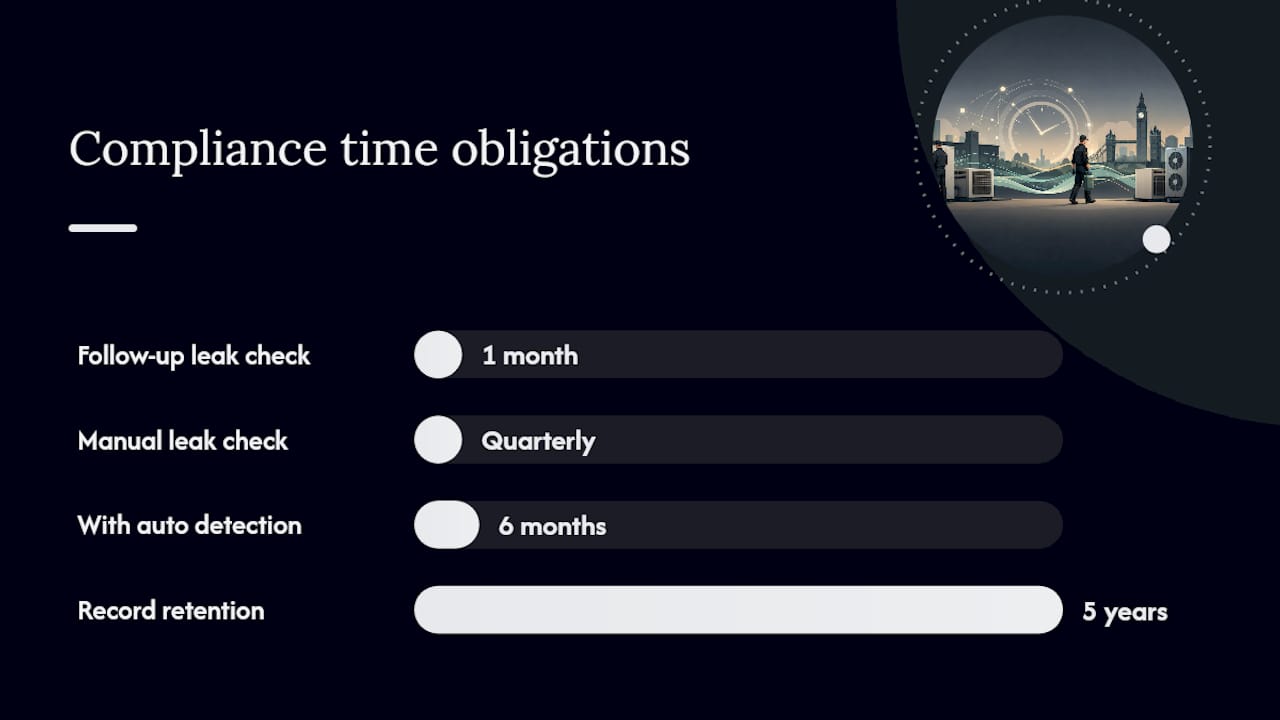
A few points that the table alone does not capture. First, if a leak is found and repaired, a follow-up leak check is required within one month of the repair to confirm the fix holds. Second, fitting automatic leak detection on a system above 300 kg halves the required manual check frequency from quarterly to every six months. Third, the charge thresholds above refer to the actual refrigerant charge in kilograms; for CO₂-equivalent calculations, multiply by the refrigerant’s global warming potential (GWP).
Recovery and end-of-life duties are non-negotiable. When refrigerant is removed from a system for any reason, including servicing, repair or decommissioning, it must be recovered by certificated personnel into approved containers. Recovered refrigerant is classified as hazardous waste and must be handled under the duty-of-care framework: transferred to a licensed reclaimer or destroyer with the appropriate waste transfer documentation. Releasing refrigerant to atmosphere is an offence.
Records must capture:
- System identification (location, make, model, refrigerant type)
- Refrigerant charge quantity
- Dates and results of all leak checks
- Name and certificate number of the technician who performed each check
- Quantities of refrigerant added or recovered, with reasons
- Disposal documentation for recovered gas
All records must be retained for five years and produced on request to the Environment Agency, SEPA or NRW. Inspectors expect to see a continuous log, not a collection of loose engineer’s job sheets. A gap in the record is treated as a gap in compliance.
For a broader understanding of why refrigerant containment matters environmentally, Akita’s guide on the role of refrigerants in cooling explains the properties and environmental impact of common refrigerant types used in UK systems.
Personnel and company certification: categories, bodies and how to get certified
Two distinct certificates operate in parallel, and confusing them is one of the most common compliance mistakes.
Individual qualifications are personal to the technician. GOV.UK sets out four categories:
- Category I: covers all activities on stationary refrigeration, air conditioning and heat pump equipment, including recovery, leak checking, installation and commissioning. City & Guilds qualification 2079-11 (Unit 1) is widely used for this category.
- Category II: covers leak checking, installation and commissioning but not recovery from larger systems. Suited to technicians working on smaller equipment.
- Category III: covers recovery only from refrigeration equipment with hermetically sealed systems.
- Category IV: covers leak checking only.
A technician must hold the category that matches the activities they actually perform. Holding Category II does not authorise recovery from systems where Category I is required. Personnel must hold their own recognised qualification even when employed by a company that holds a company certificate.
Company certificates (formally, Stationary Equipment Qualification company certificates) are required for businesses that carry out installation, maintenance, servicing, repair or decommissioning of stationary refrigeration and air conditioning equipment. RAC5 guidance sets out the evidence a business must provide: sufficient Category I or II qualified staff, appropriate recovery equipment, and documented procedures. Company certificates are valid for three years and must be renewed.
A critical point that REFCOM’s guidance makes explicit: a company certificate requires Category 1 or 2 staff, not Category 3 or 4. Businesses that assume lower-level individual qualifications are sufficient for company certification will be refused. The certification body will check that the number of qualified staff is proportionate to the volume and type of work the company undertakes.
The three designated certification bodies for stationary equipment in Great Britain are:
- REFCOM (Register of Companies Competent to Handle Refrigerants): the largest UK-specific body, with an online register of certificated companies and individual qualifications.
- Bureau Veritas: an international certification and testing organisation that issues F-gas company certificates in the UK.
- Quidos: a UK-based certification body offering F-gas company certificates and individual qualification assessment.
Mutual recognition: UK F-gas certificates are not automatically recognised in EU member states following EU Exit, and EU certificates are not automatically valid in Great Britain. Technicians or businesses working across the border need to check the requirements of the specific jurisdiction.
To verify a technician’s qualification, ask for the certificate number and check it against the issuing body’s online register before work starts. REFCOM’s register is publicly searchable at no cost.
Training for individual qualifications is available through a range of approved training providers; City & Guilds-approved centres can be located through the City & Guilds website, and the certification bodies above can direct applicants to recognised assessment routes.
A step-by-step compliance checklist for operators and business owners
Getting compliant is straightforward when you work through it systematically. Here is the sequence that works in practice.
-
Inventory every F-gas system. List each system by location, refrigerant type, charge size in kilograms and CO₂-equivalent tonnes, and the date of the last leak check. Include split systems, chillers, refrigerated display cases, heat pumps and any other equipment containing F-gases.
-
Classify obligations per system. Using the charge-size table above, determine which leak-check frequency applies, whether automatic leak detection is required, and whether records must be kept. Flag any system where the current maintenance schedule does not meet the required frequency.
-
Confirm certificated personnel and company certificates. For each contractor or in-house technician who works on your systems, obtain their individual certificate number and verify it. If you use a maintenance company, confirm they hold a valid company certificate from REFCOM, Bureau Veritas or Quidos.
-
Schedule and document leak checks. Set calendar reminders for each system’s next required check. After any repair, schedule the one-month follow-up check immediately. Record every check in your compliance log with the technician’s name, certificate number, date, result and any action taken.
-
Implement recovery and waste procedures. Confirm your maintenance contractor uses approved recovery equipment and transfers recovered refrigerant to a licensed reclaimer with a hazardous-waste transfer note. Keep copies of all waste transfer documentation in your compliance file.
-
Prepare records for inspection. Organise records by system, not by date or engineer. Inspectors find it easier to review a complete history for one system at a time. Retain all records for five years from the date of the entry.
Pro Tip: When resource is limited and you cannot address every system at once, prioritise by charge size. Systems above 300 kg carry the heaviest obligations (quarterly checks, automatic detection) and the greatest enforcement risk if missed. Fix the largest systems first, then work down.
A compliant record for each system should include these fields as a minimum:
- Unique system ID or asset tag
- Site address and plant room location
- Refrigerant type and charge quantity (kg)
- Date of each leak check and result (pass/fail/leak found)
- Name and certificate number of the technician
- Quantity of refrigerant added (kg) and reason
- Quantity of refrigerant recovered (kg) and disposal route
- Waste transfer note reference number
- Date of any repair and one-month follow-up check result
Store records in a format that can be produced quickly: a shared cloud folder organised by system ID works well, with filenames that include the system ID and the date of the entry (for example, “SYS-04_LeakCheck_2026-03-15”). Paper records are acceptable but harder to retrieve under inspection pressure. For practical maintenance scheduling advice, Akita’s guide on maintaining eco-friendly HVAC systems covers scheduling approaches that translate directly to compliance record-keeping.
Enforcement, penalties and the compliance failures that trigger them
The Environment Agency, SEPA and NRW hold enforcement powers under the Fluorinated Greenhouse Gases Regulations 2015. Authorised officers can inspect premises, require the production of records and interview personnel. Enforcement outcomes range from advisory notices through to formal enforcement notices, civil penalties and, in serious cases, prosecution.
The compliance failures that most commonly attract enforcement attention are:
- No records or incomplete records: the single most frequent trigger. Inspectors cannot verify compliance without a continuous log; absence of records is treated as evidence of non-compliance.
- Unqualified personnel: using technicians without the correct individual qualification, or relying on a company certificate as a substitute for individual certification.
- Missed leak repairs: finding a leak and failing to repair it promptly, or failing to carry out the required one-month follow-up check after repair.
- Improper gas recovery or disposal: releasing refrigerant to atmosphere, using unqualified personnel for recovery, or failing to transfer recovered gas to a licensed reclaimer with proper documentation.
- Placing HFCs on the market without quota: producers and importers who supply bulk HFCs without holding the required quota face customs holds and civil penalties administered by the Environment Agency.
Civil penalties under the Regulations are applied through a structured process; the Environment Agency publishes its enforcement and sanctions policy, which sets out the factors that affect penalty levels. Quota penalties operate through a separate mechanism: the Environment Agency can reduce a quota holder’s future allocation as a consequence of non-compliance, in addition to civil financial penalties.
Pro Tip: Before an inspection, prepare a single summary sheet for each system: asset ID, refrigerant type, charge, last three leak-check dates and results, technician certificate numbers, and a list of waste transfer note references. Handing an inspector a well-organised summary immediately signals that compliance is being managed actively, which typically shortens the inspection and reduces the risk of a formal notice.
Common HVAC equipment failures that lead to refrigerant leaks, and therefore compliance events, are worth understanding proactively. KC Air Control’s overview of common causes of HVAC failure covers the mechanical and maintenance factors that most often result in refrigerant loss, which maps directly to the leak-check and repair obligations under UK F-gas rules.
HFC phasedown, the quota system and what it means for purchasing and servicing
The HFC phasedown is the mechanism by which the total quantity of HFCs that producers and importers may place on the GB market is progressively reduced over time, expressed in CO₂-equivalent tonnes against a historical baseline. The Environment Agency administers quota allocation for Great Britain. The practical effect is that the supply of high-GWP HFCs tightens over time, which pushes up prices and creates supply-chain risk for businesses that depend on them for servicing existing equipment.
Who needs quota and when to apply. Any producer or importer who wants to place bulk HFCs on the GB market must hold quota. GOV.UK guidance on quota applications explains the annual application window and the process for new entrants. Missing the application window means waiting another year. Placing HFCs on the GB market without quota risks customs holds at the border and civil penalties from the Environment Agency.
For businesses that buy refrigerants for servicing rather than importing them, the immediate practical implication is cost. As quota tightens, the price of common HFCs such as R-410A rises. This creates a clear financial incentive to move towards low-GWP alternatives where equipment allows.
Practical implications for purchasers and service providers:
- Pre-charged equipment: units supplied pre-charged with refrigerant are subject to different rules than bulk refrigerant imports. Check the specific obligations for pre-charged equipment before purchasing from outside Great Britain.
- Low-GWP alternatives: refrigerants such as R-32, R-290 (propane) and R-454B carry significantly lower GWPs than R-410A. Equipment designed for these refrigerants is increasingly available and avoids some of the supply-chain risk associated with high-GWP HFCs.
- Import and export nuances: businesses that import or export pre-charged equipment need to check whether the refrigerant charge is subject to quota rules, as the position differs from bulk refrigerant.
Pro Tip: When procuring replacement or new equipment, build a low-GWP checklist: confirm the refrigerant type and GWP, check whether the refrigerant is subject to phasedown restrictions, verify that your technicians hold qualifications covering that refrigerant type, and confirm that recovery equipment compatible with the refrigerant is available on site. Akita’s guide on eco-friendly HVAC upgrades covers practical examples of low-GWP system choices for UK properties.
Where to find official guidance, certification bodies and regulator contacts
The Gov is the authoritative starting point. It brings together the information sheets (RAC series), application forms, quota guidance and links to the statutory instruments in one place. Bookmark it and check it when regulations are updated.
For quota and reporting, the Environment Agency runs an F-gas service where quota holders register, submit returns and manage their allocation. New entrants should check the GOV.UK quota application page for the current application window dates before each annual cycle opens.
Designated company certification bodies:
- REFCOM: issues company certificates and maintains the public register of certificated companies and individual qualifications. Contact via refcom.org.uk.
- Bureau Veritas: issues company certificates; contact through bureauveritas.co.uk.
- Quidos: issues company certificates; contact through quidos.co.uk.
For individual qualifications, City & Guilds-approved assessment centres deliver the 2079 suite of qualifications. The City & Guilds website lists approved centres by location.
Useful GOV.UK pages to bookmark:
- F-gas guidance collection for users, producers and traders
- Qualifications required to work on F-gas equipment
- Applying for quota to produce or import F-gas
- The Fluorinated Greenhouse Gases Regulations 2015 on legislation.gov.uk
To register for an F-gas quota account, follow the GOV.UK guidance page for quota applicants, which sets out the evidence required and the steps to create an account with the Environment Agency’s online service. Application windows are annual; missing one has real commercial consequences for importers and producers.
Akita’s perspective on compliance and operational continuity
The businesses that struggle most with F-gas compliance are not the ones that ignore it deliberately. They are the ones that treat it as a one-off administrative task rather than a maintenance discipline. Compliance is not a certificate you obtain and file away; it is a continuous cycle of scheduled checks, documented repairs and verified personnel, repeated for every system you operate.

What the regulations actually reward is good maintenance practice. A system that is leak-checked on schedule, repaired promptly and properly documented is also a system that runs efficiently, lasts longer and costs less to operate. The compliance record and the maintenance record are the same document. Businesses that understand this stop seeing F-gas obligations as a burden and start seeing them as a structured framework for protecting their equipment investment.
The operator responsibility question is the one that catches businesses most off guard. Outsourcing maintenance does not outsource liability. REFCOM’s guidance is clear that the operator must be satisfied the work and record-keeping are properly performed, not merely that a contractor has been appointed. That means asking for records, checking certificate numbers and reviewing the log, not just signing a service contract and assuming the rest follows.
Compliant HVAC installation and servicing in Suffolk, Norfolk and Essex
F-gas compliance starts at installation. A system installed by certificated technicians, with the correct refrigerant charge documented from day one, gives you a clean compliance baseline. Retrofitting records onto a system with no installation documentation is far harder than starting right.
Akita’s engineers hold the individual qualifications required under UK F-gas rules and work across Suffolk, Norfolk and Essex for both residential and commercial clients. Whether you need a compliant commercial air conditioning installation or a domestic system installed to the correct standard, every Akita installation includes full documentation of the refrigerant type, charge quantity and technician certification, giving you the compliance baseline your records need from day one.

If you are unsure whether your existing systems meet current F-gas requirements, contact Akita to arrange a site assessment. We will review your equipment, check charge sizes against current thresholds and confirm whether your maintenance schedule and records meet regulator expectations. Book a compliance assessment or installation quote through akita.ac.
Sources
The sources below are the primary references for F-gas compliance in Great Britain. Each covers a distinct area of the regulatory framework.
- Fluorinated gas (F gas): guidance for users, producers and traders
- F gas regulation in Great Britain
- Gov
- REFCOM | F‑Gas certification frequently asked questions
- The Fluorinated Greenhouse Gases Regulations 2015 (SI 2015/310)
- Gov
This article is general information, not a substitute for advice from a qualified lawyer. Consult a qualified legal professional about your own circumstances before acting on anything here.