

What is air quality control? A guide for families
TL;DR:
- Indoor air quality improves significantly when families focus on source control before relying on ventilation and filtration. Eliminating pollutant sources is cost-effective and prevents indoor air problems from developing, while proper ventilation dilutes remaining pollutants. Regular maintenance of filters and humidity control further support clean indoor air and overall health.
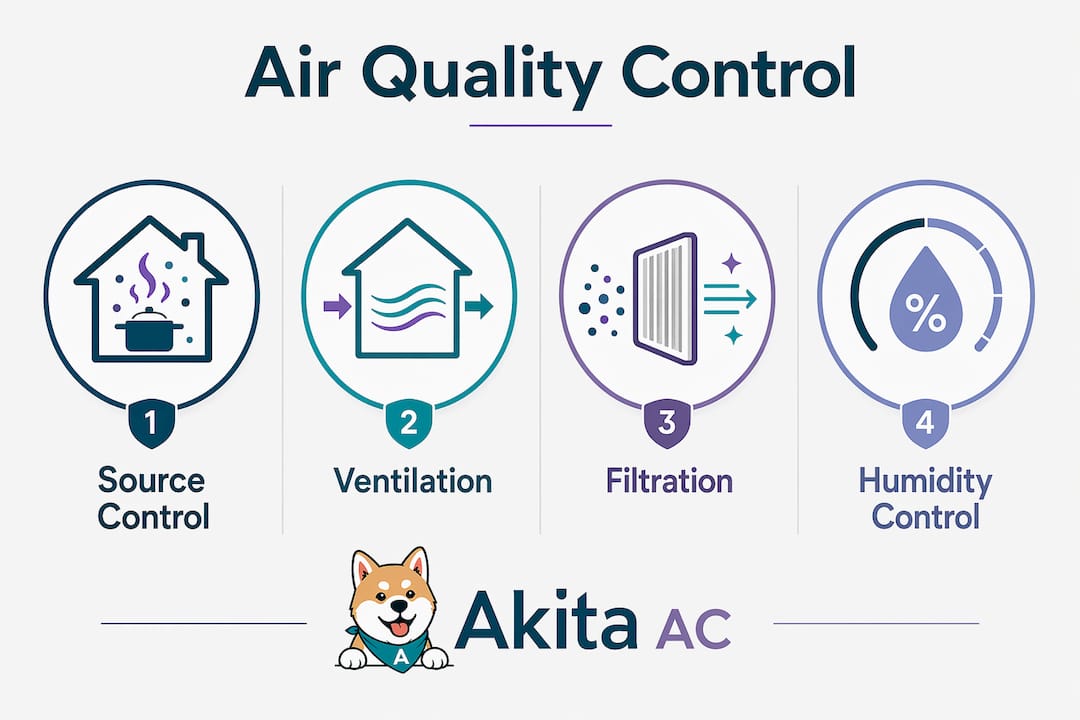
Air quality control is the practice of managing and reducing indoor air pollutants through specific strategies to protect health and comfort at home. The air inside your home can carry pollutants at concentrations far higher than outdoor air, including dust, mould spores, volatile organic compounds (VOCs), and cooking fumes. The US Environmental Protection Agency (EPA) and ASHRAE, the global authority on building standards, both recognise that effective indoor air quality management follows a clear hierarchy: source control first, then ventilation, then filtration. Understanding that order is the single most important thing a family can do to breathe cleaner air at home.
What is air quality control and why does the hierarchy matter?
Air quality control, known in professional circles as indoor air quality (IAQ) management, is the systematic process of identifying, reducing, and monitoring pollutants inside a building. The EPA defines a strict three-tier hierarchy for this process. Source control comes first, ventilation second, and filtration third as a supplement. Skipping the first step and relying solely on air purifiers is one of the most common and costly mistakes families make.
Source control means eliminating or reducing the things that produce pollutants in the first place. Common indoor pollutant sources include:
- Gas cookers and hobs, which release nitrogen dioxide and carbon monoxide
- Aerosol cleaning sprays and chemical products, which emit VOCs
- Damp building materials and poor drainage, which encourage mould growth
- Carpets, upholstered furniture, and older paint, which off-gas formaldehyde
Eliminating these sources often costs nothing. Switching to unscented, water-based cleaning products, for example, immediately reduces VOC levels without any equipment. Removing pollutant sources is more cost-effective and impactful than any filter on the market.
Pro Tip: An air purifier placed in a room with an active pollutant source, such as a gas hob or a damp wall, will run continuously and still fail to keep up. Fix the source first, then use filtration to catch what remains.
How does ventilation improve air quality at home?
Ventilation works by diluting indoor air with fresh outdoor air, reducing the concentration of pollutants that build up from cooking, breathing, and everyday activities. ASHRAE recommends a minimum of 0.35 air changes per hour for residential spaces. That figure means the entire volume of air in a room should be replaced at least once every three hours. Most homes without mechanical ventilation fall well short of this.

Natural ventilation is free and effective when done correctly. The key technique is cross-ventilation: opening windows on opposite sides of a room or home so that air flows through rather than simply pooling near one opening. Opening windows on opposite sides for 10–15 minutes effectively flushes indoor pollutants. Opening a single window, by contrast, mostly recirculates stale air around the same space.
Practical steps for better home ventilation:
- Open windows on opposite sides of the house simultaneously to create a through-draught.
- Ventilate in the early morning in urban areas, when outdoor pollution from traffic is at its lowest.
- Run kitchen extractor fans during and after cooking, not just while food is on the hob.
- Use bathroom fans during showers and for at least 20 minutes afterwards.
- Check that trickle vents in window frames are open and unblocked year-round.
Mechanical ventilation systems, such as whole-house heat recovery ventilation (MVHR), deliver consistent air exchange without relying on weather or window-opening habits. These systems are particularly valuable in well-insulated modern homes where natural air leakage is minimal. For a detailed comparison of natural and mechanical approaches, the HVAC ventilation guide from Akita covers both in practical terms.
Pro Tip: Never rely on a single open window for ventilation. Without a second opening to create airflow, you are simply letting outdoor noise in, not pollutants out.
What role does filtration play in controlling indoor air quality?
Filtration is the third line of defence in air quality management, not the first. Its job is to capture particles that remain after source control and ventilation have done their work. Two filter types dominate residential use: MERV-13 and HEPA.
HEPA filters remove 99.97% of particles as small as 0.3 microns, including fine dust, pollen, and many bacteria. That performance sounds definitive, but HEPA filters have a significant limitation. They cannot remove gases, radon, or VOCs without an activated carbon component. A HEPA filter in a home with a gas cooker or new furniture off-gassing formaldehyde will capture particles but leave the gaseous pollutants entirely untouched.
There is also a compatibility problem. Standard residential furnace blowers are usually not compatible with true HEPA filters because the dense filter material restricts airflow too severely. Forcing a HEPA filter into a standard HVAC unit can damage the blower motor and reduce heating or cooling efficiency. MERV-13 filters are the pragmatic choice for most home HVAC systems. They capture smoke, bacteria, and fine particles while maintaining adequate airflow.
| Filter type | Particle capture | Gas removal | HVAC compatible |
|---|---|---|---|
| MERV-13 | Fine particles, smoke, bacteria | No | Yes, most systems |
| HEPA | 99.97% of particles ≥0.3 microns | No | Portable units only |
| Activated carbon | Limited particle capture | Yes, VOCs and odours | As add-on only |
Key maintenance points for filtration:
- Replace MERV-13 filters every 60–90 days, or more often in homes with pets.
- Use a sealed HEPA-rated vacuum at least twice weekly to reduce dust recirculation.
- Replace activated carbon filters on schedule; once saturated, they release stored pollutants back into the air.
- Check portable air purifier pre-filters monthly and clean them to maintain airflow.
For guidance on keeping your entire system in good condition, Akita’s residential HVAC maintenance checklist sets out a practical routine.
How does humidity control support clean indoor air?
Humidity is the most overlooked variable in home air quality management. Indoor relative humidity (RH) outside the 30–50% range creates conditions that directly worsen air quality and health. Humidity outside 30–50% RH exacerbates allergic triggers and respiratory conditions. That is not a minor inconvenience. Dust mites thrive above 50% RH, and mould colonies can establish within 24–48 hours on damp surfaces.
Low humidity, below 30% RH, causes its own problems. Dry air irritates the mucous membranes in the nose and throat, reducing the body’s natural defence against airborne pathogens. It also causes wooden floors and furniture to crack, which can release fine particles into the air.
Practical ways to keep humidity in the healthy range:
- Run bathroom extractor fans for at least 20 minutes after showering to prevent moisture from spreading through the home.
- Use a kitchen extractor hood whenever boiling, frying, or using a dishwasher.
- Place a hygrometer (a simple humidity gauge, available for under £15) in the bedroom and living room to monitor RH daily.
- Use a dehumidifier in rooms that consistently read above 55% RH, particularly basements and utility rooms.
- Seal gaps around windows and doors to prevent damp outdoor air from entering during wet weather.
For a deeper look at how HVAC systems manage moisture, the Akita article on humidity control in HVAC explains the mechanics clearly. A well-maintained air conditioning system actively removes excess moisture from indoor air as part of its normal cooling cycle, making it one of the most practical tools for year-round humidity management.
Pro Tip: Place your hygrometer away from exterior walls and windows. Readings near cold surfaces are artificially high and will not reflect the true humidity of the room.
Key takeaways
Air quality control works best as a layered system: source control removes pollutants at origin, ventilation dilutes what remains, and filtration captures residual particles.
| Point | Details |
|---|---|
| Source control is the priority | Eliminating pollutant sources like chemical sprays and damp materials costs little and delivers the greatest impact. |
| Cross-ventilation beats a single open window | Opening windows on opposite sides for 10–15 minutes flushes pollutants; one window alone recirculates stale air. |
| MERV-13 suits most home HVAC systems | HEPA filters are too restrictive for standard blowers; MERV-13 captures fine particles without damaging equipment. |
| Humidity must stay between 30–50% RH | Outside this range, dust mites, mould, and respiratory irritation all increase significantly. |
| Filtration needs regular maintenance | Saturated carbon filters and blocked HEPA pre-filters actively worsen air quality rather than improve it. |
What I have learnt from years of helping families breathe better at home
The most common mistake I see is families investing in an expensive air purifier and assuming the problem is solved. They place it in the corner of a room, leave it running, and wonder why someone in the household still wakes up with a blocked nose or a cough. The device is doing its job. The problem is that the job was never the right one to start with.
A systems approach to air quality is not a complicated idea. It simply means addressing the cause before the symptom. A gas cooker without an extractor hood, a bathroom with no fan, a carpet that has never been vacuumed with a sealed machine: these are the real drivers of poor indoor air in most UK homes. No purifier compensates for them.
What I find genuinely encouraging is how much families can achieve without spending a great deal of money. Cross-ventilation costs nothing. Switching to fragrance-free cleaning products costs nothing. Checking that trickle vents are open costs nothing. These steps, done consistently, outperform a £300 air purifier placed in front of an unaddressed source. The importance of air quality for long-term health is well established. The good news is that the most effective responses are also the most accessible ones.
— Akita
How Akita supports better air quality in your home
Good air quality control depends on the right systems working together, and a professionally installed air conditioning unit does more than cool a room.

Akita installs modern, energy-efficient air conditioning systems across Suffolk, Norfolk, and Essex that actively support ventilation and humidity control as part of their normal operation. A well-specified unit circulates and filters air continuously, removes excess moisture during cooling, and can be paired with MERV-13 compatible filtration for whole-home air management. Akita’s team assesses each property individually to recommend the right system for your layout and air quality needs. For families looking to take a practical next step, domestic air conditioning installation from Akita is a straightforward way to bring professional-grade air management into your home.
FAQ
What is the most effective method of air quality control at home?
Source control is the most effective method. Eliminating pollutant sources such as gas appliances without extraction, chemical sprays, and damp materials reduces indoor pollution more than any filter or purifier.
Can an air purifier alone control indoor air quality?
No. Air purifiers cannot remove radon, carbon monoxide, or VOCs without activated carbon components, and they cannot compensate for inadequate ventilation or active pollutant sources.
What humidity level is best for indoor air quality?
The recommended range is 30–50% relative humidity. Outside this range, dust mites and mould thrive, and respiratory irritation increases for everyone in the household.
What does MERV-13 mean and should I use it?
MERV-13 is a filter efficiency rating that captures fine particles including smoke, bacteria, and viruses. It is the recommended choice for most home HVAC systems because, unlike HEPA filters, it maintains adequate airflow without damaging standard blower motors.
How often should I replace home air filters?
MERV-13 filters should be replaced every 60–90 days in most homes, and more frequently in households with pets or allergy sufferers. Activated carbon filters should be replaced on the manufacturer’s schedule, as saturated filters release stored pollutants back into the air.