

VRF Heat Recovery: 3 Architectures and 4 Install Checks for Facilities
VRF heat recovery is a multi-zone air conditioning technology that captures rejected heat from zones in cooling mode and redirects it to zones that need heating, running both processes on the same system at once. It suits hotels, hospitals and mixed-use offices with varying zone loads. Building owners with diverse occupancy patterns typically see the strongest return.
TL;DR:
- Heat recovery VRF systems are most cost-effective and efficient in buildings with high opposing zone demands, such as hotels and hospitals.
- The choice of system architecture, like three-pipe or hybrid, significantly impacts installation complexity, refrigerant charge, and long-term performance.
- Proper pipe routing, selector box sizing, and thorough commissioning are critical to prevent silent underperformance and leaks over the system’s lifespan.
- Newer refrigerants with low global warming potential, such as R-32, are favored, with systems designed for minimal refrigerant charge to future-proof against regulations.
- The higher upfront cost of heat recovery VRF is balanced by energy savings in buildings with genuine simultaneous heating and cooling needs.
Table of Contents
- What is a VRF heat recovery system and how does it differ from a heat pump?
- What are the main VRF heat recovery architectures?
- How does VRF heat recovery move heat around a building?
- What efficiency and cost gains does heat recovery deliver?
- Where does heat recovery VRF work best?
- What should owners plan for during installation and maintenance?
- What refrigerants and environmental factors matter now?
- Akita’s perspective on briefing and delivering heat recovery projects
- Get expert help specifying and installing heat recovery VRF
- Sources
- FAQ
What is a VRF heat recovery system and how does it differ from a heat pump?
The distinction comes down to one capability: a VRF heat recovery system allows individual indoor zones to heat or cool simultaneously, while a standard VRF heat pump can only run every zone in the same mode at once, either all heating or all cooling. That single difference changes how a building performs day to day.
Picture an office block where the south-facing meeting room overheats by midday while the north-facing reception stays cold. A heat pump VRF system forces a compromise. A heat recovery VRF system lets both zones run exactly as needed, because the rejected heat from the meeting room’s cooling cycle gets rerouted to warm the reception area instead of being dumped outside.
Before choosing between them, weigh:
- Zone diversity: how often do different areas need opposite modes at the same time?
- Building type: hotels and hospitals see this daily; a single-tenant warehouse rarely does.
- Expected loads: perimeter zones with glazing behave very differently from internal core spaces.
Read more in our guide to VRF systems for the underlying refrigerant technology.
What are the main VRF heat recovery architectures?
Heat recovery VRF isn’t a single design. Manufacturers offer a handful of configurations, each suited to different building constraints:
- Three-pipe systems: these use separate hot gas, liquid, and suction lines, giving the most flexible simultaneous heating and cooling but requiring more refrigerant pipework and careful routing through the building fabric.
- Two-pipe hybrid systems with branch controllers: these reduce pipe count by using branch selector boxes, sometimes called heat recovery branch controllers, to switch refrigerant flow direction at each zone rather than running dedicated hot gas lines throughout.
- Hybrid HVRF systems: refrigerant stays confined to plant rooms and branch controllers, while a hydronic loop carries conditioned water out to occupied spaces, an approach Mitsubishi Electric documents for buildings where refrigerant charge near occupants is a concern.
Selector box sizing matters here. Undersized units restrict flow during peak simultaneous demand; oversized ones add unnecessary cost and refrigerant volume.
How does VRF heat recovery move heat around a building?
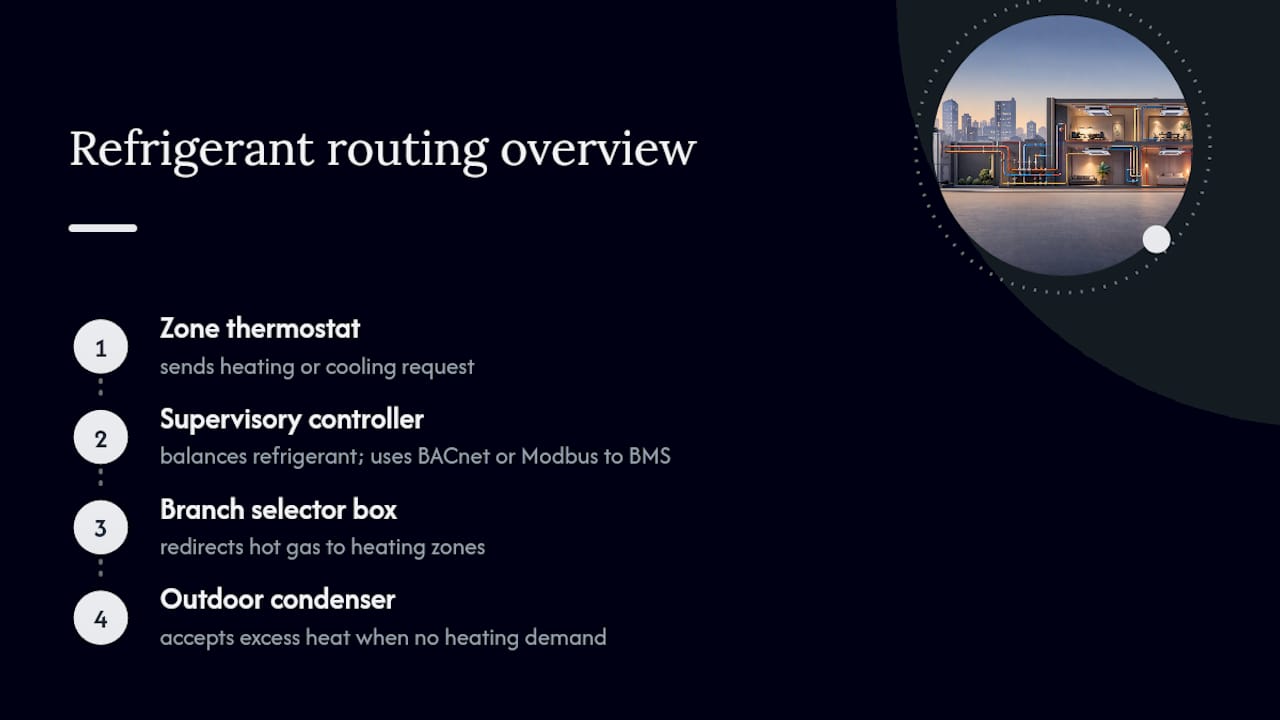
Refrigerant routing is the mechanism that makes this work. When a zone calls for cooling, its indoor unit acts as an evaporator and rejects heat into the system. A branch selector box at or near that zone then redirects the resulting hot refrigerant gas toward any zone calling for heating, where it condenses and releases that heat, rather than sending it to the outdoor condenser to be wasted.
Control logic sits above this hardware layer. Individual zone thermostats send heating or cooling requests to a supervisory controller, which calculates the overall refrigerant balance across the branch selectors and outdoor unit. Larger commercial installations typically integrate this supervisory layer with a building management system over BACnet or Modbus, letting facility teams monitor zone-by-zone demand, schedule setback periods, and flag faults centrally rather than walking the building floor by floor.
On the installation side, two decisions affect long-term performance more than any other. First, liquid-line routing: fewer brazed joints between the outdoor unit and each branch selector reduces both installation time and the number of potential leak points over the system’s life. Second, commissioning checks on selector box operation and refrigerant charge before handover, since an undercharged system will underperform silently for months before anyone notices.
What efficiency and cost gains does heat recovery deliver?
Reusing heat rather than rejecting it outdoors is the single biggest efficiency lever in this technology. Industry coverage of well-balanced heat recovery installations reports very high apparent COP values in favourable mixed-load scenarios, because the system is effectively getting heating output for free from a process (cooling) it was already running.
Pro Tip: *Don’t take theoretical efficiency figures at face value. The apparent gains depend heavily on how closely a building’s actual heating and cooling demand overlap in time.
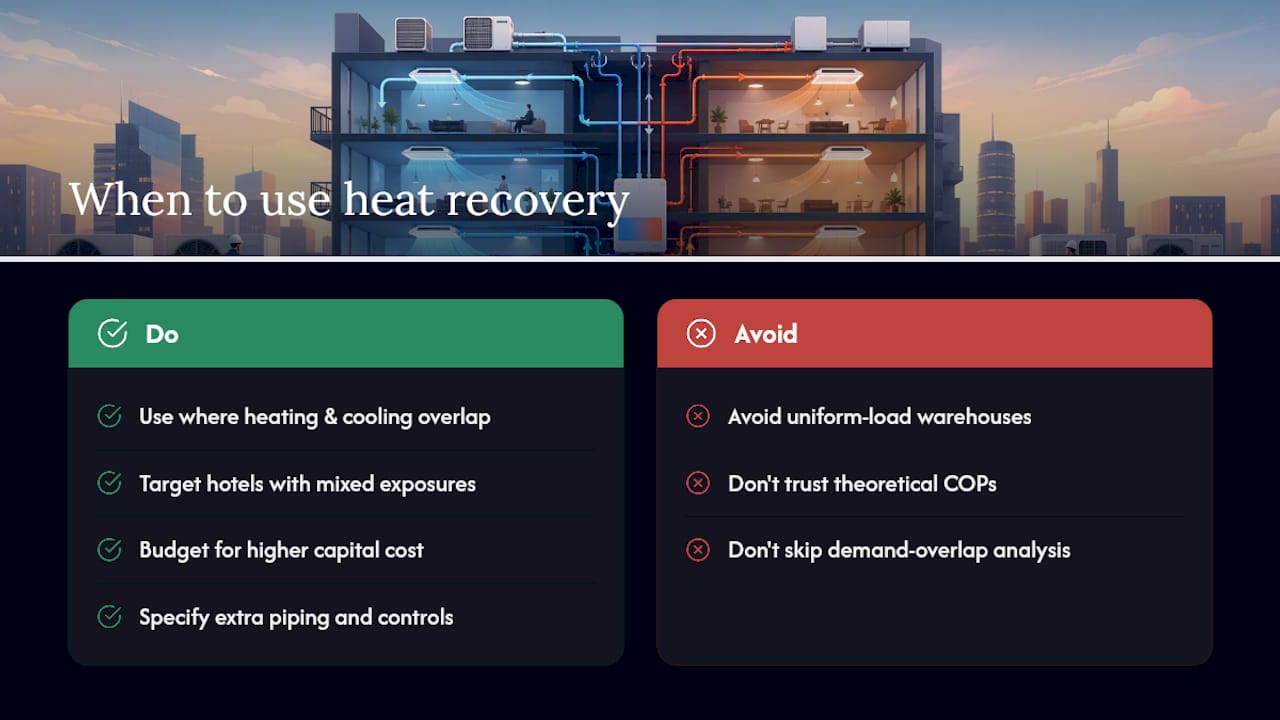
Capital cost runs higher than a heat pump VRF equivalent. Extra piping runs, branch selector boxes, and more sophisticated controls all add to the installed price. The trade-off pays back fastest in buildings with genuine simultaneous demand: a hotel with south-facing rooms baking in the afternoon sun, while north-facing rooms still need warmth, is a textbook case. A single-use warehouse with uniform loads rarely justifies the extra spend. Our piece on reducing HVAC operating costs covers the wider running-cost picture.
Where does heat recovery VRF work best?
Some buildings are built for this technology; others simply don’t generate enough opposing demand to justify it. Heat recovery VRF suits hotels, hospitals and multi-use buildings where different zones need heating and cooling concurrently, almost by design.
- Hotels: guest rooms on different orientations, plus function rooms and corridors, rarely want the same temperature at the same time.
- Hospitals: operating theatres, wards and plant rooms all run wildly different thermal profiles around the clock.
- Mixed-use offices: perimeter offices with solar gain sit against internal meeting rooms and server closets needing near-constant cooling.
Where zone diversity is low, a simpler heat pump VRF or hybrid HVRF setup often makes more sense; the extra complexity and cost of full heat recovery buys little if every zone wants the same thing at the same time. Our HVAC zoning guide breaks down zoning logic in more detail.
What should owners plan for during installation and maintenance?
Getting heat recovery VRF right on day one saves years of service calls later. Four things deserve attention before a single pipe goes in:
- Pipe routing: minimise the distance and joint count between outdoor units, branch selectors and each indoor unit.
- Service access: branch selector boxes need clear access panels, since they’re the components most likely to need attention over the system’s life.
- Commissioning tests: verify refrigerant charge, confirm every selector box switches correctly between heating and cooling calls, and check communication between zone controllers and the BMS before sign-off.
- Ongoing maintenance: schedule filter cleaning, refrigerant leak checks, and controller firmware updates on a fixed calendar rather than waiting for a complaint.
Pro Tip: Ask your installer specifically how many brazed joints sit between the outdoor unit and each branch selector. Fewer joints means fewer places refrigerant can leak from over a 10 to 15 year system life, and it’s one of the easiest questions a contractor can answer honestly on the spot.
Watch for warning signs: unexplained loss of heating or cooling capacity in specific zones, unusual noise from a selector box, or a system that seems to “hunt” between modes. These often point to a failing branch selector or a slow refrigerant leak rather than a compressor problem. Our eco-friendly HVAC maintenance guide covers routine servicing tasks in more depth.
What refrigerants and environmental factors matter now?
Refrigerant choice increasingly shapes specification decisions, not just performance ones. The industry has shifted toward lower-GWP refrigerants such as R-32, alongside system designs that reduce total refrigerant charge, both driven by carbon reduction targets and tightening F-Gas regulation.
Design choices influence this directly. Specifying liquid-line headers that bypass unnecessary internal joints in branch selector assemblies cuts the volume of refrigerant held in pipework and reduces the number of brazed connections that could eventually leak. Fewer joints means lower lifecycle carbon exposure, independent of which refrigerant is used.
For owners planning a system now, the practical question isn’t just “what refrigerant is compliant today” but “what happens when regulation tightens further.” Specifying equipment designed around lower-GWP refrigerants and minimal charge gives more headroom against future rule changes than choosing the cheapest compliant option available this year.
Akita’s perspective on briefing and delivering heat recovery projects
We recommend heat recovery VRF when a client’s brief genuinely involves opposing zone demands, a hotel, a clinic, a building with a busy server room next to occupied offices. Anything less, and a heat pump system usually serves the budget better.
On site surveys, we check zone orientation, existing pipe routes, and realistic branch selector placement before quoting. In commissioning, refrigerant charge verification and selector box switching tests are non-negotiable steps, not paperwork.
When comparing quotes, ask for the commissioning plan in writing, confirm the engineer’s F-Gas certification, and check what maintenance options sit behind the installation price.
— Akita
Get expert help specifying and installing heat recovery VRF
Getting the architecture right, three-pipe, two-pipe hybrid, or HVRF, before a single pipe is fixed saves far more than it costs to plan properly, and that’s why using experienced F-Gas certified engineers is important on commercial projects.

The company handles the full lifecycle: site surveys and load modelling, commercial air conditioning installation, commissioning with documented acceptance tests, and ongoing support through air conditioning maintenance contracts once the system is running. If an existing VRF installation is underperforming or throwing faults, their air conditioning repairs service can diagnose branch selector and refrigerant issues directly.
When requesting a quote, ask for evidence of F-Gas certification, a written commissioning plan, and clear maintenance pricing. Contact providers for site surveys and fixed quotes on commercial VRF projects.
Sources
For deeper technical detail beyond this guide, manufacturer pages such as Mitsubishi Electric’s VRF overview and trade coverage from the ACR Journal cover branch selector specifications and refrigerant guidance in more depth.
FAQ
What are the drawbacks of VRF heat recovery systems?
Higher upfront cost is the main drawback, driven by extra pipework, branch selector boxes and more complex controls compared with a heat pump VRF system. Installations also need more careful commissioning, since undetected refrigerant charge errors or selector faults can quietly reduce performance for months.
Is VRF the same as a heat pump?
No. A VRF heat pump runs every zone in the same mode at once, either all heating or all cooling, while VRF heat recovery lets individual zones heat and cool simultaneously by redirecting rejected heat between them.
How long do VRF systems last?
Industry sources put typical VRF system lifespans broadly between 10 and 15 years, with actual results depending heavily on maintenance quality and operating conditions.
Is VRF better than split air conditioning?
For buildings with multiple zones needing independent, simultaneous control, VRF generally outperforms multiple standalone split units on efficiency and control granularity, particularly with heat recovery reusing heat between zones. A single room or small space rarely justifies the added system complexity.
What does a heat recovery VRF installation cost with Akita?
Pricing depends on building size, zone count and architecture chosen, so Akita quotes commercial VRF projects individually after a site survey. Current pricing details and enquiry forms are available on Akita’s commercial air conditioning page.