

Energy-efficient climate control brands: UK buyer's guide
Prioritise system type, life-cycle costing, and accredited installation above all else. The brand badge matters far less than whether the equipment is correctly sized, properly commissioned, and matched to your building fabric. Before shortlisting any product, run these five checks:
- Efficiency ratings first: look for SEER (seasonal cooling), SCOP (seasonal heating), and EER values on the product datasheet. Higher figures mean lower running costs, not just lower carbon.
- Refrigerant GWP: R32 and R454B are the current low-global-warming-potential options replacing older R410A systems. Prefer them.
- Accredited installer: the CMA advises obtaining at least three independent quotes from accredited businesses and recommends addressing building fabric before buying high-efficiency equipment.
- Correct sizing and controls: an oversized unit cycling on and off wastes more energy than a modestly rated unit running steadily.
- Inspection obligations: systems above 12 kW effective rated output require periodic accredited inspections under UK law.
Key takeaways
The single most important decision rule when selecting energy-efficient climate control systems is to prioritise correct system type, life-cycle cost, and accredited installation over brand name or capital price alone.
| Point | Details |
|---|---|
| System type before brand | Heat pumps, VRF, and inverter splits outperform older fixed-speed equipment in most UK buildings. |
| Check SEER, SCOP, and refrigerant | Declared efficiency figures and low-GWP refrigerants (R32, R454B) are the objective product checks that matter. |
| Three independent quotes minimum | The CMA recommends multiple quotes from accredited installers and addressing building fabric before equipment purchase. |
| Commissioning determines real savings | Poorly commissioned systems can consume more energy than well-commissioned older equipment, regardless of brand. |
| Akita for Suffolk, Norfolk, and Essex | Akita provides accredited surveys, life-cycle costing, and installations with ongoing maintenance plans across the region. |
Table of Contents
- Which system types deliver real energy savings in UK buildings?
- What product and brand checks should every UK buyer make?
- UK rules and inspections that affect what you buy and how you maintain it
- Why system design usually matters more than the brand name
- How to choose a brand and installer and compare UK quotes properly
- Typical installation timelines and the factors that drive cost
- What maintenance and monitoring look like after installation
- Akita covers Suffolk, Norfolk, and Essex with accredited surveys and installations
- Why life-cycle thinking is the only honest way to choose
- Sources
Which system types deliver real energy savings in UK buildings?
Heat pumps, variable refrigerant flow (VRF) systems, and high-efficiency inverter splits consistently outperform older fixed-speed equipment in UK conditions. BRE modelling confirms that centralised air systems are typically less efficient than VRF, chilled beams, or well-specified split systems, though real-world performance depends heavily on installation and controls.
Heat pumps suit most UK homes and smaller commercial premises. Air-source units with SCOP values above 3.5 can deliver three to four units of heat per unit of electricity consumed, making them the strongest candidate for replacing gas boilers in well-insulated properties.
VRF systems are the workhorse of medium-to-large commercial buildings. They allow simultaneous heating and cooling in different zones, recover heat internally, and use variable-speed compressors that modulate output to match actual load rather than cycling on and off.
High-efficiency inverter splits cover most residential and small-office applications. A single-split or multi-split inverter unit with a SEER above 6.5 will comfortably outperform a fixed-speed predecessor on the same circuit.
Active chilled beams and evaporative coolers appear on the Energy Technology List as high-efficiency options for commercial buildings with suitable ceiling heights and humidity control. Direct evaporative coolers can save substantial energy in dry, well-ventilated spaces.
Pro Tip: Match the system type to your building’s occupancy pattern, not just its floor area. A building occupied for four hours a day needs a fast-response inverter system, not a large central plant sized for continuous operation.
What product and brand checks should every UK buyer make?
Lead with the numbers, not the marketing copy. The metrics that matter are:
- SEER / SCOP / EER / COP: declared by the manufacturer on the product datasheet. Compare like-for-like across brands using the same test standard.
- ErP energy label and UK energy label: the rating band (A+++ to D in older labelling, or the rescaled A-to-G scale) gives a quick relative benchmark, but always read the underlying declared figures.
- UKCA or CE marking: Ecodesign regulations require manufacturers and importers to affix UKCA or CE marks and supply a Declaration of Conformity. Ask for this document before purchase; suppliers must retain it for ten years.
- Refrigerant type: R32 has a global warming potential of 675, roughly one-third that of R410A. R454B is lower still. Both are now standard in new residential splits.
- Minimum Energy Performance Standards (MEPS): products sold in the UK must meet Ecodesign thresholds. A product that only just clears MEPS is legal but not necessarily the best available technology.
Declared efficiency figures are measured under standardised laboratory conditions. Real-world performance in a UK building will vary with outdoor temperature, occupancy, duct condition, and controls quality. The gap between declared and in-situ performance is often larger than the gap between two competing brands at similar price points.
UK rules and inspections that affect what you buy and how you maintain it
A handful of UK regulations set the minimum floor for efficiency and inspection, and ignoring them carries legal and financial risk.
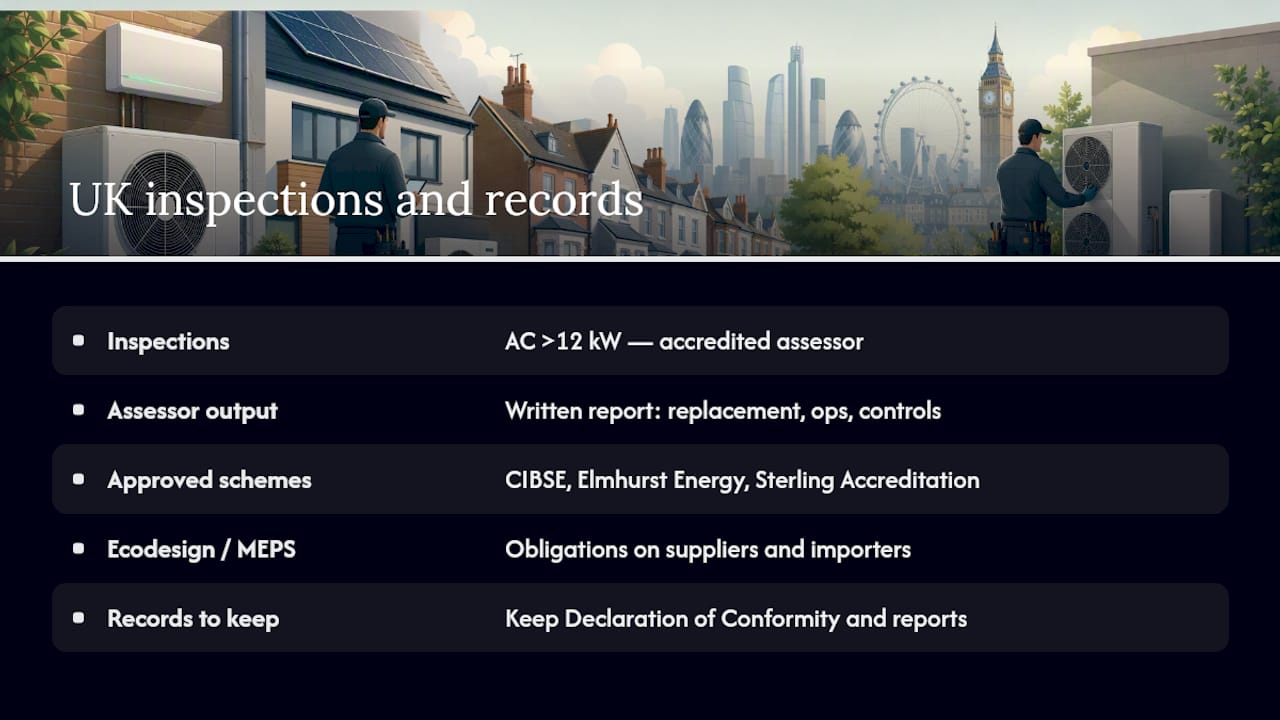
The Energy Performance of Buildings (England and Wales) Regulations 2012 require that air-conditioning systems with an effective rated output exceeding 12 kW undergo periodic inspections by an accredited assessor. The inspection is not a box-ticking exercise. Gov.uk guidance explains that assessors from approved schemes, including CIBSE, Elmhurst Energy, and Sterling Accreditation, produce a written report with recommendations that can include replacement, operational changes, or control upgrades.
Ecodesign and MEPS rules place obligations on suppliers and importers, not buyers. But as a buyer, you benefit from checking conformity: a Declaration of Conformity confirms the product has been assessed against the relevant regulation and that the manufacturer stands behind the declared performance.
Keep the Declaration of Conformity and any inspection reports. They form part of the building’s compliance record and are useful evidence if you sell or let the property.
Why system design usually matters more than the brand name
Empirical monitoring of UK office buildings shows wide variation in real-world energy consumption, with poorly commissioned variable-air-volume systems among the highest consumers and chilled ceilings among the lowest, regardless of the equipment brand. The lesson is consistent: design and commissioning decisions outweigh the nameplate.
The most common system-level losses are:
- Oversizing: a unit rated 20% above actual peak load will short-cycle, wear faster, and dehumidify poorly.
- Duct leakage: poorly sealed ductwork can lose 20–30% of conditioned air before it reaches the occupied space.
- Poor zoning: conditioning unoccupied areas at full output is one of the easiest ways to waste energy. HVAC zoning pays back quickly.
- Conflicting controls: a heating system and cooling system fighting each other in the same zone is more common than it sounds, particularly in refurbished buildings.
Life-cycle costing consistently shows that higher-specification compressors, variable-speed drives, and electronic expansion valves pay back through lower operating costs. The BRE/DECC study identifies load reduction, system efficiency, and improved operation and maintenance as three comparable routes to reducing air-conditioning energy use, each capable of significant savings when combined.
Pro Tip: After installation, insist on a commissioning report that includes sensor calibration records, internal unit grouping confirmation, and a baseline energy reading. Without it, you have no way to verify the system is performing as designed.
How to choose a brand and installer and compare UK quotes properly
Always get at least three independent quotes and compare life-cycle costs, not just the capital price. The CMA’s consumer guide on green heating products is explicit on this point.
Ask each installer to provide:
- Model number and manufacturer datasheet with declared SEER/SCOP figures
- Refrigerant type and GWP value
- Estimated annual running cost based on your building’s usage profile
- Full warranty terms, including parts, labour, and refrigerant
- Commissioning plan and post-install performance check
- Installation timescale and any building works required
- Accreditation evidence (MCS for heat pumps, TrustMark where applicable, F-Gas certification for refrigerant handling)
Check the installer’s accreditation independently. MCS-certified installers appear on the MCS installer database; TrustMark-registered businesses are searchable on the TrustMark website. For choosing HVAC installers, accreditation is the single most reliable proxy for installation quality.
After-sales matters too. Ask about spare-parts availability, typical response times for warranty callouts, and whether the brand has a UK service network. A highly efficient unit from a brand with no UK parts stock is a liability.
Typical installation timelines and the factors that drive cost
Installation time and cost vary strongly with complexity. A straightforward single-split residential installation typically takes one day. A multi-zone VRF system across a commercial building can take several weeks.
Main cost drivers:
- Building works: penetrations through solid walls, roof access, or listed-building constraints add time and cost.
- Electrical upgrades: dedicated circuits, consumer unit changes, or three-phase supply work can add significantly to the bill.
- Ductwork: new or modified ductwork is often the largest single cost item in a ducted system.
- Refrigerant handling: F-Gas regulations require certified engineers; disposal of old refrigerant carries a charge.
- Controls integration: connecting to a building energy management system (BEMS) or smart thermostat adds cost but pays back in savings.
A typical installation sequence runs:
- Site survey and heat-loss/heat-gain calculation
- System design and equipment specification
- Installation of indoor and outdoor units, pipework, and electrical connections
- Commissioning, sensor calibration, and controls configuration
- Inspection report and handover documentation
Budget items that often disappear from initial quotes include scaffolding, permit fees for listed buildings, insulation upgrades recommended before installation, and the cost of commissioning verification.
What maintenance and monitoring look like after installation
Regular maintenance and simple monitoring frequently unlock additional savings versus unchecked systems. Recommended intervals are:
- Annual service: filter cleaning, refrigerant pressure check, electrical connections, controls verification.
- Bi-annual check for commercial systems: coil cleaning, drain inspection, belt and bearing checks on fan units.
- Continuous monitoring: a smart thermostat or BEMS logging energy consumption flags performance drift before it becomes expensive.
In the first year after installation, benchmark actual energy consumption against the pre-install baseline and the installer’s projected running cost. A significant gap suggests a commissioning issue or a controls problem worth investigating.
Pro Tip: The biggest enemy of a well-commissioned system is manual override. Set a policy: thermostats stay within a defined range, and overrides require a log entry. Reducing HVAC energy costs is as much about behaviour as equipment.
Akita covers Suffolk, Norfolk, and Essex with accredited surveys and installations
Choosing the right system is one thing. Getting it installed correctly is another. Akita provides independent surveys, life-cycle cost assessments, and accredited installations for homeowners and businesses across Suffolk, Norfolk, and Essex.

The survey process covers building fabric, existing ductwork, electrical supply, and occupancy patterns before any equipment is specified, so you get a system sized for your actual load, not a generic catalogue recommendation. Akita’s domestic air conditioning installations and commercial air conditioning services include commissioning, handover documentation, and ongoing maintenance plans that keep the system performing as designed. Flexible finance options are available, and all installations carry a warranty backed by Akita’s local service team. Request a survey and quote to get started.
Why life-cycle thinking is the only honest way to choose
The clients who get the most from their HVAC investment are rarely the ones who bought the most expensive brand. They are the ones who asked the right questions before signing anything: What is the projected annual running cost? Is the system sized for my actual load? Who commissions it, and what does the report include?
Marketing claims about efficiency are easy to make and hard to verify without the underlying datasheet. What is verifiable is the declared SEER or SCOP, the refrigerant GWP, the installer’s accreditation, and the commissioning record. Those four things, combined with a fabric-first approach and at least three independent quotes, will outperform any brand loyalty every time.
Sources
- Gov
- The Energy Performance of Buildings (England and Wales) Regulations 2012 - regulation 17
- HVAC: heating, ventilation and air conditioning equipment
- Air conditioning energy use annex - BRE