

Best commercial air conditioning options for UK businesses
TL;DR:
- Most UK businesses consider VRF, multi-split, ducted, or ceiling cassette systems for air conditioning needs. Choosing the right system depends on building load, zoning, and total ownership costs, not just purchase price. A site survey and consultation with an accredited installer are essential for optimal, compliant cooling solutions.
For most UK businesses, the shortlist comes down to four system types: VRF/VRV (including heat-recovery variants), multi-split, ducted packaged systems, and ceiling cassettes. The exemplar models worth evaluating immediately are:
- Mitsubishi Electric City Multi (VRF) — the go-to for large, multi-zone commercial buildings where simultaneous heating and cooling across floors is a priority.
- Daikin VRV 5 (heat-recovery variant) — best for mixed-use buildings where recovered heat from cooling zones can offset heating demand elsewhere, cutting net energy use.
- Mitsubishi Electric M Series (wall-mounted, R32) — the practical choice for small-to-medium offices, server rooms, or individual suites needing reliable, low-noise cooling without complex pipework.
- Daikin FXFA round-flow ceiling cassette — suited to open-plan offices and retail spaces where even air distribution and a discreet ceiling-mounted profile matter.
The single most important next step: arrange a site survey with an accredited installer. That survey should include a full building load calculation, a TM44/EPB threshold check (mandatory for systems above 12 kW), and a costed proposal covering both capital and running costs. Akita provides exactly this for commercial premises across Suffolk, Norfolk, and Essex.
Table of Contents
- Which commercial AC system is right for your building?
- How to choose the right commercial HVAC system for your business
- A closer look at each system type
- What does installation actually involve, and what will it cost?
- Energy efficiency, refrigerants and UK compliance in 2026
- Why accredited specification and installation reduce your lifetime costs
- Key takeaways
- The specification mistakes that cost businesses the most
- Get a costed commercial AC proposal from Akita
Which commercial AC system is right for your building?
| System / Model | Best for | Typical UK installed cost | Efficiency note | Refrigerant | Warranty / installer availability |
|---|---|---|---|---|---|
| Mitsubishi Electric City Multi (VRF) | Large multi-zone offices, hotels, mixed-use buildings | Premium (£30,000+) | High COP; variable refrigerant flow reduces part-load energy | R32 | 5-year manufacturer warranty; wide UK partner network |
| Daikin VRV 5 (heat recovery) | Mixed-use buildings with simultaneous heating and cooling zones | Premium (£30,000+) | Heat recovery delivers ≈85% efficiency on extracted air | R32 | 5-year manufacturer warranty; Daikin D1 partner network |
| Mitsubishi Electric M Series (wall-mounted) | Small-to-medium offices, single zones, server rooms | Entry-to-mid (£1,500–£6,000 per zone) | Inverter-driven; up to 30% energy saving vs non-inverter | R32 | 5-year warranty with accredited installer; broad UK coverage |
| Daikin FXFA round-flow cassette | Open-plan offices, retail, reception areas | Mid-range (£1,500–£6,000 per zone) | 360° airflow; good part-load SEER | R32 | 5-year manufacturer warranty; Daikin partner network |
| Ducted packaged / AHU system | Large floor plates, new-build fit-outs, plant-room projects | Mid-to-premium (£30,000+) | Centralised control; efficiency varies by specification | R410A / R32 | Varies by manufacturer; typically 2–5 years |
| Multi-split (non-VRF) | Small offices, up to 5–6 zones, limited budgets | Entry-to-mid (£1,500–£6,000) | Good for limited zones; less efficient at part load than VRF | R32 | 5-year warranty with accredited installer |
Cost bands are indicative supply-and-install figures for UK commercial projects. Always request a site-specific costed proposal.
How to choose the right commercial HVAC system for your business
The most common procurement mistake is choosing on purchase price alone rather than total cost of ownership. A system that looks affordable at quotation stage can cost significantly more over a ten-year lifecycle if it is undersized, poorly zoned, or incompatible with your building management system.
Start with the building, not the product
Before you look at any model, map your building’s thermal load and zoning profile. How many independently controlled zones do you need? Are there spaces that need heating while others need cooling simultaneously? What are the occupancy patterns — a call centre running 24/7 has a very different load profile from a solicitors’ office occupied 9–5.
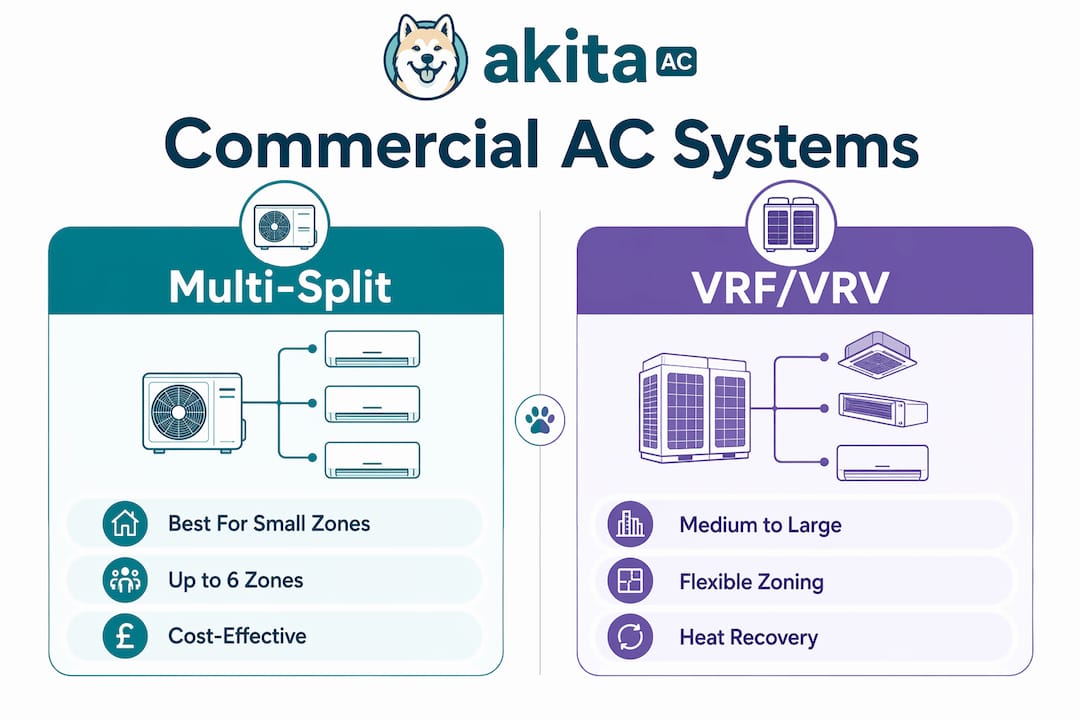
As a rough crossover point: up to five or six zones, a well-specified multi-split is usually the more cost-effective choice. Beyond that, a VRF system’s modular architecture and variable refrigerant flow start to justify the higher upfront cost through lower running costs and greater flexibility. For large floor plates or buildings with a plant room, ducted systems or chilled-water air handling units may be the right answer entirely.
Pro Tip: If your office layout is likely to change within two to three years, avoid a rigid split configuration. Installing a fixed multi-split for a space that will be reconfigured often leads to expensive decommissioning and reinstallation. Plan for indoor unit add-ons and adequate outdoor capacity from the outset.
Questions to ask at survey
Ask every prospective installer these before accepting a proposal:
- What design capacity have you calculated, and what methodology did you use?
- Does the proposed system support heat recovery, and is that relevant to our building?
- What refrigerant does the system use, and what are the servicing implications over a ten-year period?
- How does the system integrate with our existing BMS or smart controls?
- Where are the service access points, and what does annual maintenance require?
- What are the warranty terms, and do they require maintenance by an accredited engineer to remain valid?
- Are you F-Gas certified, and are you a manufacturer-accredited partner for this brand?
Red flags in proposals
- No site survey conducted before pricing (a desk-based quote is not a load calculation).
- Undersized outdoor unit relative to the total indoor unit capacity.
- No commissioning plan or handover documentation included in scope.
- Missing F-Gas certification or no evidence of manufacturer partner status.
- Controls specified with no zoning granularity — a single thermostat for an entire floor is a warning sign.
- No mention of TM44/EPB obligations if the aggregate system output exceeds 12 kW.
A closer look at each system type
VRF and VRV systems
VRF (Variable Refrigerant Flow) and VRV (Daikin’s trademarked equivalent) are the dominant choice for medium-to-large commercial buildings. A single outdoor unit connects to dozens of indoor units, each independently controlled. The inverter-driven compressor modulates refrigerant flow to match actual demand rather than cycling on and off, which is where the efficiency gains come from.

Heat-recovery VRF goes further: it can simultaneously cool one zone and heat another by transferring the heat energy extracted from the cooling zone. In a mixed-use building where the server room needs cooling year-round while the reception needs heating in winter, that recovered energy reduces net consumption. Heat recovery ventilation systems can recover approximately 85% of heat from extracted air using a counter-flow exchanger.
Mitsubishi Electric City Multi is the benchmark for large commercial VRF in the UK. It supports R32 refrigerant, offers extensive indoor unit variety (wall-mounted, cassette, concealed ducted), and integrates with most BMS platforms via Mitsubishi’s own controllers or third-party gateways. Typical installed cost for a full multi-floor system starts at £30,000 and rises significantly with building complexity.
Daikin VRV 5 is the current-generation heat-recovery flagship from Daikin. It runs on R32, supports simultaneous heating and cooling, and connects to Daikin’s D1 Net BMS. For a building where energy recovery is a genuine priority, the VRV 5 heat-recovery variant is worth specifying. VRF systems typically have higher upfront costs than multi-split setups for comparable zone counts, but operational savings often deliver payback over several years.
Statistic: Air conditioning can account for up to a third of a business’s electricity costs. Choosing a system with strong part-load efficiency is not a luxury — it directly affects the monthly bill.
Multi-split systems
Multi-split connects multiple indoor units to one outdoor unit, typically up to five or six zones. Each indoor unit has independent temperature control, but the system generally operates in a single mode — all heating or all cooling — at any one time. That limitation matters in buildings with mixed thermal demands.
For a small professional services office, a dental practice, or a retail unit with a back office, multi-split is often the most cost-effective entry point. The air conditioning buying guide from Akita covers the sizing and selection criteria in detail.
Wall-mounted split units: Mitsubishi Electric M Series
The M Series is the workhorse of small commercial installations. Running on R32, it is quiet, reliable, and straightforward to install. For a single office, server room, or meeting room, it is hard to beat on value. Typical installed cost per zone sits in the £1,500–£6,000 range depending on pipework runs and access. Inverter-driven units like the M Series can cut power consumption by up to 30% compared with older non-inverter models.

Ceiling cassettes: Daikin FXFA round-flow
The FXFA is designed for open-plan spaces where wall space is limited or aesthetics matter. Its 360° round-flow discharge distributes conditioned air evenly across the room, avoiding the cold-draught complaints that poorly positioned wall units generate. It is a fan coil unit within a VRF or multi-split system rather than a standalone product, so it needs to be paired with a compatible outdoor unit. For a reception area, open-plan office, or retail floor, it is the indoor unit of choice.
Ducted and monoblock systems
Ducted systems hide all the air distribution within the ceiling void, delivering conditioned air through grilles. They suit new-build fit-outs or major refurbishments where ductwork can be designed in from the start. Monoblock units — self-contained, typically wall-mounted externally — are a simpler option for spaces where refrigerant pipework is impractical, though they are generally less efficient and less flexible than split or VRF configurations.
What does installation actually involve, and what will it cost?
The installation timeline
- Site survey and load calculation (1–2 days): An accredited engineer surveys the building, calculates heating and cooling loads per zone, checks structural and electrical constraints, and identifies plant locations.
- Design and specification (1–2 weeks): System design, equipment selection, ductwork or pipework routing, BMS integration plan, and a costed proposal.
- Procurement (2–8 weeks): Lead times vary by manufacturer and model. VRF outdoor units for large projects can have longer lead times, particularly for bespoke configurations.
- Installation (1 day to several weeks): A single-split wall unit can be installed in a day. A full VRF system across multiple floors of a commercial building may take two to four weeks.
- Commissioning (1–3 days): F-Gas leak testing, refrigerant charge verification, controls configuration, BMS integration testing, and performance verification.
- Handover (half day): Operator training, documentation pack (commissioning records, F-Gas certificate, warranty registration, TM44 baseline data).
Cost drivers
Several factors push a project’s cost up or down significantly:
- Pipework runs: Long or complex refrigerant pipe routes add labour and materials cost.
- Electrical supply: Three-phase supply upgrades or new distribution boards add cost.
- Ductwork: New ductwork in an occupied building is expensive and disruptive.
- BMS integration: Connecting to an existing building management system requires additional controls hardware and commissioning time.
- Access: Roof plant, high ceilings, or listed building constraints all affect installation complexity.
Maintenance schedule
- Every three months: Filter cleaning on all indoor units; visual check of drain trays and condensate pumps.
- Annually: Full planned preventative maintenance (PPM) visit — coil cleaning, refrigerant pressure check, electrical connections, controls calibration, and performance logging.
- Every five years (or sooner if triggered): TM44/EPB inspection by an accredited energy assessor for systems above 12 kW aggregate.
Retaining a valid TM44 report is a legal obligation. Failure to do so can result in penalty charge notices under the Energy Performance of Buildings Regulations. The reasons to maintain commercial AC systems go beyond compliance — a well-maintained system runs more efficiently and lasts longer.
Energy efficiency, refrigerants and UK compliance in 2026
The metrics that matter
When reviewing manufacturer datasheets, focus on four figures:
- COP (Coefficient of Performance): Heating output divided by electrical input. A COP of 4.0 means 4 kW of heat for every 1 kW of electricity consumed.
- EER (Energy Efficiency Ratio): Cooling output divided by electrical input at a fixed test condition.
- SEER (Seasonal Energy Efficiency Ratio): EER averaged across a range of operating conditions. More representative of real-world performance than a single-point EER.
- SCOP (Seasonal Coefficient of Performance): The heating equivalent of SEER.
For procurement conversations, ask for SEER and SCOP figures at the specific climate zone relevant to the UK (typically the “average” European climate zone used in EN 14825 testing). A higher SEER means lower running costs per unit of cooling delivered.
| Metric | What it measures | Higher is better? |
|---|---|---|
| COP | Heating efficiency at rated conditions | Yes |
| EER | Cooling efficiency at rated conditions | Yes |
| SEER | Seasonal cooling efficiency (real-world proxy) | Yes |
| SCOP | Seasonal heating efficiency (real-world proxy) | Yes |
Refrigerant guidance
R32 is now the dominant refrigerant in new commercial split, multi-split, and VRF equipment. It has a global warming potential (GWP) of 675 — significantly lower than the R410A it replaced (GWP 2,088). Most of the systems in this article use R32, which is the right choice for new installations in 2026 from both a regulatory and servicing-availability standpoint.
R410A equipment is still in service across many UK buildings but is subject to the UK’s F-Gas phase-down schedule. If you are replacing an existing R410A system, confirm with your installer that the replacement uses R32 or a lower-GWP alternative, and factor in the disposal cost of the old refrigerant charge.
Pro Tip: Ask your installer for the F-Gas certificate at handover. This document records the refrigerant type, charge weight, and engineer credentials. You will need it for future servicing and for your TM44 inspection file.
TM44 and EPB compliance
Any air conditioning system with an effective rated output above 12 kW must be inspected by an accredited energy assessor at intervals of no more than five years. Where a building has multiple smaller units, a suitably qualified person must determine whether the aggregate capacity crosses the 12 kW threshold — several small units in adjacent rooms often do.
TM44 inspections are not just a compliance tick-box. They should highlight low-cost operational improvements — adjusting control schedules, resetting thermostat setpoints — before recommending capital replacement. For commercial energy efficiency, those control fixes are often the quickest wins available.
Why accredited specification and installation reduce your lifetime costs
The single most expensive mistake in commercial air conditioning is not choosing the wrong brand. It is choosing the wrong size, the wrong configuration, or the wrong installer. A system that is 20% undersized will run at full load continuously, wear out faster, and never achieve the comfort levels it was sold on.
What good specification looks like
A proper procurement brief should include:
- Detailed room-by-room load survey (not a rule-of-thumb estimate).
- Zoning map showing which areas need independent control.
- Heat recovery assessment for mixed-use buildings.
- BMS integration requirements and preferred control protocol.
- Commissioning report as a contractual deliverable, not an optional extra.
- Operator training included in the handover scope.
- Warranty terms confirmed in writing, including maintenance obligations.
Why F-Gas certification and manufacturer accreditation matter
F-Gas qualified engineers are legally required to handle refrigerants in the UK. Beyond the legal minimum, manufacturer-accredited partners — Mitsubishi Electric Diamond Quality or Daikin D1 partners, for example — receive factory training on specific product ranges, have access to technical support lines, and can register extended warranties on your behalf. An installation by a non-accredited engineer may void the manufacturer warranty entirely.
Pro Tip: At handover, ask for a staged demonstration: watch the engineer run the system through heating and cooling modes, check each zone independently, and verify the BMS integration is live. If the installer cannot demonstrate the system working correctly at handover, do not sign off the job.
Key takeaways
For most UK businesses, the right commercial air conditioning system is determined by zone count, building flexibility, and total lifecycle cost — not purchase price alone.
| Point | Details |
|---|---|
| Match system to zone count | Multi-split suits up to 5–6 zones; VRF becomes cost-effective beyond that threshold. |
| VRF costs more upfront | VRF typically costs more than multi-split but can deliver payback in several years. |
| TM44 compliance is mandatory | Systems above 12 kW aggregate require an accredited inspection every five years. |
| Accredited installers protect warranties | F-Gas certified, manufacturer-accredited engineers are required to retain full warranty cover. |
| Akita for commercial projects | Akita provides accredited commercial installation, load surveys, and maintenance across Suffolk, Norfolk, and Essex. |
The specification mistakes that cost businesses the most
The pattern that comes up repeatedly in commercial air conditioning projects is not a product failure — it is a specification failure. A system gets sized on a quick estimate rather than a proper load calculation. The commissioning gets rushed because the fit-out is running late. Nobody asks about BMS integration until the controls engineer turns up and finds the system uses a proprietary protocol that does not talk to the building’s existing infrastructure.
The result is a system that works, technically, but runs inefficiently, generates comfort complaints, and costs more to maintain than it should. Skipped commissioning is particularly damaging: a system that has not been properly charged, balanced, and tested from day one will degrade faster and may never reach its rated efficiency.
The fix is straightforward but requires discipline: insist on a full load survey before accepting any proposal, make commissioning records a contractual deliverable, and use an installer with manufacturer accreditation for the specific brand you are buying. Those three steps eliminate the majority of the problems that end up as expensive remedial work two years after installation.
Get a costed commercial AC proposal from Akita
Choosing between a VRF system, a multi-split, or a ducted installation is genuinely complex when you factor in building load, zoning, refrigerant compliance, and BMS integration. Akita’s commercial team handles that complexity for you.

Akita is an F-Gas certified, manufacturer-accredited installer covering Suffolk, Norfolk, and Essex. For commercial projects, the process starts with a full site survey: load calculation per zone, TM44 threshold check, refrigerant and controls recommendations, and a transparent costed proposal covering supply, installation, commissioning, and ongoing maintenance options. Flexible finance is available, and maintenance memberships keep your warranty valid and your system running at peak efficiency year-round. To arrange a survey for your premises, visit Akita’s commercial air conditioning page and request a callback.
Useful sources and further reading
- The Energy Performance of Buildings (England and Wales) Regulations 2012 — primary legislation covering TM44/EPB inspection obligations.
- GOV.UK: A guide to air conditioning inspections in buildings — plain-English guidance on inspection thresholds, intervals, and what assessors check.
- CIBSE TM44: Inspection of Air Conditioning Systems — the technical standard used by accredited energy assessors across the UK.
- Akita commercial air conditioning services — survey, specification, installation, and maintenance for commercial premises in Suffolk, Norfolk, and Essex.
- Akita: commercial HVAC energy efficiency guide — practical guidance on system selection and running-cost reduction.
- Manufacturer datasheets for COP, SEER, and SCOP figures should be requested directly from your installer during the procurement process — published headline figures are tested under standard conditions and may differ from real-world performance in your building.
This article is general information for business owners and facility managers. For compliance obligations specific to your building, consult an accredited energy assessor or qualified HVAC engineer.