

Stop repeat AC pipe sweating: DIY triage and closed cell insulation
Sweating on AC pipes is usually harmless, caused by warm humid air meeting a cold refrigerant line rather than a fault. If it’s a light film on exposed pipework, wrapping or replacing the insulation and running a dehumidifier normally sorts it within days. Heavy dripping, ice on the line, or damp appearing inside a wall means something mechanical has gone wrong, so start by checking the insulation and the condensate drain, then call a technician if either the ice or the wall moisture shows up.
TL;DR:
- Insulation deterioration and indoor humidity are the main causes of AC pipe sweating, not system faults, and should be checked first.
- Sealing all joints with proper tape and replacing old foam with high-performance elastomeric insulation prevent recurring condensation.
- Symptoms like ice on the line, oil near the unit, or water inside walls indicate mechanical issues requiring a technician’s intervention.
- Regular maintenance of filters, drains, and insulation every quarter helps prevent moisture buildup and detects problems early.
- Ignoring persistent condensation risks structural damage, mold growth, and component failure due to prolonged moisture exposure.
Table of Contents
- What causes condensation on air conditioning pipes
- How do I inspect AC pipe condensation myself?
- Fix AC pipe condensation: DIY steps that actually work
- When AC pipe sweating means a technician is needed
- Insulation materials and vapour barriers that stop it recurring
- Quarterly and annual AC maintenance checklist
- What happens if AC pipe sweating is left unfixed?
- Practitioner perspective and what actually resolves it
- Sources
- FAQ
What causes condensation on air conditioning pipes
Condensation forms the moment a pipe’s surface temperature drops below the dew point of the air around it. Refrigerant lines, particularly the suction line running back to the outdoor unit, often sit well below that threshold when the system is cooling, so any humid air touching bare or poorly wrapped copper turns to water almost instantly.
Several factors decide how bad it gets:
- Insulation condition. Foam sleeves crack, compress, or slip out of place over a few years, exposing bare metal to the room.
- Indoor humidity. Cooking, showering, drying laundry indoors, and poor ventilation all push relative humidity up, and higher humidity means a higher dew point.
- System faults. Low refrigerant charge, a restricted filter, or an oversized unit that short-cycles can all chill the suction line further than it should run, according to the US Department of Energy’s guidance on common AC problems.
- Location. Basements, attics, and garages tend to run more humid and less ventilated than living spaces, so pipes routed through them sweat first and worst.
Most cases trace back to humidity and ageing insulation rather than a broken system, according to PickComfort’s breakdown of sweating AC pipes. That’s worth remembering before you assume the worst.
How do I inspect AC pipe condensation myself?
A ten-minute walk-round tells you most of what you need to know. Work through it in this order:
- Check the indoor unit and exposed lines. Look at the suction line where it enters the wall or ceiling, and note whether moisture is on the surface only or dripping from a joint.
- Touch-test the pipe. A cold, damp line is expected; a line coated in ice is not.
- Inspect the insulation. Look for splits, gaps, or sections that have slid away from elbows and valves, where sweating concentrates first.
- Look at the condensate pan and drain. Standing water in the pan or a drain that gurgles instead of running freely points to a blockage rather than simple humidity.
- Check nearby ceilings and walls for staining. Discolouration or a musty smell suggests water has been tracking for a while.
- Measure relative humidity with a hygrometer. Anything consistently above 50% raises condensation risk on any cold surface, insulated or not.
Pro Tip: Keep a cheap hygrometer near the indoor unit for a week. If humidity spikes every evening around cooking or shower time, you’ve found your trigger without calling anyone out.
Stop the DIY checklist and call a technician if you see ice forming on the lines, an oily or discoloured fluid anywhere near the unit, water appearing inside a wall cavity, or the system running far longer than usual to reach set temperature. Those signs point to a refrigerant, airflow, or drainage fault rather than ordinary sweating.
Fix AC pipe condensation: DIY steps that actually work
Most minor sweating responds well to a handful of fixes that don’t involve opening the refrigerant circuit, which is sealed for good reason and off-limits to anyone without an EPA certification.
- Replace old insulation properly. Swap cracked foam for closed-cell elastomeric insulation, which resists water vapour far better than the thin polyethylene sleeves sold in most hardware stores. Those retail sleeves are rarely rated for continuous vapour resistance, according to MRCOOL’s technical guidance on pipe insulation, which is why the same spot keeps sweating even after a fresh wrap.
- Seal every joint and seam. Vapour bypasses a single unsealed seam as easily as bare copper, so tape or glue every join rather than just butting sleeves together.
- Cut indoor humidity. Run a standalone dehumidifier in problem rooms, switch on extractor fans when cooking or showering, and avoid drying several loads of washing indoors at once.
- Improve airflow. Change filters every one to three months, clear furniture and rugs away from return vents, and seal obvious gaps around duct joints.
- Clear the condensate drain. Check that the line slopes downward the whole way to the exit point, then flush it with warm water or a mild bleach solution through the cleanout to clear algae and sludge.
Pro Tip: If the drain trap keeps clogging every few months regardless of flushing, replace it rather than fight it. A worn trap loses its shape and holds sediment no amount of flushing shifts.
Where gravity drainage isn’t possible and a condensate pump handles the job instead, check that its float switch still works. A stuck float is one of the more common reasons homeowners find water pooling with no obvious blockage.
When AC pipe sweating means a technician is needed
Some symptoms move past simple sweating into genuine mechanical fault territory, and DIY fixes won’t touch them. Ice forming on the suction line, a hissing sound near the outdoor unit, or a line that’s noticeably colder than normal usually point to low refrigerant charge, and only an EPA-certified technician can legally handle refrigerant under federal rules.
Airflow problems show up differently: dirty evaporator coils, a blocked return, or a failing fan motor all starve the system of the air it needs and chill the lines further than they should run.
Drainage faults are the third category, and they’re often the simplest to miss:
- A blocked condensate line backing up into the pan
- A failed condensate pump
- A bypassed safety float switch, left disconnected after a previous repair
A cooling system in normal operation can shed a surprising amount of water. Indoor units have been recorded producing up to 10 to 20 litres of condensate a day, so drainage that can’t keep pace with that volume needs fixing, not just monitoring. A proper inspection covers pressure and leak testing, airflow measurement across the coil, and a full service of the condensate pump and drain.
Insulation materials and vapour barriers that stop it recurring
Closed-cell elastomeric insulation is the material of choice for refrigerant lines because it does two jobs at once: it slows heat transfer and blocks water vapour from migrating through to the cold pipe underneath. Ordinary open-cell foam or thin polyethylene sleeves let vapour pass through gradually, so moisture collects under the wrap where you can’t see it until the insulation itself starts to rot.
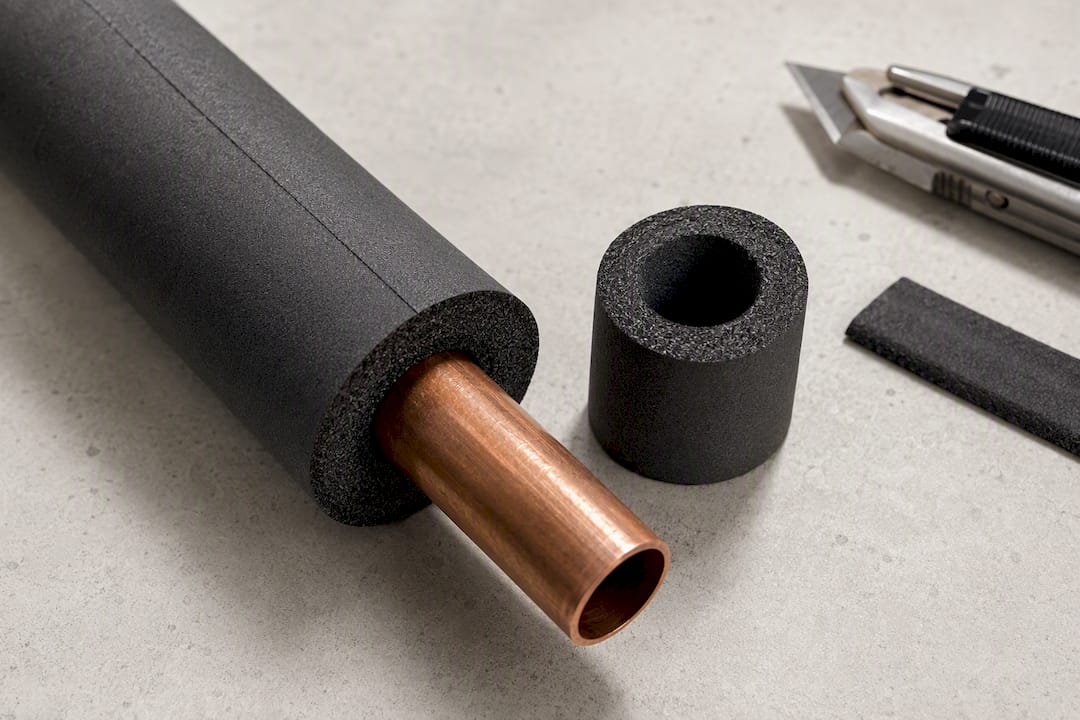
Thickness isn’t a fixed number. It depends on the ambient humidity and the pipe’s running temperature, and installers calculate a dew-point margin so the insulation’s outer surface always stays warmer than the surrounding air’s dew point, as detailed in the ACR Journal’s guidance on condensation control.
The weak points are predictable:
- Joints and elbows, where insulation is harder to fit snugly
- Valve bodies, often left thinly covered or skipped altogether
- Seams along straight runs, where tape lifts over time
Careful sealing at these points preserves the vapour barrier as a continuous shield rather than a patchwork with gaps. If sweating keeps returning despite fresh insulation, that’s usually a sign the job needs a proper site survey and an installer-calculated spec, not another roll of foam.
Quarterly and annual AC maintenance checklist
A short routine catches most condensation problems before they become drips or damp patches.
- Every quarter: Inspect visible insulation for gaps, clear the condensate trap and line, and replace or clean the filter.
- Through summer: Track indoor humidity and switch on dehumidification whenever relative humidity sits above 50% for more than a day or two.
- Once a year: Book a professional service to check refrigerant charge, clean the coils, and service the condensate pump or float switch.
- Ongoing: Keep a short log noting when sweating shows up, alongside the weather and how many people were home that day. Patterns tied to hot, humid spells or full houses point straight at humidity rather than a system fault.
What happens if AC pipe sweating is left unfixed?
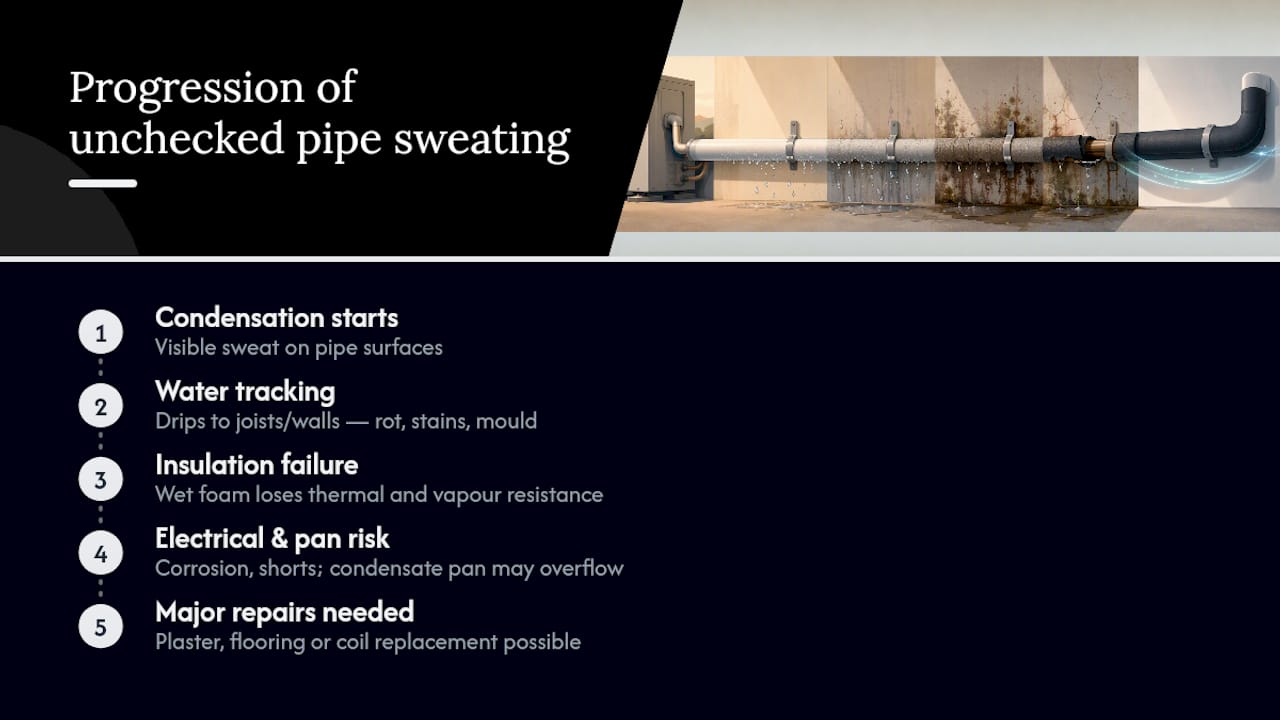
Persistent condensation does more damage the longer it’s ignored, and the effects rarely stay confined to the pipe itself. Water tracking down insulation and dripping onto ceiling joists or wall cavities over months can rot timber, stain plasterboard, and create the damp conditions mould needs to establish itself, often out of sight until the smell or the stain reaches a visible surface.
The insulation itself degrades too. Wet foam loses its thermal performance and stops resisting vapour, so a small problem compounds. Once insulation is saturated, sweating worsens rather than settles, because the wrap that was meant to stop the cycle is now part of it.
On the system side, chronic moisture around electrical connections and control boards near the indoor unit raises the risk of corrosion and short circuits, shortening the life of components that are otherwise straightforward to maintain. A condensate pan that’s constantly overwhelmed can also overflow past its safety float, sending water into places it was never designed to reach, sometimes tracking down into a floor below.
None of this happens overnight. It’s the slow accumulation, one humid summer after another, that turns a five-minute insulation fix into a repair involving plasterwork, flooring, or a replacement coil. Catching sweating early, and understanding why it’s happening rather than just mopping it up, is what actually protects both the system and the building around it.
Practitioner perspective and what actually resolves it
Most call-outs Akita sees for sweating pipes trace back to two things: insulation that’s aged past its job, or a condensate drain that’s partially blocked. A proper survey, rather than guesswork, usually resolves it in one visit. Scheduled maintenance through Akita’s Comfort Club membership catches both before they turn into drips.
— Akita
Sources
For more detail beyond this guide, these sources cover the mechanics and maintenance side in depth:
- Air conditioning pipes sweating: how to fix it | PickComfort
- Why pipe insulation is essential for HVAC systems | MRCOOL support
If insulation keeps failing or a drain keeps blocking despite your best efforts, it may be time for a proper inspection. Akita’s air conditioning maintenance service covers exactly this: checking refrigerant charge, coil condition, and drainage in one visit, and if the fault turns out to be mechanical rather than cosmetic, AC repair support is on hand across Suffolk, Norfolk, and Essex. For homes where the pipework itself needs rerouting or upgrading as part of a wider job, it’s also worth checking the cable and power requirements that come with larger split systems before work starts.
FAQ
How do I stop my AC pipe from sweating?
Wrap exposed lines in closed-cell elastomeric insulation, seal every joint, and bring indoor relative humidity below 50% with a dehumidifier or better ventilation. If sweating continues after that, check the condensate drain for blockages before assuming a system fault.
Why is there condensation on my air conditioner’s pipes?
Warm, humid air is meeting a cold refrigerant line and reaching its dew point, most often due to worn insulation or high indoor humidity. Less commonly, low refrigerant charge or restricted airflow chills the line further than normal and makes sweating worse.
Is it normal for an AC condensate line to drip?
Yes, some dripping from the condensate line outdoors is normal while the system is cooling, since indoor units can produce 10 to 20 litres of condensate a day. Heavy, constant dripping or water appearing indoors is not normal and points to a blocked or faulty drain.
Is it normal for moisture to be on the AC pipe?
A light, even film of moisture on an exposed refrigerant line is normal in humid weather. Ice, heavy dripping, or damp tracking into a wall is not, and signals an insulation, airflow, or refrigerant problem worth a technician’s attention.