

Homeowners: 5 Quick Checks to Fix Weak AC Airflow and What to Record
In most homes, weak airflow from an air conditioner comes down to one thing: a blocked filter starving the system of air. Check it before anything else. If the filter is clean and airflow is still poor, look next at frozen coils, closed vents, or a struggling blower motor. Leave anything involving refrigerant or wiring to a certified engineer.
TL;DR:
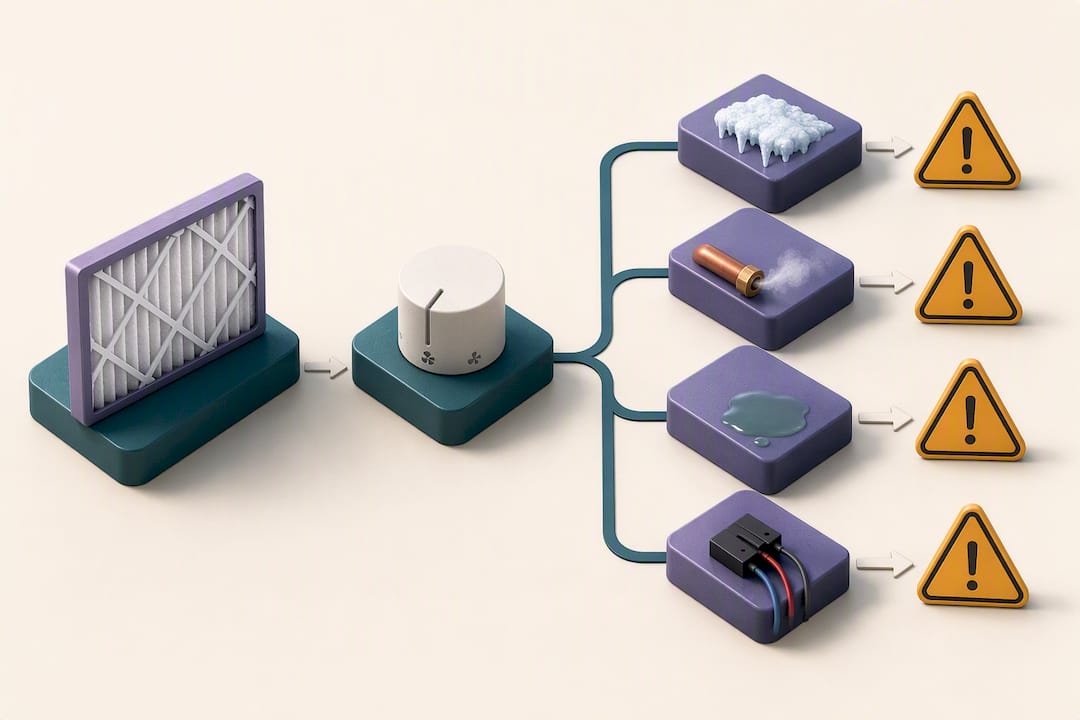
- Checking and replacing a dirty filter is the simplest way to restore airflow, and it can fix most cases within five minutes.
- Frozen coils often stem from restricted airflow or refrigerant issues and require a full thaw before further troubleshooting.
- Leaks or disconnections in ductwork cause partial airflow loss, especially if only certain rooms are affected, while systemic issues impact the whole house.
- Mechanical faults like failing blower motors or worn fan resistors cause gradual airflow decline, often accompanied by unusual noises.
- Homeowners should avoid refrigerant or electrical repairs and instead record symptoms and contact certified engineers when severe signs like refrigerant leaks or repeated coil freezing occur.
Table of Contents
- What causes weak AC airflow — a homeowner’s breakdown
- Quick checks and safe fixes you can do now
- When to call a professional and what to record first
- Preventative maintenance to stop weak airflow returning
- Akita’s practical support: diagnostics, repairs and maintenance memberships
- Why most weak-airflow advice skips a step
- Get your airflow fixed properly with Akita
- Sources
- FAQ
What causes weak AC airflow — a homeowner’s breakdown
A dirty filter is the single most common reason air conditioners stop pushing enough air, and it is also the easiest to fix. ASHRAE recommends checking filters every one to three months during heavy use, because dust and pet hair build up gradually enough that most people do not notice until the airflow has already dropped by half. A clogged filter does not just weaken the breeze from your vents. It forces the system to work harder, drives up your energy bill, and starves the evaporator coil of the warm air it needs to stay above freezing.
That last point matters more than most homeowners realise. When airflow drops far enough, moisture on the coil freezes instead of draining away, and you end up with a block of ice sitting where warm air should be passing through. The unit might still feel cold at the vent, but the airflow will be feeble at best. According to StayKool, frozen coils are almost always a downstream effect of restricted airflow or low refrigerant, not a fault on their own, and they need a full thaw before you touch the system again. Our guide to frozen evaporator coils covers this in more depth if you are seeing visible frost.
Ductwork is the part homeowners overlook most, largely because it is hidden behind walls and ceilings. A leak, a disconnected joint, or a section crushed during a loft clearance will not stop your system running. It just means the air you paid to cool escapes before it reaches the room. This is where symptom patterns become useful diagnostically: if every room in the house is short on airflow, the problem is more likely sitting at the shared outdoor unit. If only one room is affected, suspect a local duct issue, a closed vent, or a fault specific to that zone’s controller.
Mechanical faults inside the indoor unit deserve equal attention. A blower motor that is failing will often still spin, just slower or with a rattle, so the airflow drop can be gradual rather than sudden. A worn fan resistor produces a similar symptom: the highest fan speed still works, but the lower settings barely move air. If you notice a grinding or clicking sound alongside the weak airflow, that is a mechanical clue worth mentioning to an engineer rather than ignoring.
Sometimes the fault is not a fault at all. Thermostats set to “auto” fan mode only run the blower when actively cooling, which can feel like weak airflow compared to a system left on continuous fan. Some units also default to a low fan speed after a power cut or firmware reset. According to Aircon Adviser, settings mistakes are common enough that testing the controls should happen before assuming anything mechanical has failed.
Finally, age plays a background role. Systems running past 12 to 15 years often show weak airflow as one of several symptoms, alongside rising energy bills and uneven cooling, simply because ductwork, motors, and coils degrade together over time. If every other fix has been tried and airflow is still poor, an ageing or undersized system may be the actual explanation.
Common culprits, roughly in order of likelihood:
- Dirty or clogged air filter restricting intake air
- Frozen evaporator coil from restricted airflow or low refrigerant
- Duct leaks, disconnections, or crushed sections
- Blower motor or fan resistor faults
- Incorrect thermostat or fan settings
- Ageing or undersized system as an underlying cause
Quick checks and safe fixes you can do now
Work through these steps roughly in order. Most weak-airflow problems resolve at step one or two.
- Check and clean or replace the filter. Pull it out, hold it up to a light source, and if you cannot see light through it clearly, it needs cleaning or replacing. Aircon Adviser notes this takes most homeowners two to five minutes on wall and portable units, and it is often enough on its own to restore normal airflow. During peak summer use, repeat this every one to three months.
- Test the fan speed and thermostat mode. Switch from “auto” to “cool” mode and cycle through each fan speed. If low and medium settings barely move air but high works fine, that points to a fan resistor or blower fault rather than a blockage.
- Inspect every vent and register in the affected rooms. Confirm dampers are fully open, furniture is not blocking the grille, and curtains have not fallen across a floor vent. This sounds obvious, but it is one of the most frequently missed causes.
- Check clearance around the outdoor unit. Power it off first, then clear leaves, grass cuttings, or anything piled against the fins. Keep a healthy clearance of open space around the condenser so it can breathe properly, and never use a pressure washer on the fins.
- If you see ice on the indoor coil, switch the system off completely and let it thaw naturally. This usually takes one to two hours; do not use a hairdryer or scrape the ice, as both risk damaging the coil. Once it has fully cleared, clean or replace the filter, then restart. If it freezes again within a day or two, stop and call an engineer, since repeat icing usually points to a refrigerant leak.
You can use tape to temporarily seal an obviously split section of visible ductwork as a stopgap, but treat it as exactly that. It buys you time, not a repair. Our step-by-step troubleshooting guide walks through this same sequence with more detail on spotting each fault.
Pro Tip: Run through steps one and two before you touch anything outdoors. A dirty filter and the wrong fan mode together account for the majority of “weak airflow” calls, and both take under ten minutes to rule out.
Do not attempt anything involving refrigerant, the sealed cooling circuit, or mains wiring yourself. Beyond the safety risk, refrigerant work legally requires certification in most jurisdictions, and getting it wrong can damage the compressor entirely.
When to call a professional and what to record first
Some symptoms are a clear signal to stop troubleshooting and book an engineer.
- The coil freezes again shortly after you have let it fully thaw and cleaned the filter
- You hear a hissing sound near the indoor or outdoor unit, which can indicate a refrigerant leak
- The blower does not run at all, even after checking power and settings
- A breaker trips repeatedly when the system starts
- Grinding, banging, or a burning smell from either unit
None of these are safe or legal for a homeowner to fix directly. Refrigerant handling, sealed-system repairs, and mains electrical work all require a certified engineer, both for your safety and to keep any warranty intact.
Before the visit, gather a few details that will save time and often money. Note which specific vents feel weak versus normal, whether the issue affects every room or just one, and what time of day it seems worse. Photograph the outdoor unit’s condition, jot down any error codes on the display, and mention any unusual smells. If the fan has stopped entirely, our guide on what to record when your AC fan won’t spin gives a fuller checklist. A typical diagnostic visit involves refrigerant pressure checks, blower speed testing, and a duct inspection, usually billed as a call-out or diagnostic fee separate from any parts and labour needed for the repair itself.
Preventative maintenance to stop weak airflow returning
Most weak-airflow callouts trace back to a maintenance gap rather than a sudden fault, which means the fix is largely about routine rather than repair.
Filters are the obvious starting point. Check them monthly during summer and swap or clean them every one to three months depending on use, pets, and local dust levels. A basic pleated filter is fine for most homes; higher-rated filters trap finer particles but can restrict airflow further if the system was not designed for them, so match the filter to your unit’s specification rather than buying the highest rating available.
Clearance matters just as much as cleaning. Keep roughly 30 to 50 centimetres of open space around outdoor condensers, away from fences, bins, and overgrown shrubs, since restricted airflow at the condenser reduces the whole system’s cooling capacity. Heatable makes the same point about clearance and warns against pressure-washing the fins, which bend easily and reduce airflow further. Partner guidance on commercial ventilation from Hoods Kitchen Exhaust covers similar clearance and blockage principles, useful if you are managing a small business site alongside a home system.
Build two fixed checkpoints into your year: one before the cooling season starts, covering filters, vents, and outdoor clearance, and one at the end of the season to catch any wear before it sits idle over winter. Our broader homeowner’s guide to common HVAC problems is worth bookmarking for that seasonal review.
- Check filters monthly in summer, replace every 1 to 3 months
- Keep 30 to 50 centimetres of clearance around the outdoor unit
- Book a seasonal check before and after peak summer use
- Consider an annual professional service if the system is over five years old
Pro Tip: If you’ve replaced the filter twice this summer and airflow is still inconsistent, that’s usually the point where a professional service pays for itself rather than another DIY attempt.
Akita’s practical support: diagnostics, repairs and maintenance memberships
A proper diagnostic visit goes well beyond swapping a filter. A certified engineer checks refrigerant pressure against the manufacturer’s specification, tests the blower motor across every fan speed, and inspects accessible ductwork for leaks or disconnections that a homeowner simply cannot see without specialist tools. That combination is what catches the faults this article’s checklist cannot: a slow refrigerant leak, a failing resistor, or a duct joint that has worked loose behind a ceiling panel.
Professional diagnostic visits and repair work are available for air conditioning issues once a fault is identified. What that typically covers:
- Diagnostic checks covering refrigerant levels, blower performance, and visible ductwork
- Repairs carried out by F-Gas certified engineers, which is a legal requirement for any refrigerant-related work
- Ongoing servicing through the Comfort Club Membership, aimed at catching filter and airflow issues before they become breakdowns
Certification matters here in a way that goes beyond box-ticking. F-Gas certification specifically covers safe handling of the refrigerants used in most residential and commercial systems, which is precisely the work a homeowner cannot legally or safely attempt. If your own checks have ruled out the filter, the vents, and the settings, and airflow is still weak, that is the point to book a professional AC repair rather than keep guessing.
Why most weak-airflow advice skips a step
Most guides on this topic jump straight to a checklist and stop there. What they miss is the sequencing: check the cheap, fast things first, but stop the moment a symptom suggests refrigerant or electrical involvement. Homeowners who get into trouble usually do so not because they tried to fix a filter, but because they kept pushing past a warning sign like repeat icing or a hissing sound.
The other gap is documentation. An engineer working from “it’s just weak” wastes half the visit re-discovering what you already know. A homeowner who can say which rooms are affected, when it started, and what the outdoor unit sounded like gets a faster, often cheaper diagnosis.
If there’s one thing worth prioritising above all else, it’s the filter check. It’s unglamorous, but it resolves more weak-airflow cases than every other cause combined. Everything past that point is about knowing your limits and handing over cleanly when a job needs certification you don’t have.
— Akita
Get your airflow fixed properly with Akita
If your own checks have not solved it, the next step is a proper diagnostic rather than another guess. Qualified engineers offer refrigerant checks, blower testing, and duct inspections with transparent fixed quotes rather than open-ended billing.

For a one-off weak-airflow problem, book an air conditioning repair and an engineer will identify the exact cause rather than treat the symptom. If your system has been showing repeated issues over more than one season, ongoing air conditioning maintenance through the Comfort Club Membership catches filter and airflow problems before they turn into a breakdown, with flexible finance available if a bigger repair or replacement is needed. Either way, the next step is the same: get a real diagnosis instead of another round of guesswork, starting with a quote from Akita.
Sources
- ASHRAE
- StayKool — ‘Car AC Weak Airflow? Here’s Why’
- Aircon Adviser — ‘Air conditioner not cooling? Causes and fixes’
FAQ
How do you fix weak AC airflow?
Start by checking the air filter. It is the most common cause of weak airflow and takes only a few minutes to inspect. If the filter is clean, test your fan speed and thermostat mode next, then check vents and outdoor unit clearance before considering a professional visit.
Why is my AC cold but airflow is weak?
This usually means the evaporator coil is frozen. Ice can form when airflow is restricted or refrigerant is low, and the unit will still feel cold at the vent even though very little air is actually moving. Switch the system off, let it thaw fully for one to two hours, clean the filter, then restart.
Why do I barely feel air coming out of my vents?
The most likely causes are a blocked filter, a closed or obstructed vent, or a fan set to a low speed or “auto” mode. If every room in the house is affected rather than just one, the fault is more often at the shared outdoor unit than at an individual vent.
When should I stop troubleshooting and call an engineer?
Call a professional if the coil re-freezes shortly after thawing, you hear hissing near the unit, the blower will not run at all, or a breaker keeps tripping. These point to refrigerant or electrical faults that require certified handling, not homeowner repair.
Does Akita charge for a diagnostic visit?
Akita provides transparent fixed quotes for repair work, though a specific diagnostic call-out fee is not published on the site. Current pricing details are available through Akita’s repair page or by requesting a quote directly.