

12–60 Month 0% APR HVAC Financing: How Dealers Hide the True Cost
Dealer 0% APR HVAC financing is real and widely offered by manufacturers and participating installers, usually for 12 to 60 month terms, but it isn’t automatically the cheapest route. It’s credit gated, and the “financed” price can sometimes carry a premium the cash price doesn’t. Before signing anything, ask the dealer for the representative example and the equivalent cash price, then compare the two side by side.
TL;DR:
- Zero percent APR financing often includes extra fees or higher total costs that may surpass the cash price, so always compare figures side by side.
- Qualification typically requires a high credit score, no recent defaults, and proof of income, with shorter promotional terms being easier to qualify for.
- The total financed amount can be higher than the cash price due to pricing strategies, so requesting both quotes on the same document is crucial.
- Rebate and tax credits usually do not reduce the financed amount, so confirm how any incentives are applied before signing.
- Trustworthy dealers are transparent with clear cash and financed prices, provide written examples, and answer key questions about fees and loan underwriting.
Table of Contents
- What is 0% APR HVAC financing and how do dealers fund it?
- What terms and eligibility rules should you expect?
- Is 0% APR actually cheaper than paying cash?
- How do you apply for and claim a dealer 0% offer?
- Does 0% financing affect your rebates and tax credits?
- What red flags and questions should you raise with your dealer?
- How does Akita handle 0% offers with customers?
- Ready for a transparent HVAC quote?
- Sources
What is 0% APR HVAC financing and how do dealers fund it?
Zero percent APR means exactly what it says: you repay only the amount borrowed, with no interest charged across the promotional term. That’s different from deferred interest, where interest quietly accrues in the background and gets billed in full if you miss the payoff date, and different again from a low rate personal loan, where you’re charged a small but real interest rate throughout.
Manufacturers and dealers subsidise the interest cost through arrangements with third party finance companies as a marketing expense.
- A typical representative example might be a system split into equal monthly payments with $0 interest across the term.
- Approval requires a credit check, and the best advertised rates are generally reserved for applicants with stronger credit.
- Weaker applicants may be offered the same system at a higher rate, or a shorter promotional term.
Statistic callout: The finance partner, not the installer, usually makes the lending decision. That’s why two homeowners buying the identical system from the same dealer can walk away with different terms.
What terms and eligibility rules should you expect?
Promotional terms cluster around a handful of common lengths, and the term you pick changes what the lender is willing to approve.
Promotional terms often range from several months to multiple years, with shorter terms generally easier to qualify for and longer terms often requiring stronger credit profiles.
Eligibility markers vary by lender, but most check a similar set of things: a minimum credit score (often in the high 600s to low 700s for the best 0% tiers), no recent defaults or bankruptcies, and sometimes proof of steady income or employment. Homeownership itself is rarely a formal requirement, though some lenders ask for it informally since HVAC work is tied to a fixed address.
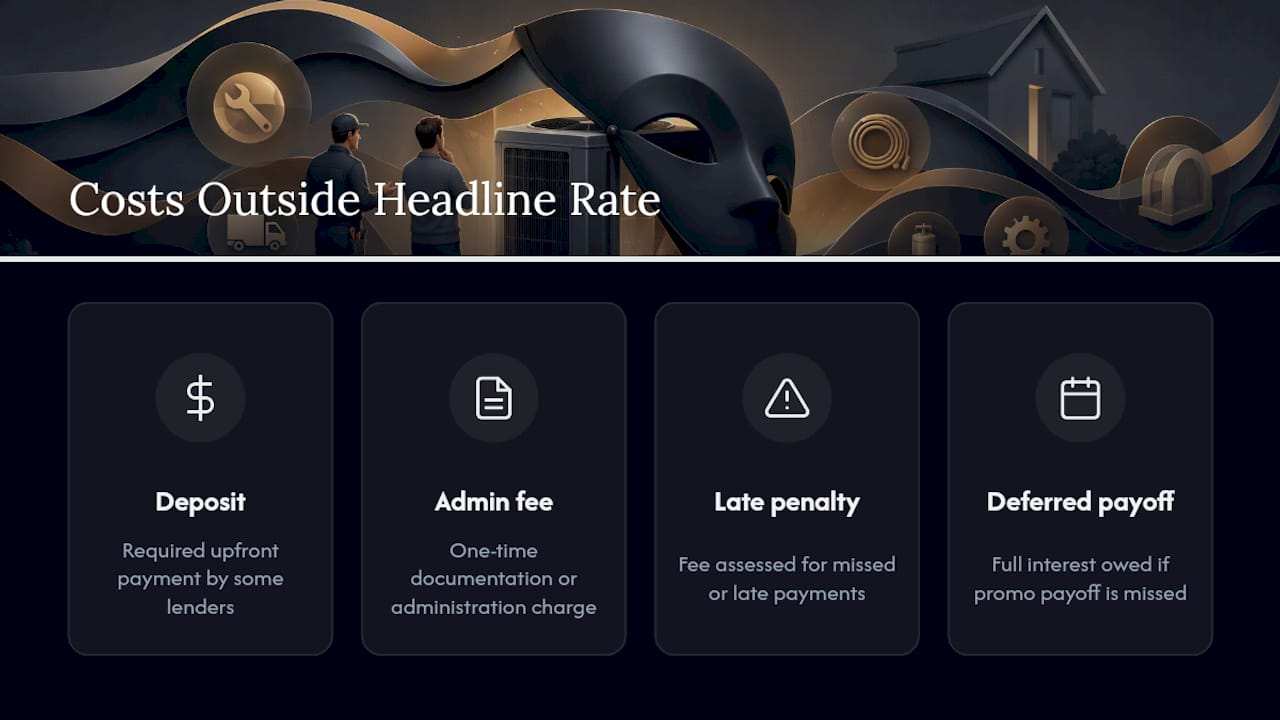
Watch for costs that sit outside the headline rate: a required deposit, a one time admin or documentation fee, a late payment penalty, and, critically, what happens if you miss the promotional payoff date on a deferred interest product mistaken for true 0%.
Is 0% APR actually cheaper than paying cash?
The only reliable way to know is to compare two numbers side by side, not to trust the sign on the storefront.
- Ask the dealer for the cash price on the exact same system, same brand, same install scope, in writing.
- Ask for the representative finance example: monthly payment, number of payments, and total amount payable.
- Add up every financed payment. If that total is higher than the cash price for the identical job, the difference is the cost of financing, dressed up as free.
- Check both invoices line by line. A financed price that’s a few hundred dollars higher than cash for the same equipment and labour is a sign the 0% has been priced in rather than genuinely absorbed.
Pro Tip: Get both quotes on the same piece of paper, on the same day. Dealers sometimes quote cash price on a Monday and finance price on a follow-up visit, which makes side-by-side comparison harder than it should be.
Consumer guidance consistently points to this cash-versus-financed comparison as the single most useful check a buyer can run before signing.
How do you apply for and claim a dealer 0% offer?
The process is fairly standardised across most participating dealers, though timelines shift with lender demand and the season.
- Get your paperwork ready before the quote visit: photo ID, recent proof of income (a pay stub or two years of tax returns for self-employed applicants), and proof you own the property.
- Submit the application, usually online or in-app at the point of quoting. Most finance partners start with a soft credit check that doesn’t affect your score, followed by a hard check only once you accept an offer.
- Wait for a decision, often same-day or within 24 to 48 hours, then book the installation date once approved.
- Sign the finance agreement at contract stage, which should include the representative APR example, total payable, and payment schedule in writing before any work begins.
Installation typically follows within a few weeks of approval, depending on availability and scheduling.
Does 0% financing affect your rebates and tax credits?
This is where a lot of homeowners lose money without realising it, because the timing of an incentive changes what you should actually be financing.
- Point-of-sale rebates reduce the price before financing is calculated, so you only borrow the discounted amount.
- Manufacturer or utility rebates paid after purchase don’t touch the financed balance at all. You keep paying the full loan and receive the rebate separately, later.
- Federal or state tax credits are claimed on your return the following year and never reduce what you finance today.
The safest move is to ask for a line-item estimate that shows exactly how any rebate is applied, and to get that in writing before you sign. The Usa is a useful starting point for checking which federal programmes might apply to your project, and Akita’s own breakdown of HVAC tax credits and what’s still available covers the current federal picture in more detail.
What red flags and questions should you raise with your dealer?
Some warning signs are easy to miss when you’re focused on getting the new system installed quickly.
- No representative APR example provided before you sign anything.
- The dealer won’t give you a cash price for comparison, or stalls when asked.
- Fees mentioned for the first time at the signing table, not during the quote.
- Vague answers about who actually underwrites the loan.
Ask directly: what’s the cash price for this exact scope of work? Who is the finance provider? Is there a deposit? What’s the late payment fee? Can I repay early without penalty? A credit APR comparison guide covers similar verification questions worth applying to any promotional credit offer, not just HVAC.
Pro Tip: If a dealer can’t answer these five questions clearly and in writing, treat that as your answer. Reputable finance partners expect these questions and have the paperwork ready.
If you believe you’ve been given misleading finance terms, consumer protection agencies are the appropriate contacts to raise concerns with.
How does Akita handle 0% offers with customers?
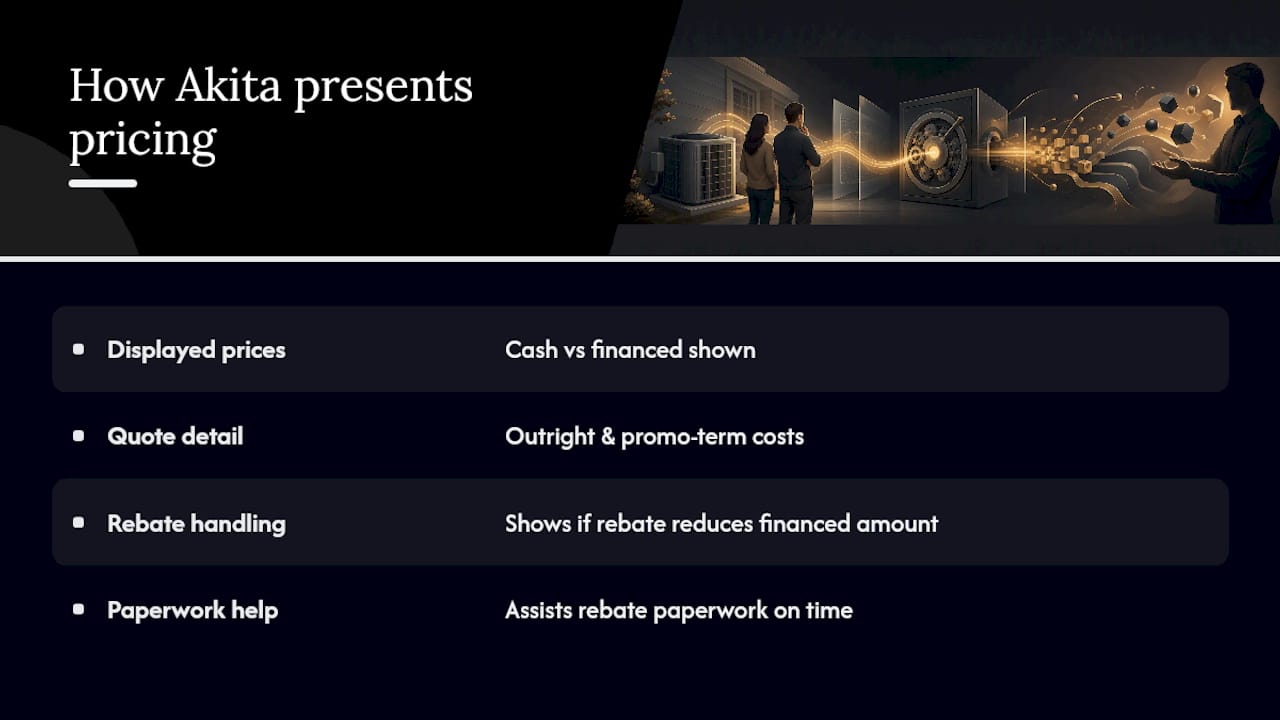
Akita treats the cash price and the financed price as two figures a customer should see side by side, not one number with financing folded in silently. Every quote is written to show what the job costs outright and what it costs across a promotional term, so the comparison in this article is one homeowners can actually run against a real estimate.
Where a rebate or utility incentive applies, Akita documents how it’s handled, whether it reduces the amount financed or arrives afterwards, and helps customers get the right paperwork submitted on time rather than discovering the deadline has passed.
— Akita
Ready for a transparent HVAC quote?
Akita is the practical alternative to the “sign here and find out later” approach that gives 0% financing a bad name. Some companies separate the cash price from the financed price from the outset, so customers can compare real numbers rather than guessing whether the interest-free offer has been priced into the equipment cost.
For homeowners weighing a new system against ongoing repair costs, knowledgeable teams can talk through eligibility for current promotional finance terms alongside any rebate or tax credit paperwork that applies to the job. If you’re comparing 0% against other routes, Akita’s guide to distinguishing genuine 0% offers from deferred interest deals is worth reading first, and the questions to ask before hiring an installer checklist pairs well with the verification steps covered here.
The next step is straightforward: request a finance-capable quote for your home installation, or check the fixed-price air conditioning install option if you already know the scope of work you need.