Whether you need planning permission for air conditioning depends on your property, where the outdoor unit goes and what type of system it is. For many houses, a carefully sited system can be installed without a formal application, but that is not guaranteed, and the rules for air conditioning differ from those for air source heat pumps. This guide sets out the main points for England in general terms. The rules are updated from time to time, so always check the current guidance or ask your council if you are unsure.
Planning permission and permitted development
Most building work needs planning permission unless it falls within permitted development, which allows certain minor works without an application, subject to conditions. Permitted development rights for houses are set out in national legislation, but they can be removed or restricted locally, and they do not apply in the same way to flats, commercial premises or listed buildings.
Air source heat pumps
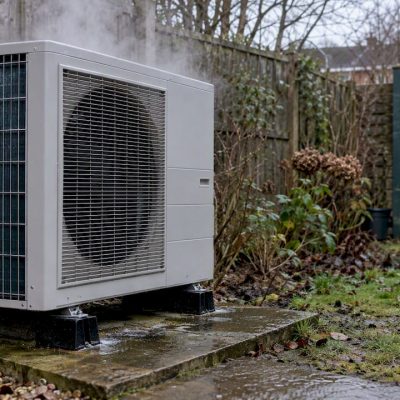
In England, installing an air source heat pump at a house is often permitted development, provided conditions are met. These conditions cover matters such as the number of units, size, siting relative to boundaries and roofs, and a noise standard at neighbouring properties. Additional restrictions apply in conservation areas, for example on units facing a highway, and the rights do not apply to listed buildings or land within their curtilage. The detailed conditions have been revised in recent years, so check the current rules before relying on them.
Air conditioning units
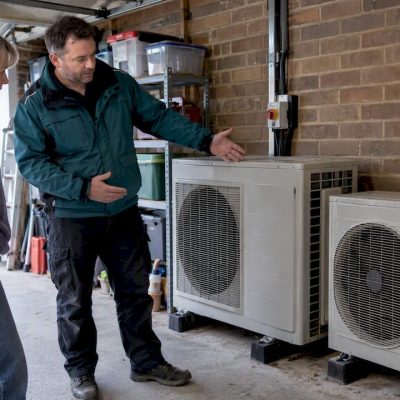
Air conditioning units, which are air-to-air systems, are not specifically covered by the permitted development rules for air source heat pumps. In practice, councils take different approaches. Some consider that a small, discreetly sited outdoor unit on a house is minor enough not to require permission; others treat it as development needing permission, particularly if it is prominent or in a sensitive location. Because of this, if the outdoor unit will be visible from a road or public space, or you are in any doubt, ask your council before installing.
When you are more likely to need permission
- Listed buildings. Listed building consent is likely to be needed for installation in or on a listed building, and planning permission may also be required. See our listed buildings guide.
- Conservation areas. Visible units, especially on the front of a building or facing a highway, are more likely to need permission.
- Article 4 directions. Some areas have directions that remove specific permitted development rights.
- Flats and maisonettes. Permitted development rights for houses do not apply in the same way, and you may also need consent from the freeholder or management company.
- Commercial premises. Units on business premises usually need planning permission, and councils may require a noise assessment.
- Prominent locations. Units on front elevations, roofs or high on walls facing the street.
Siting tips that reduce planning risk
- Place the outdoor unit at the rear or side of the property, away from the street.
- Mount it at ground level or low on a wall rather than high up.
- Keep it away from boundaries and neighbours’ windows.
- Use a quiet unit and anti-vibration mounts.
- Consider a multi-split system to reduce the number of outdoor units.
- Route pipework neatly in trunking coloured to match the wall, or internally where possible.
Noise
Even where permission is not needed, noise from equipment can be investigated by the council as a potential statutory nuisance. Good siting and quiet equipment avoid most issues. Our guide to air conditioning noise explains more.
How to check
- Look at the planning section of your council’s website for guidance on air conditioning and heat pumps.
- Check whether your property is in a conservation area or subject to an Article 4 direction.
- Check whether your property is listed using the Historic England list.
- If still unsure, use your council’s pre-application advice service, or apply for a lawful development certificate, which confirms formally that a proposal does not need planning permission.
Building regulations
Planning and building regulations are separate. Fixed heating and cooling systems should meet the expectations of Part L for efficiency, controls and commissioning, and electrical work must meet the wiring regulations. Refrigerant work must be carried out by F-Gas certified engineers.
How we help
We consider planning on every survey. We will tell you if we think your proposed location is likely to need permission or consent, and suggest alternatives that reduce visual impact. We can supply equipment details, sound levels and positions for any application. We advise but do not submit planning or listed building consent applications on your behalf, and we do not install until you have confirmed any necessary permissions are in place.
Installations start from £1,300, and domestic air conditioning is currently zero-rated for VAT. Read more on our air conditioning installation page, or about homes we look after in Long Melford.
Book a free survey
Ready to talk about your property? Book a free survey and one of our engineers will assess your space and recommend the right system for it.