

Why choose professional installation: a homeowner's guide
TL;DR:
- Hiring a qualified professional improves safety, ensures legal compliance, and extends equipment lifespan. Proper installation enhances performance, reduces running costs, and preserves warranty coverage over time. Aftercare and maintenance plans offered by professionals protect your investment and system longevity.
For most home and business installations, hiring a qualified professional is the right call. The safety risks, regulatory requirements, and long-term cost implications of getting it wrong are simply too significant to ignore.
TL;DR
- A professional installer keeps you safe, legally compliant, and covered by warranty from day one.
- Correct installation directly improves performance and extends equipment lifespan, cutting running costs over time.
- Aftercare and maintenance plans, available from professional installers, protect your investment long after the job is done.
This guide covers HVAC, flooring, security systems, and doors. There are a handful of finishing tasks an experienced DIYer can handle safely, but regulated and safety-critical work belongs with the professionals every time.
Table of Contents
- What are the real benefits of hiring a professional installer?
- Safety and UK regulatory compliance: when certification is non-negotiable
- How correct installation improves performance and extends equipment life
- Warranties, guarantees, and the paperwork you must keep
- Realistic costs and timelines for common installations
- When DIY is reasonable and where the red lines are
- How to choose a qualified UK installer: a practical checklist
- Aftercare and maintenance plans: the benefit most people overlook
- Key takeaways
- The installer’s perspective: what the job actually looks like
- Akita: fixed-price installation and maintenance across Suffolk, Norfolk, and Essex
- Useful sources and further reading
What are the real benefits of hiring a professional installer?
The advantages of hiring experts go well beyond a tidy finish. Here is what you actually get:
- Safety and compliance: Professionals work to current UK Building Regulations and industry standards, reducing the risk of electrical faults, refrigerant leaks, structural failures, and fire hazards.
- Correct sizing and fit: A qualified installer carries out load calculations and site surveys before specifying equipment. An undersized AC unit runs constantly and still fails to cool; an oversized one short-cycles and wears out prematurely.
- Energy efficiency: Properly commissioned systems run at their rated efficiency. Poor installation can add unnecessary running costs month after month.
- Workmanship: Professionals follow National Occupational Standards that define performance criteria, risk assessments, and testing procedures for every stage of the job.
- Warranty protection: Most manufacturers require professional installation to keep warranties valid. DIY voids that protection immediately.
- Speed and convenience: An experienced team completes work in a fraction of the time a DIYer would spend, with far less disruption.
- Aftercare: Certified installers offer maintenance plans, scheduled servicing, and priority call-outs. That ongoing relationship is one of the most underrated benefits of professional installation.
For flooring, correct subfloor preparation and moisture testing prevent warping and squeaking. For doors, accurate alignment and threshold work stop draughts and security weaknesses. For security systems, proper cable routing and camera placement determine whether footage is actually usable. The common thread is that professional installation affects not just the day of the job, but every day the system runs afterwards, and it tends to add measurable value to the property itself.

Safety and UK regulatory compliance: when certification is non-negotiable
Some installations carry genuine legal and safety obligations that make professional certification a requirement, not a preference.
The principal risks of unqualified installation:
- Electrical faults from incorrect wiring in security systems or HVAC controls
- Refrigerant mishandling, which is both a health hazard and a criminal offence under UK F-Gas regulations
- Structural compromise from poorly fitted doors or improperly prepared subfloors
- CCTV power and networking failures that leave a property unprotected
UK certifications and schemes to look for:
- F-Gas certification / REFCOM: Any engineer handling refrigerants in air conditioning or heat pump systems must hold a valid F-Gas qualification. This is a legal requirement under UK retained F-Gas regulations, not an optional extra.
- MCS (Microgeneration Certification Scheme): Required for heat pump installations where the homeowner intends to claim government incentives. MCS-certified installers meet defined competence and quality standards.
- Building Regulations (Part F and Part L): Relevant to HVAC and ventilation work. Part L covers energy efficiency; Part F covers ventilation adequacy. Notifiable work must be signed off, either by a building control officer or a competent-person scheme member.
- City & Guilds Level 3 NVQ Diploma in Heating and Ventilating: A recognised qualification benchmark for engineers working on commercial and industrial systems.
Air conditioning inspections in buildings with systems above a certain output threshold must be carried out by a current member of an accredited energy assessor scheme. These inspections are designed to improve efficiency and reduce energy consumption, and the assessor must hold current accreditation. Skipping this requirement can invalidate building insurance and expose property owners to regulatory penalties.
Non-compliance is not just a paperwork problem. Voided insurance, invalidated warranties, and potential enforcement action are the practical consequences of using an unqualified installer for regulated work.
How correct installation improves performance and extends equipment life
Correct installation directly improves efficiency and extends the working life of your equipment. The link between installation quality and long-term performance is well established: A large majority of service problems can be traced back to poor installation practices rather than equipment faults…
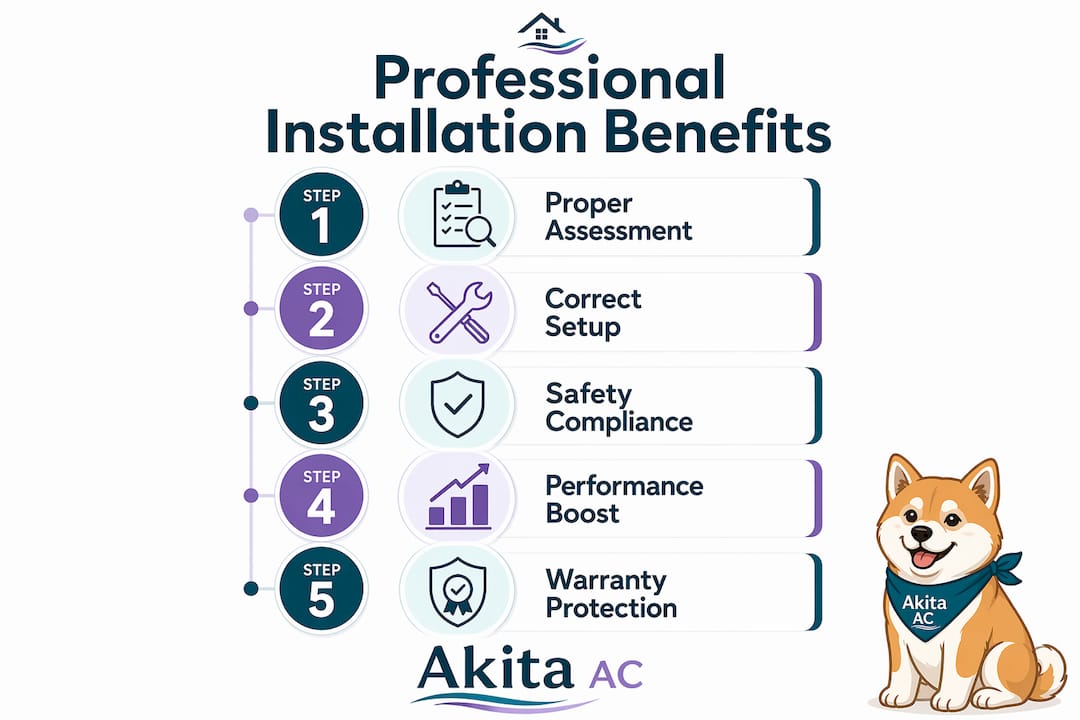
For HVAC systems, the critical steps are load calculations, correct unit placement, ductwork sealing, and full commissioning. A system that is correctly sized for the space it serves runs fewer cycles, reaches target temperature faster, and draws less power doing it. Proper load calculations and commissioning reduce uneven performance, excess noise, and unnecessary energy use. A system that is not commissioned properly may run, but it will not run well.
Consider two scenarios. A homeowner fits a split-system AC unit themselves, guessing at the capacity and mounting the indoor unit on an exterior wall with no insulation break. The system struggles to maintain temperature, runs almost continuously in summer, and develops a refrigerant leak within eighteen months because the pipework joints were not pressure-tested. A professionally installed system of the same model, correctly sized and commissioned, runs efficiently and requires only routine servicing for years.
For flooring, professional subfloor preparation and moisture testing prevent the warping and joint separation that appear six months after a DIY fit. For doors, correct alignment and threshold adjustment stop the gradual settlement that leads to draughts and difficulty closing. The pattern is consistent across categories: the installation determines the performance, not just the equipment itself.
Warranties, guarantees, and the paperwork you must keep
Manufacturer warranties often require that products are installed by qualified technicians. If they are not, coverage is invalidated, and you are left carrying the full cost of any fault, regardless of whether the fault was installation-related.
Documents to obtain and keep after every professional installation:
- Detailed invoice specifying the equipment, model numbers, and scope of work
- Commissioning or handover report confirming the system was tested and set up correctly
- Warranty certificate from the manufacturer, with the installer’s details recorded
- Copies of the installer’s qualifications and registration numbers
- Signed labour guarantee from the installer (where offered)
Professional installers can offer their own labour guarantees on top of manufacturer warranties. These cover the cost of returning to rectify any installation-related fault within the guarantee period, which is a meaningful protection that DIY simply cannot replicate.
Pro Tip: Before the engineer leaves, ask them to walk you through the commissioning report and confirm that the manufacturer’s warranty has been registered in your name. Some manufacturers require online registration within a set number of days of installation. Missing that window can shorten or void coverage even when the installation was professional.
Realistic costs and timelines for common installations
Professional installation costs more upfront than DIY. It almost always costs less over the lifetime of the equipment. Professional AC installation pays for itself through lower running costs, fewer breakdowns, and avoided repair bills.
Here are realistic timelines from quote to handover for common jobs:
- Single-split air conditioning unit: Site survey and quote within a few days; installation typically completed in half a day to a full day, including commissioning.
- Whole-house HVAC system: Survey, design, and quote may take one to two weeks; installation ranges from two days to a week depending on the property.
- Flooring (single room): Quote on site visit; installation one to two days including subfloor preparation.
- External door replacement: Quote and survey in one visit; installation usually completed in a single day.
- Security system (cameras, alarm, access control): Survey and design first; installation one to two days for a typical residential property.
Cost considerations to clarify before you sign:
- Is the quote fixed-price or an estimate? Fixed-price quotes remove the risk of cost overruns.
- Does the price include consumables, refrigerant, fixings, and commissioning?
- Are call-out or diagnostic fees included in any aftercare period?
- What is the payment schedule?
Poor installation adds hidden costs that rarely appear in the initial comparison. Repeat engineer visits, premature equipment replacement, and voided warranty claims all cost money that a slightly higher upfront professional fee would have prevented.
When DIY is reasonable and where the red lines are
DIY is reasonable for non-structural finishing tasks. It is not appropriate for regulated, safety-critical, or technically complex work.
Tasks an experienced DIYer can reasonably attempt:
- Cosmetic door trim and draught-excluding strips (not the door frame or threshold itself)
- Replacing a thermostat, provided the power supply is fully isolated and the wiring is like-for-like
- Fitting surface-mounted cable trunking for security cameras (not the electrical connections)
- Touching up floor edging strips or replacing a single damaged tile in a non-structural floor
Tasks that must go to a qualified professional:
- Any work involving refrigerants (illegal without F-Gas certification)
- Mains electrical connections, including HVAC control wiring
- Structural alterations to door frames or load-bearing elements
- Gas pipework of any kind
- Installing or commissioning a heat pump system
Red flags that mean you should stop and call a pro:
- Wiring you do not recognise or cannot trace back to a known circuit
- Any sign of refrigerant, gas, or unusual smells near existing equipment
- Visible structural damage to a door frame, floor joist, or wall
- Missing documentation on an existing system you are trying to extend or modify
- Any job where the consequence of getting it wrong is a safety risk to other people
The honest test is this: if the task requires a certification, involves a regulated substance, or connects to a structural or electrical system, it is not a DIY job.
How to choose a qualified UK installer: a practical checklist
Use a short, ordered checklist when comparing quotes. It takes ten minutes and removes most of the risk.
- Verify qualifications. Ask for F-Gas certification numbers, MCS registration, and any relevant NVQ or City & Guilds credentials. Cross-check them against the relevant registers.
- Confirm insurance. Public liability insurance is non-negotiable. Ask for a current certificate, not just a verbal assurance.
- Request a fixed-price quote in writing. A vague estimate is a red flag. A professional installer should be able to specify exactly what is included.
- Ask how they commission and test. A qualified installer will describe pressure testing, refrigerant charging, airflow checks, and a handover walkthrough. Vague answers here are a warning sign.
- Check aftercare options. Do they offer a maintenance plan or service membership? Who handles follow-up faults, and what is the response time?
- Ask for references or case studies. Not every installer will have a portfolio, but established companies should be able to point to previous work or customer reviews.
Questions worth asking on the call or site visit:
- How long have you been installing this type of system?
- Who carries out the commissioning, and will I receive a written report?
- What happens if a fault develops within the first twelve months?
- Are you registered with REFCOM or MCS where relevant?
Red flags to walk away from:
- No written quote or a quote that excludes commissioning
- Refusal to provide insurance documentation
- No mention of Building Regulations compliance for notifiable work
- Pressure to start immediately without a survey
For choosing HVAC installers specifically, the survey stage matters as much as the installation itself. An installer who skips the site survey is guessing at the specification.
Aftercare and maintenance plans: the benefit most people overlook
Aftercare is one of the strongest reasons to hire a professional installer, and it is the one most people fail to factor into their decision. Certified installers commonly offer maintenance contracts and scheduled servicing that preserve efficiency and keep systems compliant over their operational life.
Typical aftercare services from a professional installer:
- Annual or bi-annual servicing visits
- Filter cleaning and replacement schedules
- Remote diagnostics and system health checks
- Priority call-outs for members
- Bespoke maintenance plans for commercial properties
Akita’s maintenance membership is a practical example of how this works. Members receive scheduled servicing, priority response, and transparent pricing, so there are no surprises when something needs attention. That kind of structured aftercare is what HVAC maintenance plans deliver: predictable costs, preserved efficiency, and a direct line to the engineers who know your system.
Preventive maintenance for home systems follows a consistent logic: small, planned interventions prevent the large, unplanned failures. An annual service that catches a worn component costs a fraction of an emergency replacement in the middle of a heatwave.
Maintenance tasks that preserve efficiency and warranty compliance:
- Cleaning evaporator and condenser coils
- Checking refrigerant levels and pressure
- Inspecting electrical connections and controls
- Clearing condensate drain lines
- Testing system performance against commissioning benchmarks
Pro Tip: When comparing maintenance plans, look beyond the headline annual price. Check what is included in a standard visit, whether call-outs are covered or charged separately, and whether the plan explicitly states that servicing maintains manufacturer warranty compliance. A cheaper plan that excludes call-outs can cost more in practice.
Key takeaways
Professional installation is the right choice for any regulated, safety-critical, or technically complex job: it protects your safety, your warranty, and your long-term running costs.
| Point | Details |
|---|---|
| Hire a pro for regulated work | F-Gas, mains electrical, and structural jobs require certified professionals by law. |
| Insist on documentation | Commissioning report, warranty certificate, and installer credentials protect future claims. |
| Weigh lifetime cost | Upfront professional fees are typically recovered through lower running costs and avoided repairs. |
| Aftercare matters | Maintenance plans preserve efficiency, warranty compliance, and system lifespan. |
| Akita for HVAC in East Anglia | Akita provides fixed-price installation, maintenance memberships, and warranty-backed service across Suffolk, Norfolk, and Essex. |
The installer’s perspective: what the job actually looks like
The most common mistake we see is a system that was sized by guesswork. Someone measures the room, picks a unit that looks about right, and fits it themselves. The unit runs, but it never quite does the job, and within a year or two there is a fault that the manufacturer will not cover because the installation was not certified. Commissioning is where most of the value of a professional installation actually lives. It is the stage where the system is pressure-tested, charged correctly, and set up to run at its rated efficiency. Without it, you have a system that works in the loosest sense of the word. Aftercare is the other side of that. A maintenance membership means the engineers who installed the system come back regularly, know its history, and catch problems before they become failures. That relationship is worth more than most people realise until the moment they need it. Akita has been serving homes and businesses across Suffolk, Norfolk, and Essex for years, and the customers who get the most from their systems are almost always the ones on a maintenance plan.
Akita: fixed-price installation and maintenance across Suffolk, Norfolk, and Essex
If you have read this far and you want an installer who ticks every box on the checklist above, Akita is worth a call. Fixed-price quotes mean you know the full cost before any work begins, with no hidden extras for commissioning or consumables.

Akita installs domestic and commercial air conditioning systems across Suffolk, Norfolk, and Essex, with maintenance memberships available for both residential and business customers. Every installation comes with warranty-backed coverage, a commissioning report, and a direct line to the engineers who did the work. For homeowners ready to move forward, the domestic installation page sets out fixed-price options, finance availability, and service area details. Get a fixed-price quote and ask about maintenance membership when you make contact.
Useful sources and further reading
- GOV.UK: A guide to air conditioning inspections in buildings — Official guidance on when inspections are required, what assessors must check, and how to act on recommendations.
- National Occupational Standards: Install and test HVAC systems — Defines the competence criteria and performance standards expected of qualified HVAC installers in the UK.
- SQA: Install air conditioning and heat pump systems standard — The Scottish Qualifications Authority standard covering installation procedures, risk assessments, and commissioning requirements for AC and heat pump engineers.
- MD Tech Services: What is preventive maintenance for your home? — A practical overview of planned maintenance tasks that prolong system life and prevent emergency repairs.
- Akita: Why professional AC installation saves money — Akita’s own guide to the cost-saving case for professional installation, with practical examples.
- Akita: HVAC maintenance plan benefits — Explains what a maintenance membership covers and how it protects both efficiency and warranty compliance.