TL;DR:
- An energy-efficient air conditioning workflow involves accurate load calculation, proper equipment selection, meticulous installation, and documented commissioning to reduce energy use noticeably. Skipping steps like the heat-load survey, duct sealing, or commissioning documentation often results in higher costs, inefficiency, and system failure over time. Implementing smart controls and regular maintenance further sustains optimal performance and long-term savings.
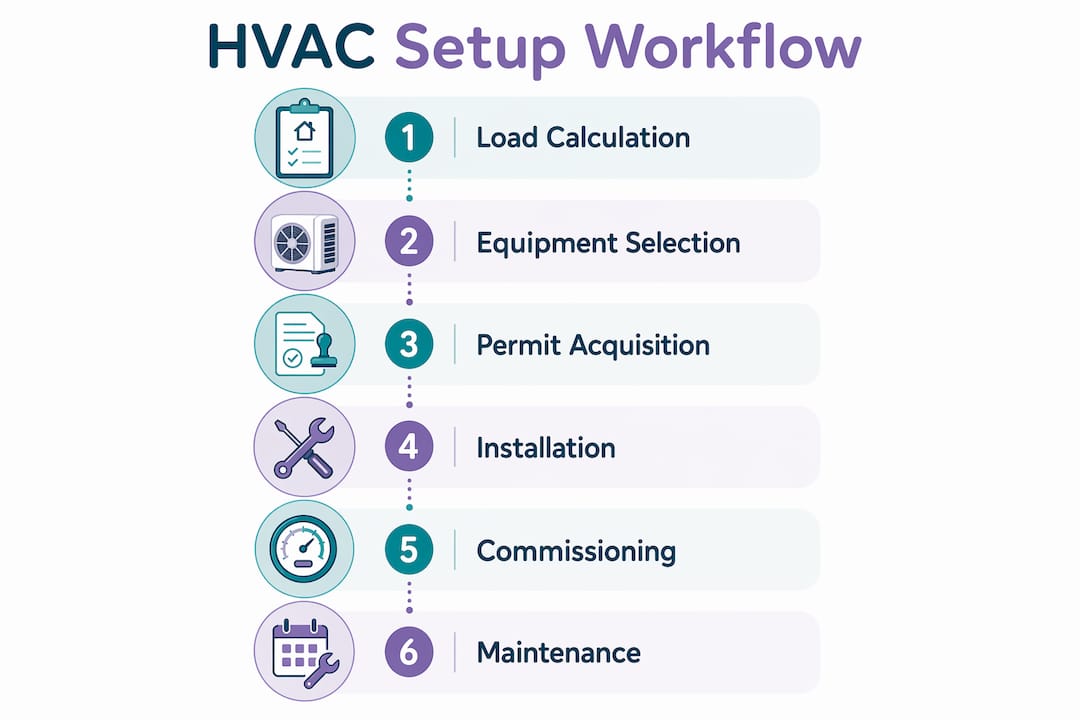
An energy efficient air conditioning setup workflow is the methodical process of sizing, installing, and commissioning a climate control system to deliver maximum performance at minimum running cost. The workflow covers four distinct phases: load calculation, equipment selection, installation, and commissioning. Each phase builds on the last, and skipping any one of them costs you money from day one. This guide walks you through every step, flags the mistakes that quietly drain efficiency, and explains which technologies sustain those savings over time.
What prerequisites are needed before an energy efficient air conditioning installation?

The heat-load survey is how our team works out exactly how much heating and cooling capacity each room needs. It takes in floor area, ceiling height, insulation, window size and orientation, and typical occupancy. Skipping it leads directly to oversized or undersized units, both of which cause discomfort, excess energy use, and premature equipment wear.
Before your installer opens any software, gather the following information about your property:
- Floor area and ceiling heights for every conditioned room
- Insulation specification in walls, loft, and floor (U-values if available)
- Window area and orientation, including glazing type (single, double, or triple)
- Occupancy patterns, including how many people live in the property and typical hours of occupation
- Existing ductwork condition, if applicable, including age and any known leaks
Replacing only one component of a split system significantly reduces efficiency and often voids the manufacturer warranty. This is a detail many homeowners discover too late.
Planning checks run in parallel with equipment selection. In the UK, permitted development rights cover most domestic air conditioning installations, but properties in conservation areas or listed buildings may need planning permission.
Pro Tip: Ask your installer to share the completed heat-load survey before any equipment is ordered. If they cannot produce one, that is a clear signal to find a different installer.
What are the detailed steps of the air conditioning system installation process?
A properly executed installation follows a defined sequence. Deviating from it, even with good intentions, introduces inefficiencies that compound over the system’s lifetime. Here is the full workflow:
- Site preparation and planning confirmation. Clear access routes for equipment delivery, confirm planning status, and protect flooring and walls in working areas.
- Removal of the old system. Recover refrigerant in compliance with F-Gas regulations before disconnecting the existing unit. Dispose of components responsibly.
- Ductwork evaluation and sealing. Inspect existing ductwork for leaks, damage, and undersized sections. Duct sealing can noticeably reduce conditioned air that would otherwise escape before reaching the room. Budget for this work during installation rather than retrofitting it later.
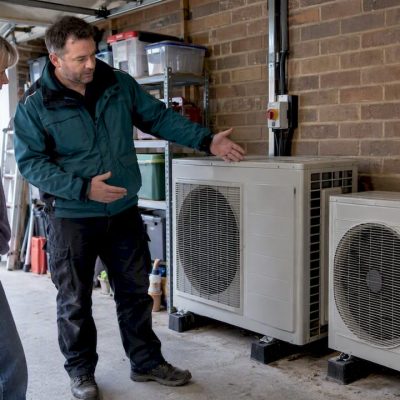
- New equipment installation. Mount the indoor unit, position the outdoor unit on a level anti-vibration pad, and run refrigerant lines through correctly sized and insulated line sets.
- Refrigerant line brazing under nitrogen. Brazing copper joints while flowing dry nitrogen through the lines prevents copper oxide scale forming inside the refrigerant circuit. Installers who skip nitrogen purging leave contamination inside the system that degrades compressor life.
- Pressure testing. Pressurise the refrigerant circuit with dry nitrogen to the manufacturer’s specified test pressure and hold for a minimum of 30 minutes to confirm there are no leaks.
- Evacuation. Use a two-stage vacuum pump to pull the system down to 500 microns or below. This removes moisture and non-condensable gases that would otherwise reduce efficiency and corrode internal components.
- Refrigerant charging to manufacturer specification. Charge by weight using calibrated scales, not by pressure alone. Pressure-only charging is imprecise and a common cause of efficiency loss.
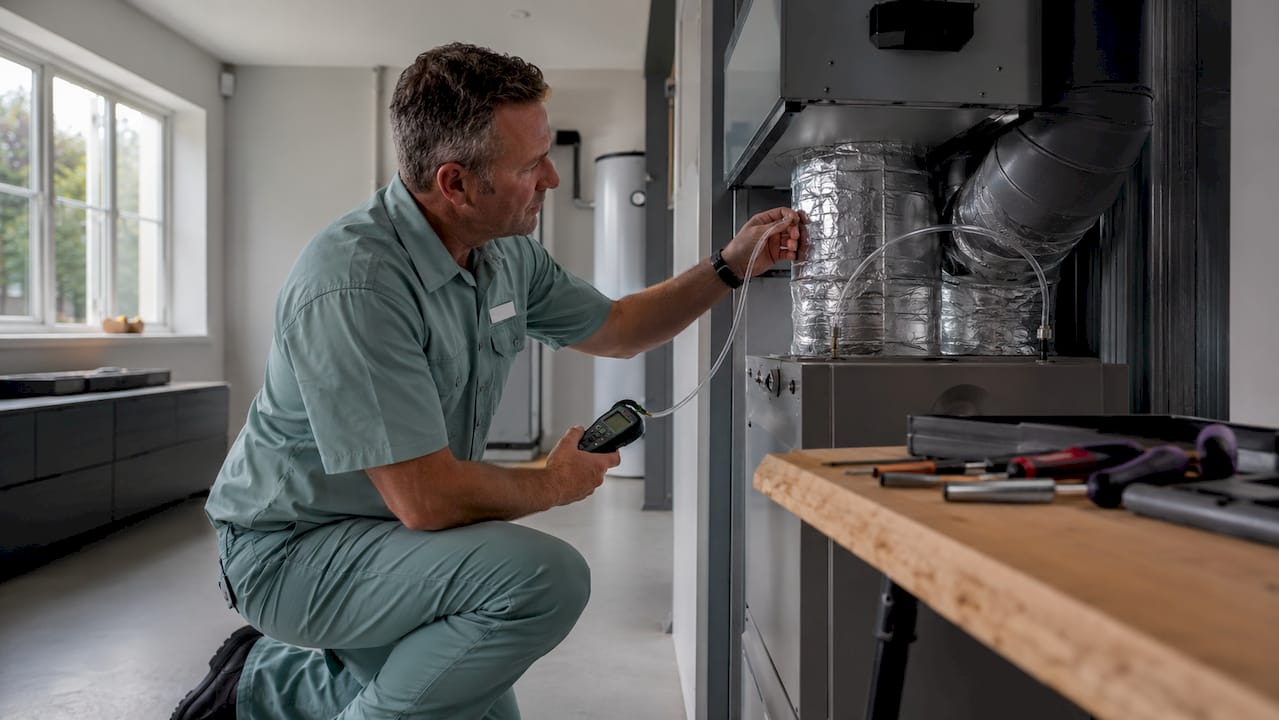
- Commissioning tests. This is the phase that separates a professional installation from a basic one.
| Commissioning test | What it measures | Target outcome |
|---|---|---|
| Static pressure | Resistance in ductwork | Within manufacturer’s specified range |
| Airflow (CFM per room) | Volume of conditioned air delivered | Matches a heat-load survey design figures |
| Temperature split | Difference between supply and return air | Typically 16 to 22°C for cooling |
| Subcooling and superheat | Refrigerant charge accuracy | Manufacturer’s published values |
| Electrical checks | Voltage, amperage, and earth continuity | Within nameplate tolerances |
Commissioning requires documented tests of subcooling, superheat, airflow, and static pressure, with written results handed to the homeowner. Installers who refuse to supply a commissioning report leave the installation incomplete, regardless of how tidy the pipework looks.
Pro Tip: Photograph the commissioning report and store it digitally alongside your warranty registration. You will need these figures as a benchmark when the system is serviced in future years.
Which technologies enhance air conditioning energy efficiency after installation?
The right controls and supplementary technologies can extract significantly more value from a well-installed system. Simple control changes alone can noticeably reduce energy consumption, which makes this one of the highest-return areas to address after installation.
The most impactful technologies to consider are:
- Smart thermostats with adaptive recovery. Devices such as those using learning algorithms adjust pre-conditioning start times based on how long your home takes to reach setpoint. Setback programming can noticeably reduce annual energy bills with no comfort penalty, but only when configured correctly rather than left on factory defaults.
- Demand controlled ventilation (DCV) with CO2 sensors. DCV adjusts fresh air supply based on actual occupancy rather than a fixed schedule. In rooms that are frequently empty, this prevents the system from conditioning air that nobody is breathing.
- Mechanical ventilation with heat recovery (MVHR). MVHR transfers heat energy between the outgoing stale air and the incoming fresh air stream. MVHR can recover much heat that would otherwise be lost through ventilation, making it one of the strongest sustainability upgrades available for UK homes.
- Air economisers for free cooling. On mild days, an economiser draws cooler outdoor air to meet the setpoint without running the compressor at all.
- AI-based predictive maintenance platforms. These monitor operational data continuously and flag performance drift before it becomes a fault.
Mixing brands or generations of equipment to save money on a replacement part undermines the efficiency of the entire system.
You can also complement your air conditioning improvements with energy efficient window upgrades, since reducing heat gain and loss through glazing directly reduces the load your system must handle.
What common mistakes reduce air conditioning efficiency, and how to avoid them?
The most expensive air conditioning mistakes are not dramatic failures. They are quiet, cumulative inefficiencies that inflate your energy bills for years before anyone notices. Understanding them is the fastest way to protect your investment.
- Oversizing or undersizing the unit. An oversized unit short-cycles, switching on and off repeatedly without completing a full conditioning cycle. This leaves humidity uncontrolled and causes accelerated wear on the compressor. An undersized unit runs continuously and never reaches setpoint on peak days. Both outcomes are direct consequences of skipping the heat-load survey. You can read more about how load calculations work before speaking to any installer.
- Neglecting duct sealing. Leaky ductwork is the single most common source of wasted energy in ducted systems. Up to a significant share of conditioned air can escape through joints and penetrations before it reaches the room. Sealing during installation costs far less than retrofitting later.
- Improper refrigerant charging. Overcharging or undercharging even slightly reduces system efficiency measurably and shortens compressor life. Charging by pressure rather than weight is the usual cause.
- Brazing without nitrogen. Copper oxide scale created during brazing without nitrogen purging circulates through the refrigerant circuit and damages the expansion valve and compressor over time.
- Skipping commissioning documentation. Without a baseline commissioning report, there is no way to measure future efficiency drift during servicing.
- Leaving thermostat settings on factory defaults. Most thermostats ship with generic settings that do not reflect your home’s thermal characteristics. Custom configuration is often neglected but takes less than an hour to complete.
“The difference between a good installation and a poor one is rarely visible. It lives in the commissioning report, the nitrogen log, and the duct leakage test results.”
Pro Tip: Request a blower door test and duct leakage test at the end of installation. Some UK energy suppliers subsidise these tests, and the results give you a verified baseline for future comparisons.
What maintenance practices sustain air conditioning efficiency over time?
A well-installed system loses efficiency gradually if maintenance is neglected. Dirty coils cause a noticeable efficiency drop, and routine coil cleaning restores much that loss immediately. The following sequence keeps your system performing at its design specification:
- Monthly filter checks. Replace or clean filters according to the manufacturer’s schedule. A clogged filter increases static pressure, forces the blower motor to work harder, and reduces airflow to every room.
- Annual coil cleaning. Both the evaporator coil (indoor) and condenser coil (outdoor) accumulate dirt that insulates the heat exchange surface. Professional cleaning with appropriate coil cleaner restores heat transfer efficiency.
- Condensate drain inspection. A blocked condensate drain causes water to back up into the unit, potentially damaging electrical components and creating conditions for mould growth.
- Refrigerant charge verification. A qualified F-Gas engineer checks refrigerant charge annually using subcooling and superheat measurements, not pressure alone.
- Electrical inspection. Check capacitors, contactors, and wiring terminations for signs of wear or corrosion. Failing capacitors are one of the most common causes of compressor failure.
- Duct leakage retest every three to five years. Duct joints can work loose over time due to thermal expansion and contraction. Retesting confirms the sealing work from installation remains intact.
- TM44 inspection every five years. TM44 inspections are required every five years in the UK for systems over 12 kW. They identify energy waste and provide documented recommendations for improvement.
Using your original commissioning report as a benchmark during each service visit allows your engineer to spot efficiency drift early. A residential air conditioning maintenance checklist gives you a practical framework for tracking these tasks year by year.
Key takeaways
A correctly executed energy efficient air conditioning setup workflow, from heat-load survey through to documented commissioning, delivers noticeably lower energy consumption and protects the system’s efficiency for its full working life.
| Point | Details |
|---|---|
| Start with a heat-load survey | A room-by-room heat-load survey prevents costly oversizing and undersizing. |
| Seal ducts during installation | Duct sealing during installation can noticeably reduce conditioned air and costs less than retrofitting. |
| Commission and document | Subcooling, superheat, airflow, and static pressure tests must be recorded and handed to the homeowner. |
| Add smart controls | Correctly configured setback programming can noticeably reduce annual energy bills with no comfort trade-off. |
| Maintain on a schedule | Annual coil cleaning restores lost efficiency; TM44 inspections are legally required every five years for larger systems. |
What experience has taught us about energy efficient air conditioning setups
The most consistent pattern we see at Akita is this: homeowners who invest in duct sealing during installation outperform those who spend the same money on a higher-specification unit with leaky ductwork. The equipment rating on the brochure is not the efficiency you experience in your home.
We also see the consequences of skipped commissioning regularly. A system that has never had its refrigerant charge verified, its airflow measured, or its static pressure documented is essentially running blind. The homeowner has no baseline, the servicing engineer has nothing to compare against, and efficiency drift goes undetected for years.
The advice we give every customer before they sign anything is straightforward: ask the installer for their a heat-load survey methodology, ask to see a sample commissioning report from a previous job, and ask whether they braze under nitrogen. Those three questions filter out the majority of installers who will leave you with an underperforming system.
Planning ahead matters more than most people realise. Decisions made during a July heatwave with no cooling in the house are rarely the best ones.
Akita
Get your energy efficient system installed by Akita
Akita installs energy efficient air conditioning systems across Suffolk and Essex, following the full workflow described in this article. Akita also supports planning applications, warranty registration, and ongoing maintenance contracts to protect your investment long after installation day. If you are ready to replace an ageing system or install climate control for the first time, fixed price installation options are available with transparent costs and no hidden charges. Speak to the our team to get a load calculation and quote for your property.
FAQ
What is a heat-load survey?
A heat-load survey works out how much heating and cooling capacity each room needs, from its size, insulation, glazing, orientation and occupancy. Skipping it leads to oversized or undersized equipment, both of which waste energy and wear the system faster.
How much energy can duct sealing save?
Properly sealed ductwork prevents a significant share of conditioned air from escaping before it reaches the room, making it one of the highest-return investments in any air conditioning installation.
What does commissioning involve for a new air conditioning system?
Commissioning involves documented measurements of subcooling, superheat, airflow volume, static pressure, and refrigerant charge, all verified against manufacturer specifications and recorded in a written report for the homeowner.
How often should an air conditioning system be serviced in the UK?
Annual servicing is recommended for all residential systems, covering coil cleaning, refrigerant charge verification, and electrical inspection. Systems over 12 kW also require a TM44 inspection every five years under UK regulations.
Can smart thermostats genuinely reduce energy bills?
Yes. Smart thermostats with correctly configured setback and adaptive recovery programming noticeably reduce annual energy bills, but only when set up to match the home’s actual thermal characteristics rather than left on factory defaults.
Our team installs Mitsubishi Electric and Daikin systems in homes across Suffolk and Essex. Every install starts with a free heat-load survey and is carried out by F-gas certified engineers under our REFCOM registration (REF1023379). Entry installs start from £1,750, and VAT on domestic installs is 0% until 31 March 2027, then 5%. Every install comes with a 12-month installation warranty, plus up to 5 years’ manufacturer warranty with annual service. Book a free survey.
Recommended
Speak to Akita Air Conditioning
Find out more about our air conditioning installation, or see how we work with homes and businesses in Suffolk and the surrounding area.
Ready to talk about your property? Book a free survey and one of our engineers will assess your space and recommend the right system for it.