

Why Finance Air Conditioning for UK Homes
Feeling frustrated by the strain of keeping your Suffolk home cool as energy costs climb higher every year? Choosing between comfort and affordability should not mean sacrificing your environmental values. Finding the right air conditioning finance can turn a major upgrade into a series of predictable payments, letting you enjoy modern, energy-efficient cooling while taking control of costs. Discover how flexible payment plans and innovative government-backed strategies make sustainable air conditioning within reach for every homeowner.
Table of Contents
- What Does Financing Air Conditioning Mean?
- Types of Air Conditioning Finance Available
- Key Features of Modern AC Finance Plans
- Financial Benefits and Cost Implications
- Common Pitfalls and Smart Alternatives
Key Takeaways
| Point | Details |
|---|---|
| Flexible Financing Options | Homeowners can spread the cost of air conditioning over time with various financing arrangements, making energy-efficient solutions more accessible. |
| Government Support and Incentives | Many schemes exist to assist low-income households and promote energy efficiency, potentially reducing overall energy costs. |
| Smart Cooling Alternatives | Options like heat pumps and passive cooling strategies can provide efficient alternatives to traditional air conditioning, emphasising sustainability. |
| Comprehensive Energy Assessments | Conducting an energy audit before purchasing an air conditioning system can help identify the most effective and economical solutions for specific homes. |
What Does Financing Air Conditioning Mean?
Financing air conditioning refers to a structured approach that allows homeowners to spread the cost of installing a new air conditioning system over time, rather than paying the entire expense upfront. This financial strategy transforms what might seem like an overwhelming investment into manageable monthly payments, making energy-efficient cooling solutions more accessible for Suffolk households.
Under typical financing arrangements, homeowners can access flexible payment plans that break down the total cost of an air conditioning system into predictable instalments. Property tax assessment financing offers one innovative model where the repayment is tied directly to the property, not the individual borrower. This approach means the financial commitment can potentially transfer with property ownership, reducing personal financial risk.
Financing options for air conditioning typically include several key approaches:
- Government-supported loan programs
- Energy-efficiency improvement mortgages
- Local energy assistance initiatives
- Specialised home improvement financing
These financing mechanisms serve multiple purposes beyond simply helping homeowners purchase air conditioning. They actively support broader goals of energy efficiency and environmental sustainability by making modern, low-carbon cooling technologies more attainable.
Financing transforms air conditioning from a significant upfront expense into an affordable, strategic home improvement investment.
Pro tip: Research multiple financing options and compare their interest rates, terms, and potential long-term savings before committing to an air conditioning finance plan.
Types of Air Conditioning Finance Available
Homeowners in the UK have several strategic options for financing air conditioning systems, each designed to make energy-efficient cooling more accessible and affordable. These finance approaches range from government-supported initiatives to specialised lending products tailored for home improvement projects.

Government energy efficiency schemes offer targeted financial support for households looking to upgrade their cooling and heating systems. These programmes typically focus on reducing energy consumption and supporting low-income or vulnerable households in accessing modern, efficient technologies.
The primary types of air conditioning finance available include:
- Personal home improvement loans
- Specialised HVAC financing products
- Green energy improvement mortgages
- Government grant programmes
- Manufacturer-backed financing options
- Utility company energy efficiency schemes
Some financing routes are particularly beneficial for specific demographics. For instance, local government grants provide free energy-saving improvements for eligible low-income households, including support for air source heat pumps and insulation installations.
Here is a comparison of popular air conditioning finance options in the UK:
| Finance Route | Who Benefits Most | Typical Application Process | Long-Term Impact on Homeowner |
|---|---|---|---|
| Government energy efficiency schemes | Low-income/vulnerable households | Local authority assessment | Reduces bills, may increase value |
| Manufacturer-backed finance | Standard buyers | Dealer-arranged at purchase | Often quicker approval, tied to product |
| Green energy mortgages | Homeowners upgrading for efficiency | Through mortgage broker | Integrates with home, lower rates |
| Utility company schemes | Energy-conscious households | Via energy supplier | Potential for bundled savings |
Choosing the right financing option can significantly reduce upfront costs and make energy-efficient air conditioning more attainable for UK households.
Pro tip: Always compare multiple financing options, considering not just interest rates but also the total long-term cost and potential energy savings associated with your new air conditioning system.
Key Features of Modern AC Finance Plans
Modern air conditioning finance plans in the United Kingdom have evolved to become sophisticated financial products that address multiple homeowner needs beyond simple equipment acquisition. These innovative financing solutions are designed to balance affordability, energy efficiency, and long-term economic benefits for households across different income brackets.
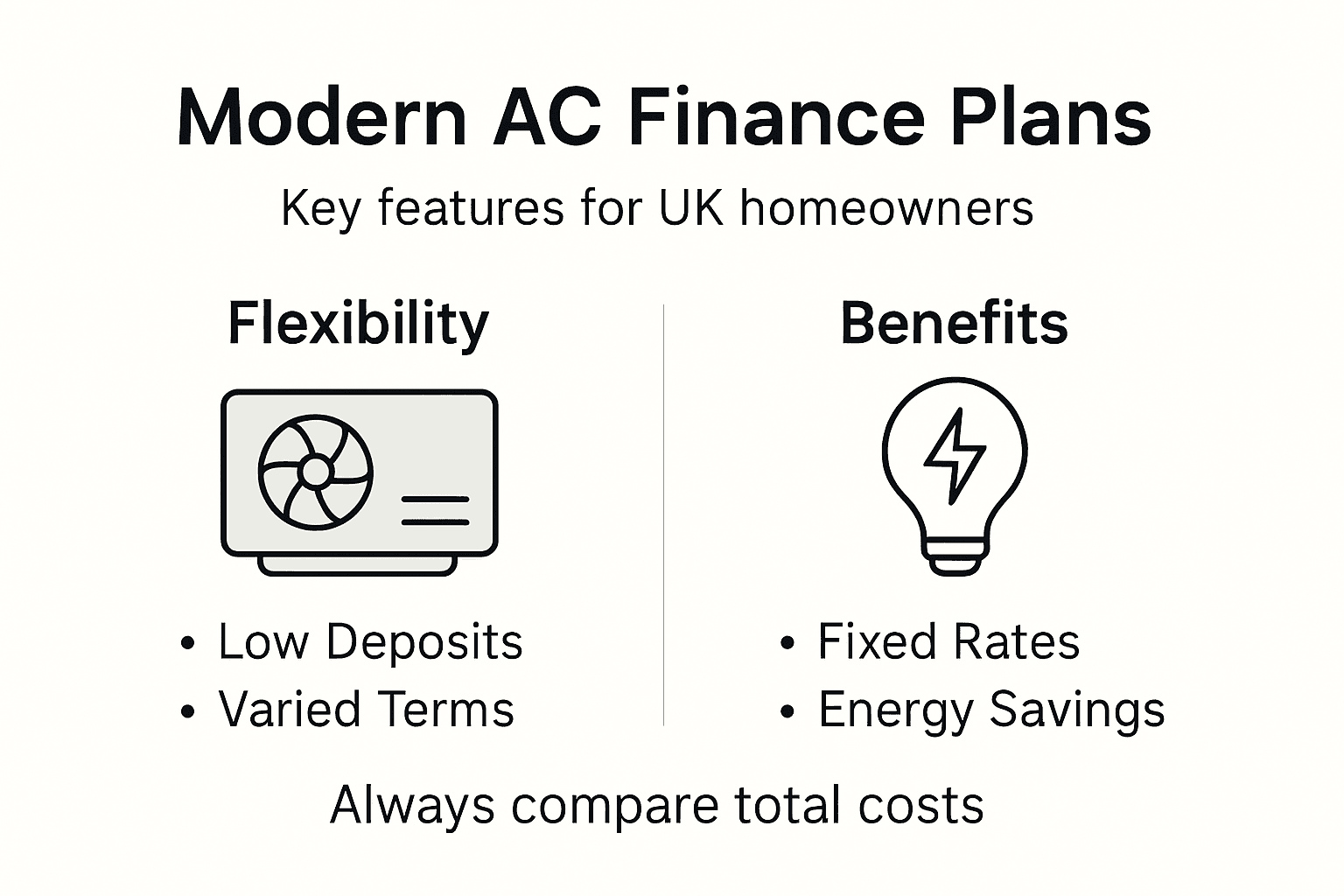
Government energy efficiency schemes now offer comprehensive financing mechanisms that go far beyond traditional lending approaches. These plans typically incorporate low or zero-interest options, targeted support for specific household demographics, and strategic interventions aimed at reducing carbon emissions and improving overall home energy performance.
Key features of contemporary AC finance plans include:
- Flexible repayment terms
- Low-interest financing
- Energy performance assessments
- Tailored eligibility criteria
- Carbon reduction incentives
- Comprehensive retrofit support
- Potential government and utility subsidies
The most progressive finance plans now integrate technological assessments with financial support. Energy efficiency programmes increasingly partner with energy suppliers to provide holistic solutions that consider not just the air conditioning unit’s cost, but its long-term operational efficiency and environmental impact.
Modern AC finance plans are not merely financial products, but strategic investments in home comfort, energy efficiency, and sustainable living.
Pro tip: Request a comprehensive energy performance assessment before finalising your air conditioning finance plan to understand the potential long-term savings and environmental benefits.
Financial Benefits and Cost Implications
Air conditioning finance in the UK represents more than a simple equipment purchase - it’s a strategic investment with complex financial implications for homeowners. Modern financing approaches are designed to balance upfront costs with long-term energy savings, creating a nuanced economic landscape for potential investors.
Home upgrade investments can potentially generate substantial financial benefits, with government plans allocating £15 billion to support energy-efficient home improvements. These initiatives aim to reduce household energy expenditure while simultaneously addressing broader environmental objectives.
Key financial considerations for air conditioning investments include:
- Potential energy bill reductions
- Tax incentive opportunities
- Grid demand management benefits
- Increased property valuation
- Carbon emission reduction credits
- Long-term maintenance savings
- Potential renewable energy integration
The broader economic context is particularly compelling. Electricity demand projections suggest that strategic AC investments could help balance grid loads, especially when combined with solar generation technologies, potentially creating additional financial advantages for environmentally conscious homeowners.
Strategic air conditioning investments are not expenses, but calculated financial decisions with measurable economic returns.
Pro tip: Calculate your potential energy savings by comparing the efficiency ratings of different air conditioning systems before finalising your financing plan.
Common Pitfalls and Smart Alternatives
Navigating air conditioning solutions requires careful consideration of potential challenges and innovative alternatives. Homeowners must look beyond traditional cooling systems to find approaches that balance comfort, energy efficiency, and long-term sustainability.
Heat pump technologies provide an increasingly compelling alternative to standard air conditioning, offering more versatile heating and cooling capabilities. These systems transfer heat rather than generate it, resulting in significantly reduced carbon emissions and potentially lower energy bills for households.
Common pitfalls in air conditioning decision-making include:
- Overlooking system efficiency ratings
- Neglecting proper installation requirements
- Ignoring long-term maintenance costs
- Failing to consider alternative cooling strategies
- Underestimating energy consumption
- Disregarding property-specific cooling needs
- Choosing oversized or undersized units
Sustainable cooling approaches emphasize passive design strategies that reduce overall energy demand. These methods include improving building insulation, implementing smart ventilation techniques, and using architectural shading to minimise heat absorption, presenting intelligent alternatives to traditional air conditioning.
The table below highlights major pitfalls and suitable smart alternatives when considering air conditioning for UK homes:
| Common Pitfall | Smart Alternative Suggestion |
|---|---|
| Overlooking system efficiency rating | Request an independent energy audit |
| Ignoring maintenance costs | Choose long-term service contracts |
| Relying only on traditional AC | Explore passive cooling and heat pumps |
| Choosing oversized units | Use tailored load assessments |
| Underestimating future energy needs | Consider flexible, scalable systems |
Smart cooling solutions prioritise energy efficiency and environmental sustainability over simple temperature control.
Pro tip: Conduct a comprehensive home energy audit before investing in any cooling system to identify the most cost-effective and environmentally friendly solution for your specific property.
Make Your UK Home Comfortable with Affordable, Energy-Efficient Air Conditioning Financing
Homeowners looking to upgrade their cooling systems often face the challenge of managing high upfront costs while aiming for energy efficiency and long-term savings. This article highlights key concerns such as flexible repayment terms, balancing upfront expenditure with sustainability, and avoiding common pitfalls like overlooking maintenance or system efficiency. At Akita Air Conditioning, we understand these challenges and offer tailored solutions that align perfectly with your goals of comfort, cost-effectiveness, and environmental responsibility.

Discover how you can benefit from our transparent pricing and flexible finance options designed specifically for modern UK homes. Whether you want installation, ongoing maintenance, or expert advice on selecting the right eco-friendly system, our professional team in Suffolk, Norfolk, and Essex is ready to support you. Take the next step towards a cooler, greener future by visiting Akita Air Conditioning today and explore how our energy-efficient air conditioning services can transform your home comfort without overwhelming your finances.
Frequently Asked Questions
What are the benefits of financing air conditioning?
Financing air conditioning allows homeowners to manage the cost of installation through monthly payments, making energy-efficient cooling solutions more affordable and accessible.
How can I compare different air conditioning financing options?
Consider interest rates, repayment terms, potential long-term savings, and any environmental incentives when comparing different financing options for air conditioning.
What types of financing are available for air conditioning systems?
Available financing options include personal home improvement loans, manufacturer-backed financing, green energy mortgages, government grant programmes, and utility company energy efficiency schemes.
Are there any potential drawbacks to financing air conditioning?
Common pitfalls include overlooking system efficiency ratings, neglecting long-term maintenance costs, and choosing units that are either oversized or undersized for the space they are intended to cool.