Start with the vents, the filter and the returns. Open every vent, swap a clogged filter, and clear anything blocking a return grille. If one or two rooms stay stubbornly warm after that, the cause is usually a duct problem, a badly placed thermostat, or a system fault, and that’s a job for a professional. The good news: fixing uneven cooling nearly always cuts wasted energy too.
TL;DR:
- Most cases of uneven cooling are caused by duct leaks, poor insulation, or incorrect thermostat placement, not system failure or a need for replacement.
- Sealing and insulating ducts can improve efficiency by about 20 percent and resolve the largest source of temperature imbalance without system replacement.
- Moving or blocking furniture, closing vents, or improper thermostat locations can worsen airflow and should be checked before calling a professional.
- A professional diagnosis involves measuring static pressure, duct leakage, and airflow, which helps determine whether sealing, zoning, or equipment size adjustments are necessary.
- DIY fixes are limited, and ongoing issues often require technical tests to identify leaks or faults that cannot be corrected with simple cleaning or repositioning.
Table of Contents
- Quick checks for a home with uneven cooling
- How do you diagnose the real cause of hot and cold rooms?
- What are the permanent fixes for uneven air conditioning?
- When should you call a professional for uneven cooling?
- How Akita diagnoses and fixes uneven cooling
- Does furniture placement affect how evenly a room cools?
- Our take: fix the cause, not just the symptom
- Get a proper diagnostic instead of guessing
- FAQ
Quick checks for a home with uneven cooling
Before you assume something’s broken, rule out the obvious. Most uneven cooling complaints trace back to something you can check in twenty minutes.
Walk every room in the house and physically confirm that supply grilles and return grilles are open. Sofas, rugs, and curtains blocking a return are a surprisingly common culprit, since a starved return changes airflow across the whole system.
Pull the air filter and hold it up to a light. If you can’t see through it, replace it. A clogged filter restricts airflow to every room, not just the one nearest the unit, and it’s the cheapest fix on this list.
Buy two or three inexpensive room thermometers and leave them running for a few hours in the rooms that feel off. Write down the readings. A number beats a guess when you’re trying to work out whether the problem is one room or the whole system.
- Check every vent and return is open and unobstructed
- Replace or clean the filter if it’s more than a few months old
- Log room temperatures with cheap thermometers to confirm the gap
- Use fans, blackout blinds, or run the AC during cooler parts of the day as a stopgap
Pro Tip: Don’t close vents in unused rooms to force more air elsewhere. It raises static pressure in the ductwork and can make the imbalance worse rather than better.
How do you diagnose the real cause of hot and cold rooms?
Quick checks rule out the easy stuff. If the imbalance persists, you need a proper diagnostic sequence rather than more guessing.
- Map the temperatures. Take readings in every room at the same time of day, ideally mid-afternoon when solar gain peaks, and build a simple table: room name, reading, difference from the thermostat’s room.
- Inspect visible ductwork. Check the loft, cellar, or underfloor void for disconnected joints, crushed flexible duct, or sections running through unconditioned space, since ducts routinely lose a significant share of moving air to leaks and poor connections.
- Check the thermostat’s location and setup. A thermostat in a hallway, near a kitchen, or in direct sun reads the wrong temperature for the rest of the house, and a single thermostat can only ever manage one zone properly.
- Separate envelope issues from air conditioning issues. A west-facing room that bakes in the afternoon or a loft with thin insulation behaves differently to a duct fault, even though both produce the same symptom.
An engineer takes this further with instruments: static pressure readings across the system, a duct leakage test, airflow measurement at each vent, and a refrigerant charge check. Sealing and insulating ducts that fail a leakage test can lift system efficiency noticeably, which is the single biggest lever most homes have.
What are the permanent fixes for uneven air conditioning?
Quick checks and diagnostics tell you what’s wrong. These are the fixes that actually stay fixed.
- Duct sealing and insulation. This addresses the most common root cause. Sealing joints and insulating runs through lofts or underfloor voids recovers air that’s currently escaping before it reaches the room, and industry guidance links duct condition directly to uneven room temperatures.
- Balancing and zoning. Motorised dampers, manual balancing dampers, or a second thermostat let you direct more airflow to problem rooms without overcooling the rest of the house. The same logic used to balance flow differentials in radiator systems applies to forced-air ductwork.
- Ductless split systems. For a converted garage, a loft conversion, or a room that’s always been the outlier, a dedicated split system sidesteps the duct problem entirely rather than trying to force more air through an already-stretched system.
- Equipment sizing and condition. An oversized unit cools the thermostat’s room fast, switches off, and never runs long enough to push air to the far end of the house. That’s short-cycling, and it’s a sizing problem, not a duct problem.
- Envelope improvements. Loft insulation, window coverings on the sunniest side of the house, and air sealing around doors and windows reduce the solar and thermal load that no amount of duct work will fully offset.
Most homes need a combination of two or three of these, not a single silver bullet.
When should you call a professional for uneven cooling?
DIY checks and a bit of duct-taping only go so far. Call in a professional when you’ve done the basics and the problem is still there, when energy bills have climbed without explanation, or when airflow feels weak at several vents at once rather than just one.
A proper diagnostic should include a duct leakage test, static pressure measurements, a load calculation for the property, and a refrigerant check, since sizing and refrigerant issues often compound duct or insulation problems rather than replacing them as the sole cause.
Typical installer work breaks down roughly like this:
- Diagnostic visit: usually a few hours, and should end with measured numbers, not a verbal guess
- Duct sealing: often completed in a day for a typical home
- Zoning installation: one to three days depending on how many zones and dampers are needed
- Equipment replacement: a day or two, plus lead time for the right-sized unit to arrive
Pro Tip: Ask any installer what they measured, not just what they think. “It’ll fix everything” with no static pressure reading or leakage number is a red flag worth walking away from.
How Akita diagnoses and fixes uneven cooling
Akita’s diagnostic approach starts with the same measured checks a good engineer always runs: duct inspection, airflow measurement, thermostat placement review, and a check on whether the system itself is correctly sized for the property. That’s laid out in more detail in Akita’s air conditioning diagnostics guide, which walks through what a full inspection actually covers before any work is quoted.
Our engineers work across:
- Diagnostics and fault-finding for existing systems
- Ductwork inspection, repair and sealing
- Ductless split system and air source heat pump installation
- Ongoing servicing through the Comfort Club membership
Every quote is fixed and explained before work starts, so you know what’s being fixed and why, not just a total at the bottom of an invoice.
Does furniture placement affect how evenly a room cools?
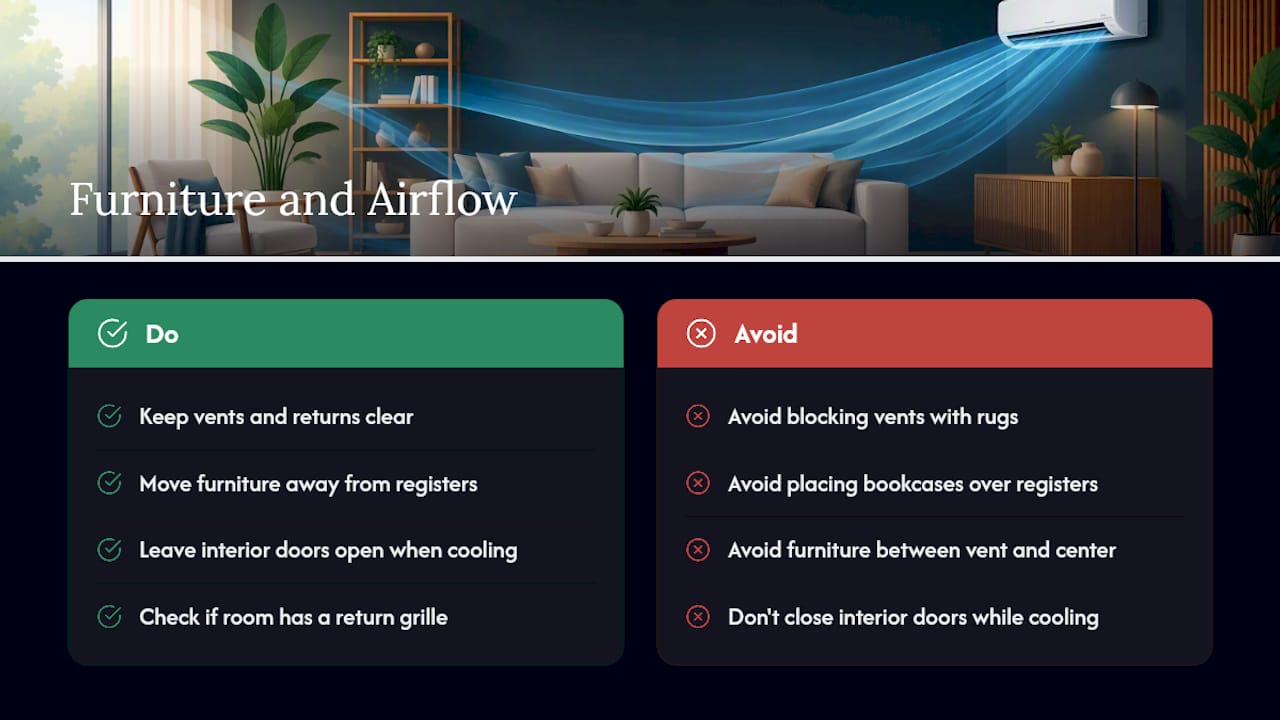
Furniture blocking a supply grille or return grille is one of the most overlooked causes on this whole list, partly because it seems too simple to matter. A sofa pushed against a wall vent, a rug covering a floor return, or a bookcase built over a supply grille all restrict airflow at exactly the point it needs to move freely.
Room layout matters beyond individual vents too. A large piece of furniture positioned between the supply grille and the middle of the room can deflect cooled air towards a corner instead of letting it circulate, leaving the far side of the room noticeably warmer even though the vent itself is technically open. Open-plan layouts create a different problem: air conditioned for a large combined space often struggles to reach a room at the far end, particularly if a door is usually kept shut.
Closed interior doors deserve a specific mention here, because they don’t just block air moving into a room, they can also starve the return path for the whole system, altering pressure and worsening the very imbalance you’re trying to fix. If a bedroom stays warm every night, check whether the door is closed and whether that room has its own return grille at all. Many older homes simply weren’t built with one, which is a design gap no amount of furniture rearranging will fully solve.
Our take: fix the cause, not just the symptom
Uneven cooling is rarely one thing. It’s usually a duct that’s leaking a bit, a thermostat that’s misreading the house, and a room layout that’s quietly blocking airflow, all at once. Treating it as a single fault is why so many DIY fixes only half work.
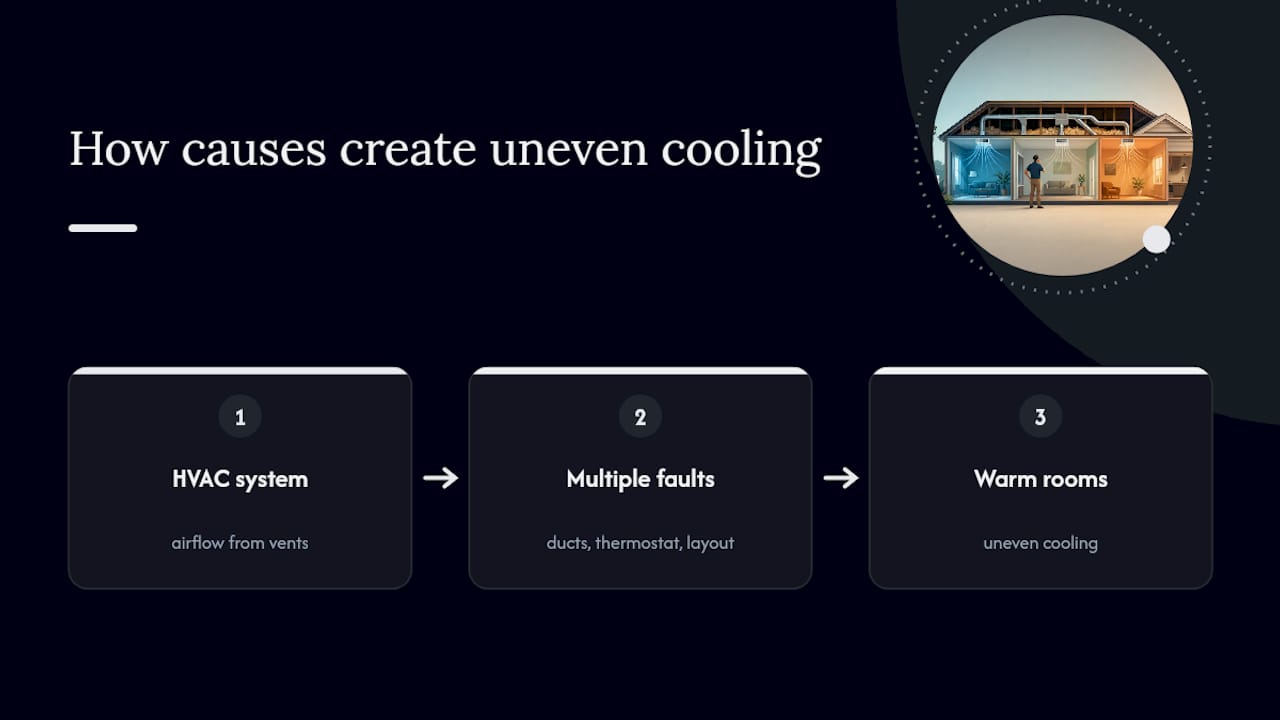
The order matters: try the quick checks first, gather temperature evidence over a few hours, then book a diagnostic if the gap persists.
We’d rather run the numbers and tell you honestly that your system is fine than sell you equipment you don’t need.
Get a proper diagnostic instead of guessing
If your existing setup just needs sealing, balancing, or a service rather than a full replacement, the Air Conditioning Maintenance page and Comfort Club membership cover ongoing care so the problem doesn’t quietly come back next summer. Book a diagnostic and get a fixed quote before you spend a penny on guesswork. If a new system is the right answer, VAT on domestic installs is 0% until 31 March 2027, then 5%.
FAQ
Why is one room in my house always hotter than the rest?
It’s usually a combination of duct leakage, thermostat placement, and solar exposure rather than a single cause. Duct systems typically lose a significant share of moving air to leaks, which hits rooms furthest from the indoor unit hardest.
Can closing vents in unused rooms fix uneven cooling?
No, this usually makes things worse. Closing vents raises static pressure in the ductwork and can reduce airflow efficiency across the whole system rather than pushing more air to the rooms that need it.
How much does duct sealing improve cooling performance?
Sealing and insulating leaky ducts can improve system efficiency noticeably, on top of fixing the room-to-room temperature gap. It’s often the single most cost-effective fix available before considering zoning or new equipment.
How much does an Akita diagnostic or installation cost?
A domestic air conditioning installation from Akita starts from £1,750 for an entry install. Diagnostic, repair, and maintenance pricing is quoted individually after an assessment, since it depends on what the inspection finds.
Is a split system better than fixing my ducts?
Not necessarily. A ductless split system makes sense for an extension, converted garage, or room that never connected properly to the main ductwork, but if your existing ducts are simply leaking or unbalanced, sealing and zoning usually solves the problem for less.
If the checks above don’t sort it, our F-gas certified engineers can find the fault. Akita is REFCOM registered (REF1023379) and works across Suffolk and Essex, and an annual service keeps the manufacturer warranty of up to 5 years valid on systems we install. If it is time for a replacement, book a free survey.
Recommended
Speak to Akita Air Conditioning
Find out more about our air conditioning installation, or see how we work with homes and businesses in Suffolk and the surrounding area.
Ready to talk about your property? Book a free survey and one of our engineers will assess your space and recommend the right system for it.